This manual is for BUS FPX 4802 Assessment 2, start to submission. Assessment 2 in BUS FPX 4802, Change Management, usually asks you to build the plan itself: the groups affected, what each one needs, the sequence of phases with owners and dates, the message every audience gets, and the reason you chose the change model you chose. Your scoring guide decides whether that arrives as an implementation plan, a communication strategy or a proposal to a sponsor. FlexPath returns a level per criterion rather than a grade. What you get below is the sequence our tutors work in, a section plan tied to the criteria, and an annotated excerpt. Rather hand it over? Send the prompt and the criteria, and a premium original sample arrives inside two days, revised free until it meets the guide. Capella's catalog lists the course as BUS-FPX4802, and some courserooms print BUS4802; both point to this same Assessment 2.
One honesty note before the manual: Capella revises courses and scoring guides over time, so always write to the exact scoring guide attached to your assessment in the courseroom. The course identity above is verified on capella.edu; the method and structure below are our tutors' approach to it, not Capella's official rubric text.
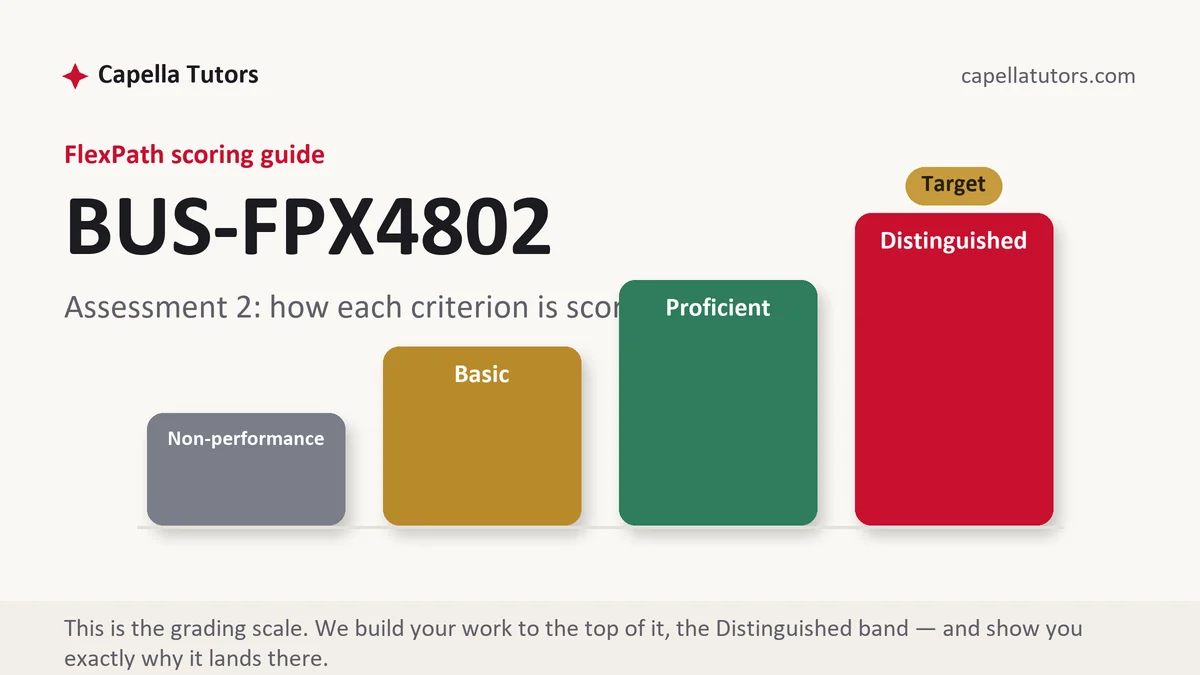
How BUS FPX 4802 Assessment 2 is scored
Four levels per criterion, no letters, and the level language tells you exactly what to produce:
| Level | What it means on a change plan |
|---|---|
| Distinguished | One model applied all the way through with a stated reason for preferring it, groups named with what each stands to lose, supervisors briefed before the announcement, and every phase carrying an owner, a date and a cost. |
| Proficient | A model is applied, the groups are identified, and the plan has phases and a communication approach. Complete work, one move short of the top row. |
| Basic | Three models mentioned, a plan built out of milestones, and a communication section that recommends clear and frequent communication without saying to whom or about what. |
| Non-performance | No model applied, or a plan with no owners and no dates. An absent element floors the criterion however fluent the writing. |
The section that decides most of these papers is the one about middle managers. Supervisors take the questions the announcement creates, usually in a corridor, usually within an hour, and a plan that briefs them afterward has installed its own failure. Put what they will be asked and the answer you want them to give into the plan as a deliverable with a date.
The BUS FPX 4802 Assessment 2 method, step by step
-
Rebuild the criteria as your table of contents
Headings first, top-level wording pasted underneath each one, then write. Anything you want to include that does not sit under a criterion is optional at best, and in a plan of this length it usually crowds out something that scores.
-
Choose one model and justify it against the obvious alternative
Say why the framework you picked suits this change and why you did not pick the other one. A model chosen because the change depends on many individuals each doing something differently is a defended choice; a model named in a heading and then ignored is decoration.
-
Name the groups and what each one loses
List them by role and count them. Then, for each, write what goes away: expertise built over years, an approval that conferred status, a workaround that made the day survivable. Every specific loss points at a specific answer, which is why this table drives the rest of the plan.
-
Build the phases with owners, dates and a cost
Give every phase a person, not a department, and put the training time into the arithmetic. Four hours each across 26 people is 104 hours out of a 1,040-hour week, and a plan that pretends that capacity is free will slip in its first fortnight.
-
Write the communication as a grid, audience by audience
Each row is one audience: the message, who delivers it, the channel, the date, and what that audience is expected to do next. Supervisors get their row first, with the three questions they will actually be asked and the answers you want given.
-
Put the adoption target in the plan, then self-score
Set a number and a date: this share of transactions through the new route by this week. Then work through the guide one row at a time, mark your own draft D, P, B or N, and fix anything under D before submitting early in the week.
A structure that maps to the criteria
Word targets are our tutors' planning figures for a plan of this size rather than Capella rules; grow whatever your own guide weights heaviest.
| Section | What it must do | Guide |
|---|---|---|
| The change and the goal | What is changing, the behavior expected afterward, and the adoption target with its date. | ~200 words |
| Model and justification | The framework chosen, why it fits this change, and why the obvious alternative was not used. | ~250 words |
| Groups and losses | Each group by role and headcount, what it loses, its influence, and what it therefore needs. | ~350 words |
| Phases, owners and cost | The sequence, a named owner per phase, dates, and the hours or money each phase consumes. | ~300 words |
| Communication grid | Audience by audience: message, messenger, channel, date, and the action expected next. | ~250 words |
| Risks and references | The two or three things most likely to derail this, the response to each, and APA both ways. | ~150 words |
Annotated sample excerpt
An original model excerpt from our team, showing how the group analysis carries its own arithmetic. Learn the moves, then write the same passage from your own initiative.
Calder Freight Brokerage books about 620 loads a week by phone and email, and the change asks its 26 dispatchers to post every load on a shared board and update its status three times before delivery. The largest loss falls on the eleven dispatchers with more than six years here, whose relationships with particular carriers are currently invisible to everyone else and become visible to all the moment the board goes live.1 Five team leads sit between them and the owners, and they will field the first questions within an hour of the announcement, so the plan briefs them two days before it, with the three answers they need in writing.2 Training is four hours each, which is 104 hours out of a 1,040-hour dispatch week, or 10 percent of one week's booking capacity, and the plan spreads it across two weeks rather than pretending that time is free.3
- 1The loss is named for a specific subgroup and counted. Eleven of 26 people losing an informal advantage is a mitigation problem, and it is invisible in a paper that only says people resist change.
- 2Supervisors get briefed before the announcement, with a date and a deliverable. This is the sentence most change plans are missing.
- 3Training hours converted into a share of weekly capacity. A plan that costs its own phases reads as executable, and the criterion on planning is usually looking for exactly that.
The full premium sample for your exact assessment, written fresh to your scoring guide and issue, is free to request. Study it, revise it into your own voice, and submit work you understand.
The five mistakes that cost Distinguished
- Several models named, none applied. Listing frameworks shows reading, and the criterion is asking for one carried through the whole plan.
- Groups listed without losses. A roster of affected parties produces no mitigations, because the answer lives in what each one is giving up.
- Phases with departments instead of owners. Operations is not a person, and a phase nobody owns is a phase nobody starts.
- Training time treated as free. Hours pulled out of a working week come from somewhere, and saying where is the difference between a plan and a wish.
- Communication reduced to an announcement. One message to everybody at once leaves supervisors improvising and gives no audience a next action.
Pre-submission checklist
- One model applied throughout, with the rejected alternative named
- Every group counted by role, with the specific loss it faces
- Owners who are people, and a date against every phase
- The hours or money each phase consumes, shown as arithmetic
- A communication grid with a next action for each audience
- An adoption target with a number and a date, APA both directions
Change plan due?
Send the initiative and the criteria. We pick and justify one model, count the groups and their losses, cost the phases, and write the communication grid with supervisors first. First premium sample free, with a 24 to 48 hour turnaround.