This manual is for BUS FPX 4062 Assessment 2, start to submission. The middle deliverable in Intermediate Financial Accounting Topics and Trends usually asks you to measure an asset whose carrying amount depends on an estimate or on a choice. Receivables are reported at what you expect to collect, inventory is reported under whichever cost flow assumption you adopted, and both answers move income. Reaching a defensible figure and showing the reasoning that produced it is the whole assessment. Below is how our tutors handle it, a section plan taken straight from the criteria, and an annotated model paragraph. If you would rather hand it off, a premium original sample for this exact assessment comes back in 24 to 48 hours with every schedule recomputed and revised free until the criteria are met. Capella's catalog lists the course as BUS-FPX4062, and some courserooms print BUS4062; both point to this same Assessment 2.
One honesty note before the manual: Capella revises courses and scoring guides over time, so always write to the exact scoring guide attached to your assessment in the courseroom. The course identity above is verified on capella.edu; the method and structure below are our tutors' approach to it, not Capella's official rubric text.
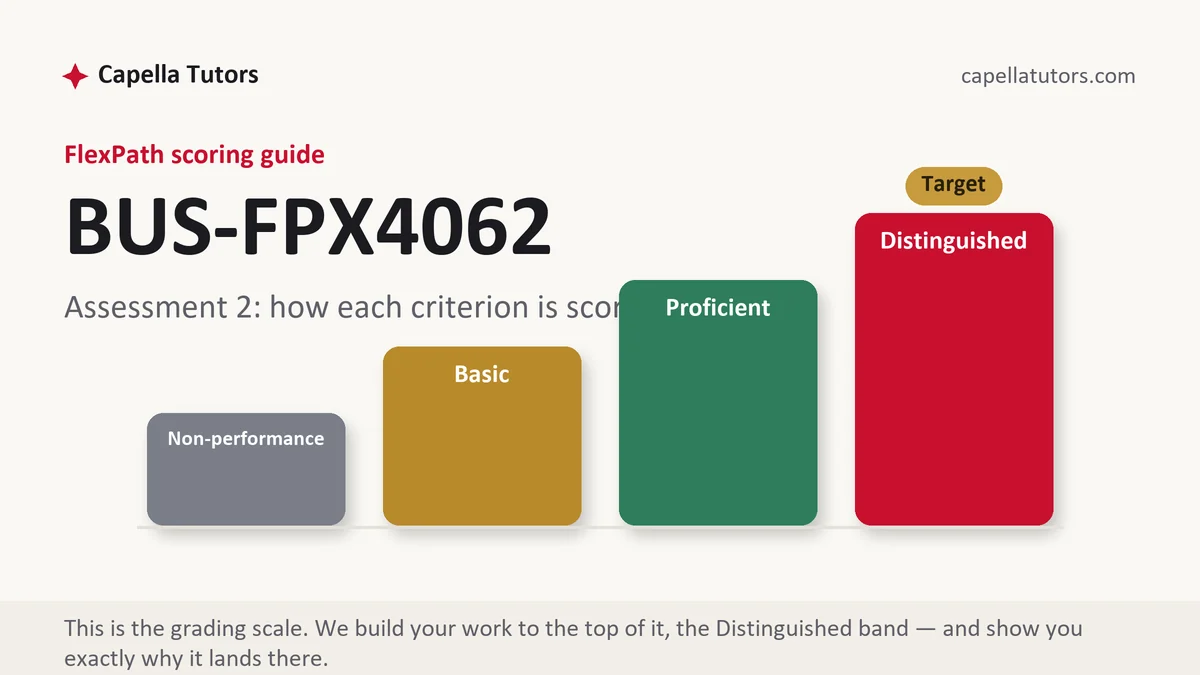
How BUS FPX 4062 Assessment 2 is scored
Four levels per criterion, no letter grade, and the level text doubles as the specification for the deliverable:
| Level | What it means on an asset measurement deliverable |
|---|---|
| Distinguished | The estimate is computed by a named method, a second method is computed for comparison, the difference is explained rather than noted, and the effect on income and on the ratios a lender reads is stated. The extra move is printed in the top column. |
| Proficient | The measurement is correct and the method is applied consistently. Right figure, and nothing said about the alternative. |
| Basic | A percentage applied to a total with no ageing and no argument, or an inventory method named and never worked through. |
| Non-performance | A required schedule is missing, or the estimate appears with no basis at all. An absent schedule scores below a debatable one. |
Both halves of this deliverable make the same point, which is why prompts pair them so often. Two accountants with identical data will report different figures depending on the method chosen, and the criteria want you to notice that out loud rather than present one answer as though it were the only one available.
The BUS FPX 4062 Assessment 2 method, step by step
-
Turn the criteria into headings, then fix what is being measured and at what date
Every measurement question has a date attached and the answer changes with it, so write the reporting date at the head of each schedule. Then give each criterion its own heading, so an evaluator can find the row being marked without hunting through your prose for it.
-
Age the receivables rather than guessing at them
Build the bands and apply a loss rate to each. Current balances of 412,000 dollars at 1 percent, 128,000 at 4 percent for one to thirty days, 61,000 at 12 percent, 24,500 at 30 percent and 17,800 over ninety days at 60 percent give a required allowance of 34,590 against total receivables of 643,300. The bands are the argument. A single rate on a single total is not an argument at all.
-
Compute the second method and explain the gap
The same year of credit sales of 5,120,000 dollars at a historical loss rate of 0.6 percent gives 30,720, which is 3,870 below the ageing figure. Say why rather than noting it: ageing looks at the balances that actually exist at the reporting date, while a percentage of sales looks at experience across the whole year, so a quarter of slower collections shows up in one and not in the other.
-
Adjust the existing allowance rather than replacing it
The allowance is a balance and the expense is the movement in it. With 9,400 dollars already sitting there, reaching 34,590 requires bad debt expense of 25,190, and writing the full 34,590 to expense double counts what was already provided. This is the step where careful students lose a criterion they had otherwise earned.
-
Work the inventory both ways and show the schedule
With opening stock of 1,200 units at 17.60 dollars and purchases of 3,000 at 18.40, 2,400 at 19.75 and 1,800 at 21.30, total cost is 162,060 across 8,400 units. If 6,900 sold, first-in first-out leaves 1,500 units from the last purchase at 21.30, which is 31,950, while weighted average at 19.29 leaves 28,939. Costs rose through the period, so the first method reports 3,011 more inventory and 3,011 more gross profit from identical physical movements.
-
State the consequence, then self-score
Name what the choices did to reported income, to total assets and to the current ratio a lender would look at. Then mark each criterion against the top level and rewrite anything short of it. Faculty have two business days per attempt, so submit with room for one resubmission inside your billing session.
A structure that maps to the criteria
Planning targets our tutors use for a measurement memo of this scope, not Capella rules; the schedules run as long as the data you were given requires.
| Section | What it must do | Guide |
|---|---|---|
| Scope and reporting date | What is being measured, at what date, and for whose benefit. | ~120 words |
| Guidance and measurement basis | The standard behind each measurement and the basis it requires. | ~180 words |
| Receivables schedule | The ageing bands, the loss rate applied to each, and the required allowance. | ~200 words |
| Comparative estimate | The second method computed, and the reason the two figures differ. | ~180 words |
| Inventory schedule | Units and costs in, units out, and ending inventory under two cost flow assumptions. | ~220 words |
| Effect, disclosure and references | What the choices did to income, assets and ratios, the notes required, and APA both ways. | ~250 words |
Annotated sample excerpt
A model excerpt from our team showing how two estimates of one balance get compared instead of merely reported side by side.
Ageing the 643,300 dollars Granite Fork Supply is owed produces a required allowance of 34,590, built from a 1 percent rate on the 412,000 of current balances up to a 60 percent rate on the 17,800 outstanding beyond ninety days.1 Applying the historical rate of 0.6 percent to the year of credit sales of 5,120,000 produces 30,720 instead, and the 3,870 difference is not an error in either method: ageing measures the balances that exist at the reporting date, while a percentage of sales measures average experience across twelve months.2 Because 9,400 is already provided, the entry recognises bad debt expense of 25,190 rather than the whole allowance, and the wholesaler should adopt the ageing figure this year because two large contractor accounts slipped past ninety days in the final quarter.3
- 1Gives the method, the range of rates and the resulting figure in one pass, so the reader knows how the 34,590 was built before being asked to accept it.
- 2Computes the alternative and explains the difference by what each method actually measures. Reporting both figures without this sentence answers half the criterion.
- 3Adjusts the existing balance rather than replacing it, then chooses between the methods on a fact from the case. A conclusion, with a reason attached.
The full premium sample for your exact assessment, written fresh to your scoring guide and issue, is free to request. Study it, revise it into your own voice, and submit work you understand.
The five mistakes that cost Distinguished
- The whole allowance written to expense. The allowance is a balance and the expense is the movement in it, so ignoring what is already provided overstates the charge for the period.
- One loss rate applied to one total. Ageing exists because a balance thirty days old and one four months old behave differently, and a single rate throws away the only evidence you have.
- An inventory method named and never worked. The criterion is about measurement, so the units, the costs and the ending figure all have to appear as a schedule.
- A method difference reported and not explained. Two figures side by side is data. Saying what each method measures, and which one fits these facts, is analysis.
- Estimates presented as certainties. Loss rates and cost flow assumptions are decisions somebody made, and a submission that offers either as a given has skipped the lesson the course was built around.
Pre-submission checklist
- The reporting date stated at the head of every schedule
- Receivables aged into bands with a loss rate defended for each band
- A second estimation method computed and the difference explained
- Bad debt expense derived from the movement in the allowance, not from the allowance itself
- Ending inventory computed under two cost flow assumptions with both schedules shown
- The effect on income, assets and at least one ratio a lender reads, stated in figures
Allowance and inventory schedules to build?
Send the ageing data, the purchase records and the criteria. We build both schedules, compute a comparison method, explain the difference by what each one measures and state the effect on the reported figures. A reconciliation pass checks every total before delivery, and the first premium sample is free.