This manual is for BUS FPX 4062 Assessment 3, start to submission. The final deliverable in Intermediate Financial Accounting Topics and Trends usually turns on a judgment about a long-lived asset: whether an expenditure was an improvement or a repair, what depreciation follows from the answer, and how an arrangement the company does not own ends up on its balance sheet. These are the questions where two defensible answers exist, and the criteria reward the student who reaches one and shows the fact that decided it. The method our tutors apply is below, with a structure mapped onto the criteria and an annotated excerpt from a model. Want it handed off? A premium original sample for this exact assessment arrives in 24 to 48 hours with every computation checked and revisions free until the criteria are satisfied. Capella's catalog lists the course as BUS-FPX4062, and some courserooms print BUS4062; both point to this same Assessment 3.
One honesty note before the manual: Capella revises courses and scoring guides over time, so always write to the exact scoring guide attached to your assessment in the courseroom. The course identity above is verified on capella.edu; the method and structure below are our tutors' approach to it, not Capella's official rubric text.
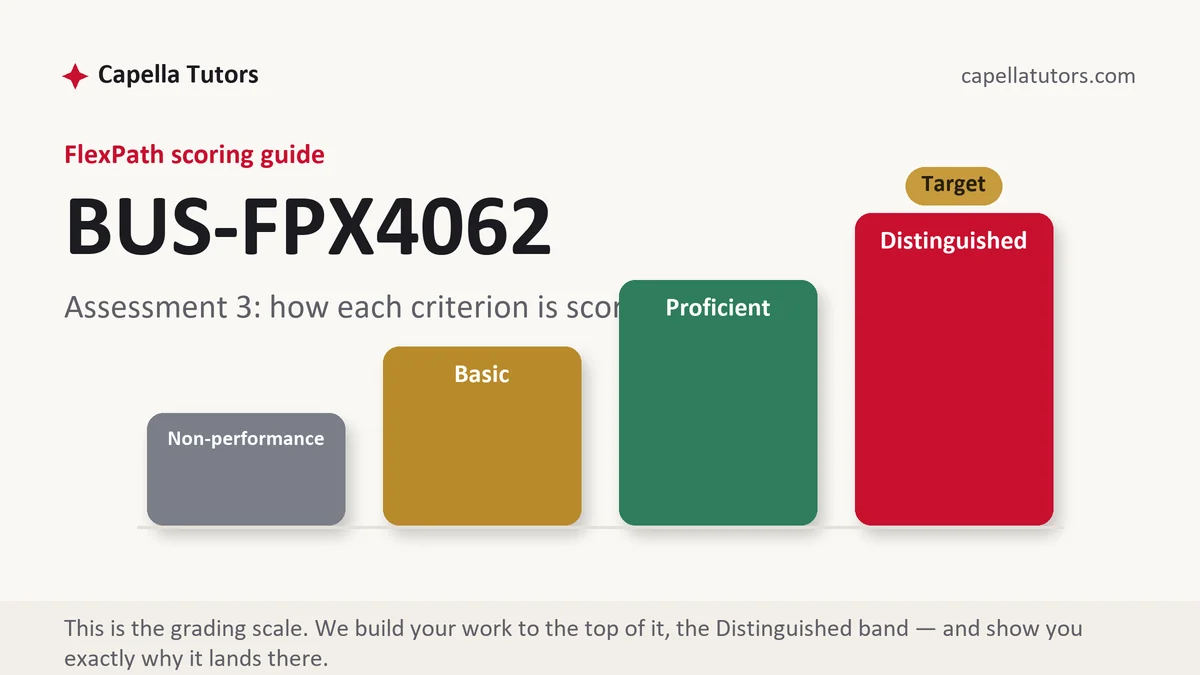
How BUS FPX 4062 Assessment 3 is scored
Each criterion lands on one of four levels and nothing averages into a grade. Read the levels as a description of what has to be on the page:
| Level | What it means on a long-lived asset deliverable |
|---|---|
| Distinguished | The split between capitalising and expensing is decided by a named fact, the depreciation consequence is computed, the lease measurement is shown, and the effect on reported income and on leverage is stated. Read the top column for the move it is paying for. |
| Proficient | The treatment is correct and supported. Sound, and silent about the alternative that was almost as defensible. |
| Basic | The whole expenditure treated one way because that was simpler, or a lease described in words with no measured amount attached. |
| Non-performance | The depreciation or the lease measurement is missing, or the conclusion rests on no guidance at all. Absence costs more than a debatable answer. |
The reason both treatments can look defensible is that the standard turns on a question of fact rather than of arithmetic. Find the fact, whether that is what the installers certified, a measurable jump in throughput, or the way the same job was booked in earlier years, and the conclusion follows from it. Refusing to conclude is the one response that certainly loses the row.
The BUS FPX 4062 Assessment 3 method, step by step
-
Write the question, then split the expenditure before you answer it
Give each criterion a heading, then break the total spend into the things that were actually bought. A 214,000 dollar tunnel rebuild is not one transaction: 148,000 replaced the conveyor and blower array while 66,000 repainted, resealed and replaced worn brushes. Answering a lump sum forces one treatment onto both halves, and that is where the criterion is usually lost.
-
Decide capitalise or expense on a named fact
The test is whether the spend extends the life or the capacity of the asset rather than maintaining what was already there. The new conveyor lifts throughput from 42 to 55 cars an hour and adds six years of service, which capitalises the 148,000, while repainting restores a condition that already existed and expenses the 66,000. Name the fact, then name the criterion it satisfies.
-
Compute the depreciation the decision creates
The capitalised 148,000 over the six added years is 24,667 a year on a straight line basis. Then quantify what the alternative would have done: expensing the whole 214,000 reduces this year of pre-tax income by 214,000 against 90,667 under the split treatment, a difference of 123,333 landing entirely in one period. Where the guide asks you to evaluate the treatment rather than merely apply it, that comparison is the evaluation.
-
Bring the lease on and measure it
Nearly all lease arrangements now appear as a right-of-use asset with a matching liability, which is the trend the course title is pointing at. Three sites at a combined 9,600 dollars a month for five years, discounted at 6 percent, measure at roughly 496,600, and the liability unwinds as interest while the asset amortises. Show the inputs, because a lease described without an amount answers nothing at all.
-
Test the carrying amount if the facts invite it
Where the case hints that one site underperforms, say what impairment testing would ask: whether the carrying amount is still recoverable, and if it is not, the write-down to fair value. Estimates that change, such as a shortened useful life, are applied going forward rather than by restating what was already reported, and saying so is worth a sentence.
-
State the effect on the reported picture, then self-score
Name what the treatments did to income for the period, to total assets, to total liabilities and to the leverage a lender reads. A technically correct memo that says nothing about the 496,600 now sitting on the balance sheet, or what it does to the debt ratio, leaves its most useful sentence unwritten. Then mark each criterion yourself and submit early enough to allow a resubmission.
A structure that maps to the criteria
Planning targets our tutors use for a memo of this kind, not Capella requirements; your scoring guide decides whether the output is a memo, an analysis of published statements or entries with commentary.
| Section | What it must do | Guide |
|---|---|---|
| Issue and expenditure breakdown | The question, and the total spend separated into what was actually acquired. | ~150 words |
| Guidance | The criteria the standard sets for capitalisation, for depreciation and for lease recognition. | ~200 words |
| Capitalise or expense | The decision on each component, with the fact that decided it named. | ~220 words |
| Depreciation and the alternative | The charge the decision creates, and what the other treatment would have done to income. | ~200 words |
| Lease measurement | Payments, term, discount rate, the amount recognised, and how it unwinds. | ~180 words |
| Effect, disclosure and references | Income, assets, liabilities, the ratios a user notices, the notes required, and APA both ways. | ~250 words |
Annotated sample excerpt
A model excerpt from our team showing how a capitalisation judgment reads when a fact decides it rather than a preference.
Bluecrest Car Wash spent 214,000 dollars on its Ridgeline tunnel, and the criterion turns on the fact that only part of that spend changed what the tunnel can do.1 Replacing the conveyor and blower array cost 148,000 and lifted rated throughput from 42 to 55 cars an hour while adding six years of expected service, which meets the test for an improvement and carries 24,667 of depreciation a year across those six years.2 The remaining 66,000 repainted the bay, resealed the floor and replaced worn brushes, restoring a condition that already existed rather than creating a new one, so it is expensed, and the split holds this year of pre-tax income down by 90,667 instead of the 214,000 a single expense treatment would have charged.3
- 1Says at once that the answer turns on a fact and not on a preference, which is the frame every intermediate criterion is written in.
- 2Names the capacity change and the life extension, applies the test to them, and computes the depreciation inside the same sentence.
- 3Treats the second component on its own facts and quantifies the difference between the two possible treatments. The comparison is what the top of the guide pays for.
The full premium sample for your exact assessment, written fresh to your scoring guide and issue, is free to request. Study it, revise it into your own voice, and submit work you understand.
The five mistakes that cost Distinguished
- The whole expenditure treated as one transaction. A rebuild usually contains an improvement and a repair, and forcing one treatment onto both is the most common way this criterion is lost.
- A conclusion reached with no fact behind it. Capitalisation turns on capacity or on life, so point at the evidence that settled it: a certified rating, a measured throughput change, or how the same job was booked last time.
- Depreciation left uncomputed. Capitalising an amount and never charging it against the later periods overstates income in every one of them.
- A lease described but never measured. The right-of-use asset and the liability are amounts, and a paragraph about the arrangement with no figures answers nothing.
- No statement of the effect on the reported picture. Moving several hundred thousand onto the balance sheet changes leverage, and a memo that passes over it leaves the analysis unfinished.
Pre-submission checklist
- The total expenditure broken into components before any treatment is chosen
- Each component decided by a named fact about capacity, life or prior practice
- Depreciation on the capitalised amount computed, with the method and the period shown
- The alternative treatment quantified so the difference to income is visible
- Lease payments, term, discount rate and recognised amount all shown
- The effect on income, assets, liabilities and one ratio stated in figures
Capitalisation and lease memo to write?
Send the spend breakdown, the lease terms and the criteria. We split the expenditure, decide each component on a named fact, compute the depreciation and the lease measurement, and state the effect on the reported figures. Everything is rechecked before delivery, and the first premium sample is free.