This manual is for BUS FPX 4062 Assessment 1, start to submission. The opening deliverable in Intermediate Financial Accounting Topics and Trends usually hands you a contract and asks you to work the revenue model through in order: identify the contract, identify the separate obligations inside it, determine the transaction price, spread it across those obligations in proportion to what each would sell for alone, and take revenue into income only as each one is discharged. A conclusion with no standard behind it does not score here even when it happens to be right. Set out below is how our tutors build it, a structure that answers each criterion in turn, and an annotated excerpt. Prefer to hand it off? A premium original sample for this exact assessment returns in 24 to 48 hours with every allocation recomputed and revised free until the criteria are met. Capella's catalog lists the course as BUS-FPX4062, and some courserooms print BUS4062; both point to this same Assessment 1.
One honesty note before the manual: Capella revises courses and scoring guides over time, so always write to the exact scoring guide attached to your assessment in the courseroom. The course identity above is verified on capella.edu; the method and structure below are our tutors' approach to it, not Capella's official rubric text.
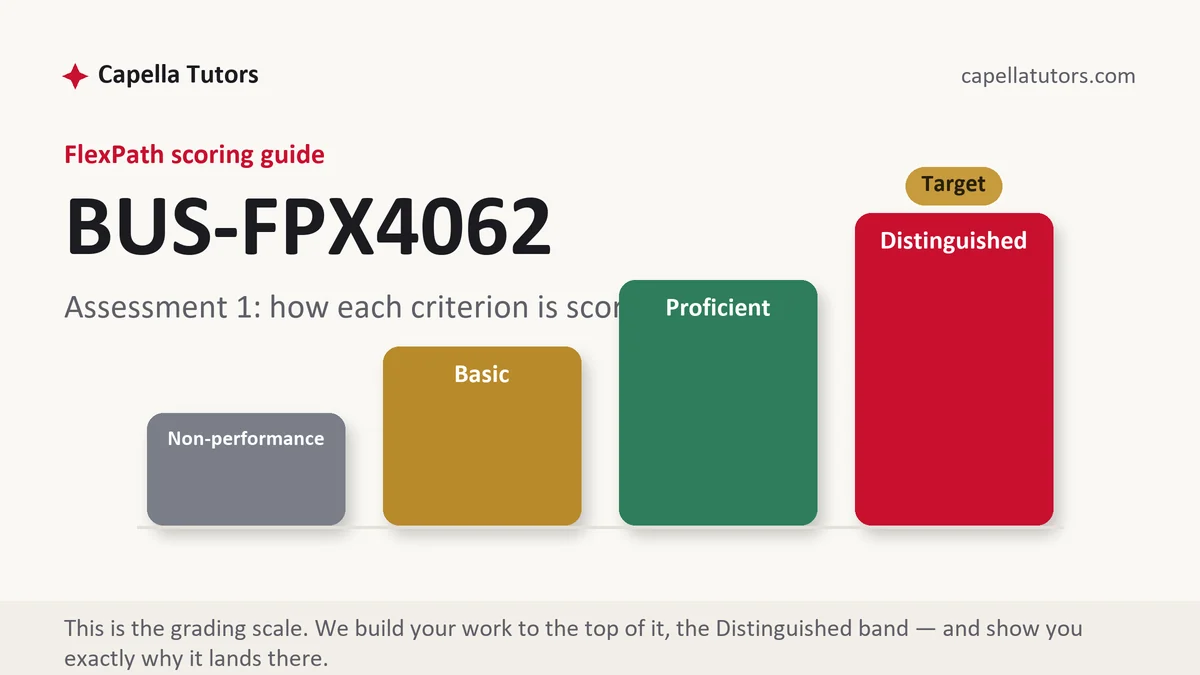
How BUS FPX 4062 Assessment 1 is scored
FlexPath marks each criterion at one of four levels and issues no letter grade. The level wording is the brief:
| Level | What it means on a revenue recognition deliverable |
|---|---|
| Distinguished | All five steps are worked in order, the judgment in steps two and three is named as judgment, the allocation arithmetic is inspectable, and both the note disclosure and the effect on reported figures are stated. The top column names the extra move. |
| Proficient | The model is applied correctly and the amounts are right. Complete, and short of the top because the judgment was presented as a fact. |
| Basic | The bundle recognised at the point of sale, or the five steps summarised rather than applied, with the standard mentioned and never used. |
| Non-performance | A step is skipped, most often the allocation, or no authoritative support appears anywhere. Absence costs more than error. |
One thing to hold onto: the interesting cases in this deliverable almost always live in steps two and three. Whether a bundle contains one obligation or three, and how variable consideration is estimated and constrained, are judgments you have to make and then defend, and the criteria are written around the defense rather than the outcome.
The BUS FPX 4062 Assessment 1 method, step by step
-
Write the issue as a question, then build the criteria into headings
Something answerable: whether the diagnostic assessment sold inside a prepaid tutoring package is a separate performance obligation, and if it is, how much of the package price it carries. Then give each criterion its own heading. A question that narrow lets the standard produce a single answer, while a heading reading revenue analysis produces a summary.
-
Find the guidance before you form a view
Reasoning from a hunch back toward a standard produces a paper that quotes only what agrees with it. Start at the guidance instead: the conditions that trigger recognition, the rules for measuring the amount, and what the notes are required to say. Read the scope paragraphs as well, since these problems are often built around a transaction that sits outside whichever standard the student reached for first.
-
Work the five steps in order, one subsection each
Identify the contract, identify the obligations, price the contract, split that price, then release it as the work is done. Five steps in the standard means five subsections in your paper, so nothing has to be inferred by the person marking it. Say which step holds the difficulty, because the criteria usually load the weight there.
-
Show the allocation arithmetic in a table
A 2,340 dollar package covering a diagnostic assessment, twenty-four sessions and twelve monthly progress reports, where those items sell separately for 260, 2,208 and 180, has standalone prices totalling 2,648. The diagnostic carries 260 over 2,648 of the price, which is 229.76; the sessions carry 1,951.18, or 81.30 each; the reporting carries 159.06, or 13.26 a month. Set it out so a reader can reproduce every figure without asking.
-
Say when each obligation is satisfied and what the entries do
The whole 2,340 arrives as a contract liability. The diagnostic releases 229.76 in the first week, each delivered session releases 81.30, and each monthly report releases 13.26. Then name the balance still owed to the customer at the reporting date, because that liability is what a reader of the balance sheet is actually trying to find.
-
Close on disclosure and effect, then self-score
Say what the notes have to explain, particularly the judgments used to identify the obligations and to allocate the price. Then say what the treatment does to reported revenue for the period, to liabilities, and to any ratio a lender would check. Mark each criterion yourself and submit early, since evaluation takes up to two business days per attempt.
A structure that maps to the criteria
Our tutors' planning targets for a technical memo of this size, not Capella requirements; your scoring guide decides whether the deliverable is a memo, a set of entries with commentary or a research paper.
| Section | What it must do | Guide |
|---|---|---|
| Issue statement | The question you have to answer, stated as a question, with the facts, amounts and dates that bear on it pulled out. | ~140 words |
| Authoritative guidance | The standard that governs, the conditions it imposes, and any scope paragraph you had to rule out. | ~200 words |
| Application, step by step | Every step of the model tested against your facts, taken in the sequence the standard lays down. | ~320 words |
| Allocation computation | Standalone selling prices, the ratios, the allocated amounts and the per-unit release. | ~180 words |
| Alternative treatment | The other answer a reasonable person could reach, the case for it, and the reason you did not take it. | ~180 words |
| Conclusion, disclosure and references | The answer you settled on, the entries it produces, the notes that must accompany it, the effect on reported figures, and APA in both directions. | ~250 words |
Annotated sample excerpt
A model excerpt from our team, showing how the allocation step reads when the arithmetic is performed rather than summarised.
Brightpath Learning Studios sells a 2,340 dollar package containing a diagnostic assessment, twenty-four tutoring sessions and twelve monthly progress reports, and each of the three is also sold on its own at 260, at 92 a session and at 15 a report, so the standalone prices total 2,648.1 The package price is allocated on those ratios rather than set equal to the separate prices, giving 229.76 to the diagnostic, 1,951.18 to the sessions and 159.06 to the reporting, which works out at 81.30 for each session delivered and 13.26 for each monthly report.2 None of it is revenue on the day the family pays; the full 2,340 is a contract liability that releases only as each obligation is satisfied, which matters to Brightpath because the second-city launch is being funded from packages sold before a single session has been taught.3
- 1Sets out every input to the allocation before performing it, including the total of the standalone prices. Nothing later in the paragraph arrives unexplained.
- 2Shows the allocation and then reduces it to the per-unit figures the entries will actually use. A criterion about measurement is asking for this line.
- 3Names the balance sheet consequence and ties it to something a reader of the business cares about, which is where the top of the guide lives.
The full premium sample for your exact assessment, written fresh to your scoring guide and issue, is free to request. Study it, revise it into your own voice, and submit work you understand.
The five mistakes that cost Distinguished
- The bundle recognised at the point of sale. Money in the account is not a promise kept, and booking the whole package on the day it is paid inflates revenue for the period while concealing the service the studio still owes.
- Standalone prices used as the allocation itself. The package price is allocated on the ratio of standalone prices, not set equal to them, and skipping the ratio quietly changes every figure.
- A conclusion with no standard behind it. The criteria in this course are built on authoritative support, so an answer that happens to be right and cites nothing still leaves the row unearned.
- Judgment presented as fact. Whether an item is a separate obligation is a decision you made. Say so, say on what basis, and the criterion is satisfied.
- Disclosure ignored. Getting recognition and measurement right still leaves the part where you tell a reader what you judged and why, and that part lives in the notes.
Pre-submission checklist
- The issue written as one narrow question the standard can answer
- Guidance cited to the source, with any scope exception considered on the page
- All five steps of the model given their own subsection, in order
- Allocation shown as a table with standalone prices, ratios and allocated amounts
- The release pattern stated per session and per period, with the closing liability named
- Disclosure requirements and the effect on reported figures both addressed
Revenue memo due and the bundle will not separate?
Send the contract facts, the prices and the criteria. We work the five steps in order, build the allocation in a table a reader can reproduce, name the judgments as judgments and write the disclosure paragraph. Every figure is rechecked before delivery, and the first premium sample is free.