This manual is for BUS FPX 4047 Assessment 2, start to submission. Assessment 2 in BUS FPX 4047, Employee Training and Development, usually asks you to design: objectives written as observable behaviour, a sequence built backwards from them, practice proportionate to what has to be learned, and transfer support that reaches the job. Your scoring guide decides whether that arrives as a design document, a facilitator package or a proposal. FlexPath scores it one criterion at a time against four levels. The method follows, then a structure the criteria can be checked against, and an annotated excerpt. Want it built for you? A premium original sample in 24 to 48 hours with free revisions. Capella's catalog lists the course as BUS-FPX4047, and some courserooms print BUS4047; both point to this same Assessment 2.
One honesty note before the manual: Capella revises courses and scoring guides over time, so always write to the exact scoring guide attached to your assessment in the courseroom. The course identity above is verified on capella.edu; the method and structure below are our tutors' approach to it, not Capella's official rubric text.
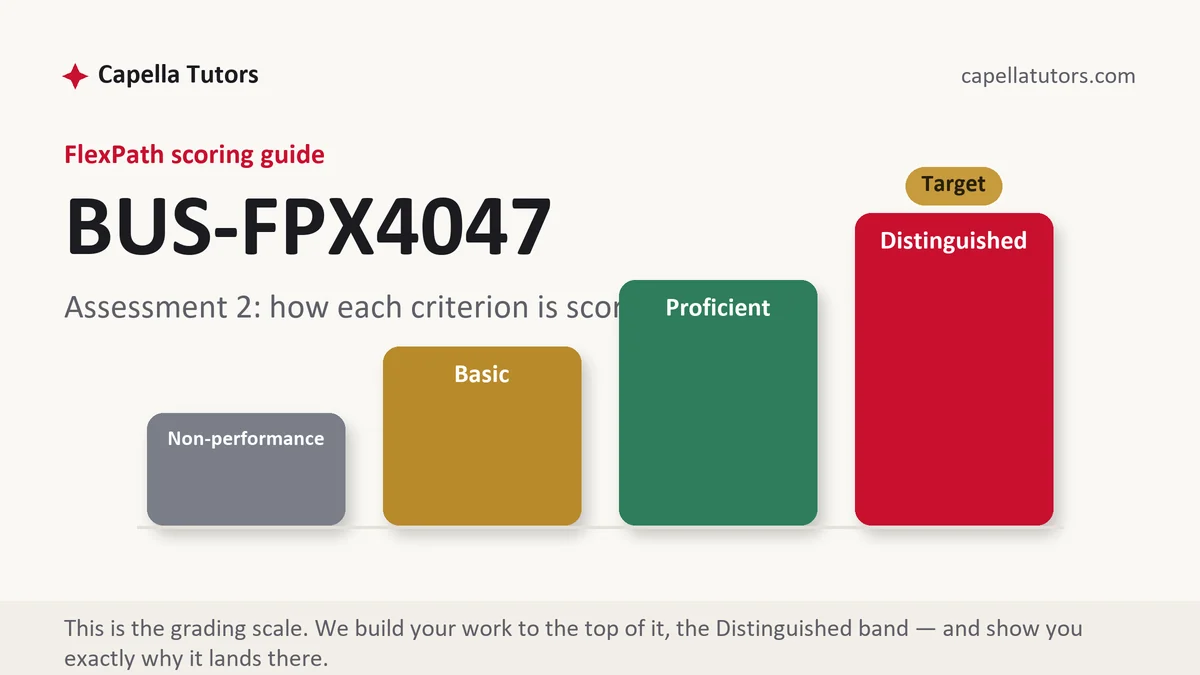
How BUS FPX 4047 Assessment 2 is scored
Four levels per criterion, no letter grade, and the level descriptions are the closest thing to a specification you will get:
| Level | What it means on a training design |
|---|---|
| Distinguished | Objectives use observable verbs with conditions and standards attached, the schedule is derived from those objectives rather than assumed, practice outweighs presentation, and transfer mechanisms have named owners. The criterion tells you which of these it weights most heavily. |
| Proficient | A coherent design with sound objectives and appropriate methods. Deliverable work that has not shown how its decisions were reached. |
| Basic | A content outline with topics and timings, objectives written around understanding and awareness, and transfer left to management support. |
| Non-performance | Objectives are absent, or the design contains no assessment of learning. Either gap takes that criterion to the floor on its own. |
Design is graded on objectives before anything else, because the objective tells you what practice is needed, what the assessment has to measure and how long the session must be. Understand, know and be aware of cannot be observed and therefore cannot be assessed; calculate, demonstrate, troubleshoot and complete can, and the whole design hangs off that difference.
The BUS FPX 4047 Assessment 2 method, step by step
-
Build the outline from the criteria, then write the objectives first
Nothing else can be designed until they exist. Each one states what the participant will be able to do, under what conditions and to what standard, using a verb somebody can watch happen. Three or four well-written objectives beat eight vague ones.
-
Trace every objective back to the gap
If an objective does not close part of the shortfall you identified, it is content somebody found interesting. Put the gap and the objectives side by side and delete anything with no line between them, then say in the paper that you did.
-
Derive the schedule from the parts
Count demonstration time per objective, the practice repetitions each needs, the feedback between them and the assessment at the end, then add the overhead of starting and finishing. Four objectives needing three practice cycles each will not fit into ninety minutes, and showing that arithmetic is better than proposing a length because it sounds reasonable.
-
Get the practice ratio right and space the sessions
Adults learn a procedure faster when they watch it done, try it with support, then try it alone, so a design that presents for fifty minutes and practises for five has the ratio backwards. Two shorter sessions a week apart with a task in between usually retain better than one long block, and saying why earns the row.
-
Build the assessment from the objective, not from the content
If the objective says the participant will complete a task to a standard within a time, the assessment is that task, timed, marked against that standard. Write the actual items and mark the correct answers. A criterion about assessment wants the instrument, not a description of one.
-
Attach transfer with owners, then self-score
Learning that never appears on the job is the normal outcome, not the exception, so specify the job aid, the supervisor briefing, the follow-up point and the thing in the work that will require the new behaviour, each with a name against it. Then score your draft against every criterion and rewrite anything below the top level.
A structure that maps to the criteria
These are the proportions our tutors plan a design deliverable around rather than any Capella limit; follow your own guide wherever it asks for more.
| Section | What it must do | Guide |
|---|---|---|
| Gap and audience | The shortfall the design closes, who is being trained, how many, and what they already do. | ~200 words |
| Objectives | Each one with its verb, condition and standard, and the part of the gap it closes. | ~250 words |
| Schedule derived | Demonstration, practice cycles, feedback, assessment and overhead, added up to a defended length. | ~250 words |
| Sequence, methods and materials | The order of content, the method for each objective, and the practice activities and job aids produced. | ~400 words |
| Assessment of learning | The actual items or tasks, the standard, who marks them, and what a pass means. | ~200 words |
| Transfer support and references | Job aid, supervisor briefing, follow-up point, the work requirement, owners, and APA both ways. | ~250 words |
Annotated sample excerpt
A short original model from our team, showing what a defended session length looks like on the page. Study the arithmetic, then run it on your own objectives.
The design covers four objectives for Sablewood Property Management's eleven leasing agents, all concerning maintenance intake: classifying urgency against the published criteria, capturing the six required fields, routing to the correct trade, and setting the resident expectation in writing.1 Each objective needs nine minutes of demonstration and three practice cycles of six minutes with feedback, which is 36 minutes of demonstration and 72 of practice; the timed assessment on live-format tickets takes 24 minutes and starting and closing take 20, so the design requires 152 minutes and not the two hours originally requested.2 Rather than extend the block, the programme runs as two 76-minute sessions a week apart with each agent logging ten real intakes in between, since spaced practice retains better than massed practice and a property office can release five agents twice more easily than eleven agents once.3
- 1Four objectives named as the tasks they are, in observable terms. Naming them here means the schedule that follows can be traced to something rather than asserted.
- 2Every component costed in minutes and then totalled, which lets the paper contradict the requested length with evidence. This is the paragraph that a design criterion is built to find.
- 3The split is justified twice over, once on retention and once on operational release. Two reasons for one decision is what professional judgment looks like in a design document.
The full premium sample for your exact assessment, written fresh to your scoring guide and issue, is free to request. Study it, revise it into your own voice, and submit work you understand.
The five mistakes that cost Distinguished
- Objectives written with unobservable verbs. If nobody can watch understanding happen, nobody can assess it, and the design loses the anchor that everything else hangs from.
- Content-heavy sessions with token practice. An hour of presentation and five minutes of doing has taught recognition rather than capability, and the criteria are asking about capability.
- Session length asserted rather than derived. A round number chosen because it sounds manageable is the single easiest thing for an evaluator to mark down in a design section.
- Assessment built from the content. Questions about what was covered do not measure whether the objective was met, and the objective is what the criterion is scored against.
- Transfer left to good intentions. Without a job aid, a follow-up point and a supervisor who mentions it, the new behaviour disappears within weeks and the design has bought nothing.
Pre-submission checklist
- Every objective carries an observable verb, a condition and a standard
- Each objective traced to a named part of the performance gap
- The schedule built from components and totalled on the page
- Practice time exceeding presentation time, with spacing justified
- Actual assessment items or tasks written out, with the standard stated
- Transfer mechanisms each carrying a named owner and a date
Training design to build?
Send the gap, the audience and the criteria. We write the objectives as observable behaviour, derive the schedule from its parts, build the practice activities and the assessment items, and attach transfer with owners. First premium sample free, delivered in 24 to 48 hours.