This manual is for BUS FPX 4047 Assessment 1, start to submission. Assessment 1 in BUS FPX 4047, Employee Training and Development, usually asks you to establish whether a performance problem is a training problem at all, and then to locate the gap at the organisational, task and person level with evidence for each. FlexPath grades it criterion by criterion off your own guide, four levels, no letters. Below is the method our tutors use on it, a structure the criteria can be ticked off against, and an annotated sample excerpt. Rather hand it over? Send the prompt and a premium original sample arrives in 24 to 48 hours, revised free until the criteria are met. Capella's catalog lists the course as BUS-FPX4047, and some courserooms print BUS4047; both point to this same Assessment 1.
One honesty note before the manual: Capella revises courses and scoring guides over time, so always write to the exact scoring guide attached to your assessment in the courseroom. The course identity above is verified on capella.edu; the method and structure below are our tutors' approach to it, not Capella's official rubric text.
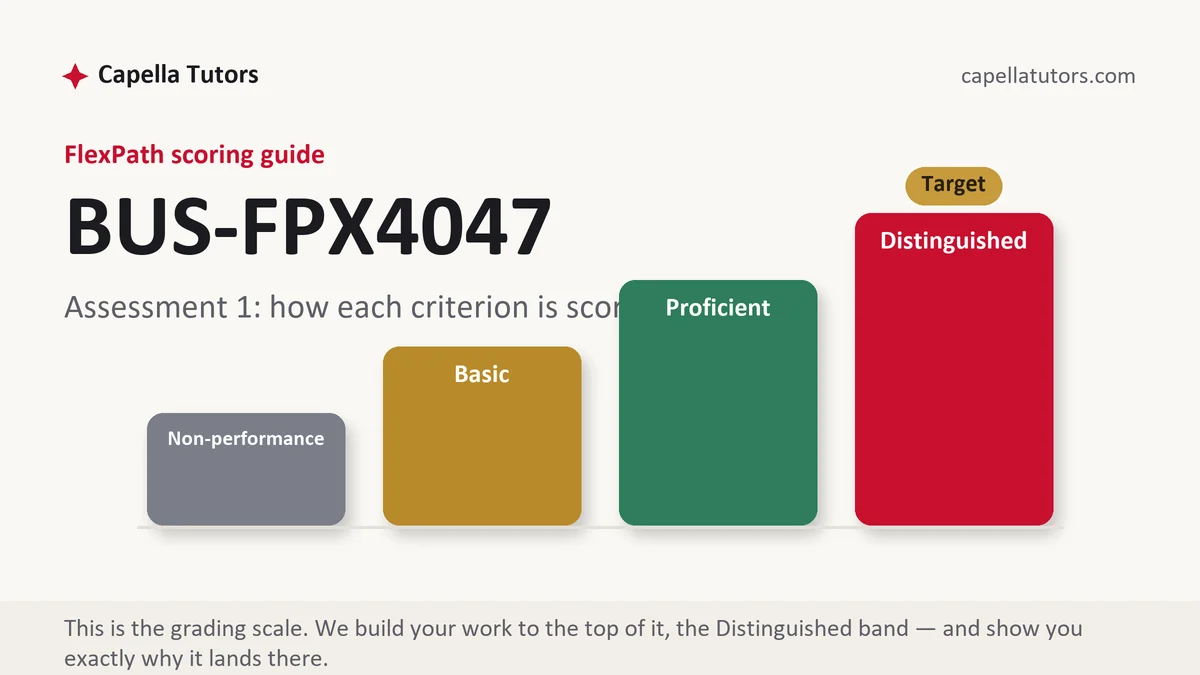
How BUS FPX 4047 Assessment 1 is scored
FlexPath does not produce a letter grade. Every criterion on the scoring guide returns at one of four levels, and that level language is the brief:
| Level | What it means on a needs assessment |
|---|---|
| Distinguished | The gap is quantified from evidence rather than described, all three levels of analysis are run, the paper checks whether training is even the right intervention, and the method and its limitations are stated. The criterion usually names which of these it weights hardest. |
| Proficient | The need is established with evidence at more than one level and the conclusion follows. Complete, and one move short of the top row. |
| Basic | A statement that employees require training, supported by a manager's impression and a description of what the course would cover. This is where most first attempts land. |
| Non-performance | A level of analysis is missing, or no method is described at all. An absent component floors the criterion no matter how well the rest reads. |
Most requests that reach a learning function are not training problems. If people know how to do the work and are not doing it, the cause is usually an incentive pointing elsewhere, a tool that does not work, a process that makes the right behaviour slower or a supervisor who tolerates the wrong one, and the criteria reward the student willing to conclude that a workshop is the wrong answer.
The BUS FPX 4047 Assessment 1 method, step by step
-
Rebuild the criteria as headings, then write the gap in one sentence
Not that staff need better attention to detail, but that a measurable output sits below a stated target, by this much, concentrated here. Everything downstream is scored against how precisely that sentence is written, so write it before anything else.
-
Ask the question that separates skill from everything else
Could these people do the task correctly today if their job depended on it. If yes, this is not a skill deficit and training will not fix it, so say so in the paper and propose the right intervention instead. If no, carry on and find out where the deficit sits.
-
Run the organisational level
Does the proposed training support what the business is actually trying to do, and will the environment let the new behaviour survive contact with the job. Name the business objective and name the environmental obstacle, because a design that ignores the second one produces a programme that works in a room and nowhere else.
-
Run the task level and then the person level
Break the work into what somebody has to do and to what standard, then find out who specifically has the gap. Training everybody when the deficit sits in one shift is expensive and mildly insulting to the rest, and the person analysis is the section most often skipped.
-
Collect evidence you can name and date
Performance records, error and rework logs, complaints, escalations, structured observation, supervisor interviews, a short assessment. Twenty observations and four interviews is a legitimate basis provided you state the method, the sample and the period, and say in one sentence what that sample cannot tell you.
-
Cost the gap, then self-score
Multiply the defect rate by its unit cost so the need has a figure beside it, and label the estimate as an estimate. Then read the draft against each criterion, mark it D, P, B or N yourself, and rewrite anything below D before submitting early in the week.
A structure that maps to the criteria
The word targets below are how our tutors plan a needs assessment of this size, not a Capella requirement; grow whichever section your own guide weights most.
| Section | What it must do | Guide |
|---|---|---|
| The performance gap | Current performance, target performance, the size of the shortfall, and who is affected. | ~200 words |
| Is this a training problem | The can-they-do-it-today test, the alternative causes considered, and the conclusion reached. | ~200 words |
| Organisational analysis | The business objective the training serves and the environmental conditions that will help or defeat it. | ~250 words |
| Task and person analysis | The work broken into tasks and standards, and who specifically holds the gap, with the evidence for each. | ~400 words |
| Method and limitations | Instruments used, sample, period, and what the data cannot establish. | ~200 words |
| Cost of the gap and references | The defect rate multiplied by its unit cost, the assumptions, and APA reconciled both ways. | ~200 words |
Annotated sample excerpt
An original model excerpt from our team, showing what the gap statement reads like once it carries arithmetic. Take the moves and rebuild them from your own evidence.
Harborview Print & Mail ran 1,270 variable-data mail jobs last quarter across a 52-person operation, and 119 of them required rework before release, a defect rate of 9.4 percent against an internal target of 3 percent.1 At an average rework cost of 84 dollars in stock, press time and postage resubmission, that quarter carried roughly 9,996 dollars of avoidable cost, or something close to 40,000 dollars annualised if nothing changes.2 The person analysis narrows it further: 84 of the 119 rework jobs trace to three of the eleven prepress operators, all three hired within the last eight months, and none of the three has ever been shown the data-merge verification step that the other eight perform from habit rather than from any written procedure.3
- 1Current performance, target performance and the shortfall in one sentence, with the denominator included. A rate without its denominator cannot be judged, and evaluators notice the omission.
- 2The defect rate multiplied by a unit cost, with the components of that unit cost named. Annualising it is what makes the number arguable in front of an owner.
- 3The person level, done properly. Concentrating the loss in three of eleven operators changes the intervention entirely, and the missing written procedure is the finding that points at the design.
The full premium sample for your exact assessment, written fresh to your scoring guide and issue, is free to request. Study it, revise it into your own voice, and submit work you understand.
The five mistakes that cost Distinguished
- Training assumed to be the answer. A skill gap and a motivation gap look identical from a distance and have completely different fixes, so the check has to appear on the page.
- Only one level of analysis run. Task analysis on its own leaves the business objective unstated and the affected population unidentified, and both are usually separate criteria.
- The gap described in adjectives. Poor accuracy is not a gap, and a criterion asking you to establish a need is asking for a number, a target and a denominator.
- Method left implicit. A needs assessment criterion is asking how you know, so the instruments, the sample and the period have to be stated even when the sample is small.
- Person analysis skipped. Training the whole workforce when three people hold the deficit wastes the budget and buries the real cause under a schedule.
Pre-submission checklist
- The gap written as current performance, target and shortfall, with a denominator
- The can-they-do-it-today test applied explicitly and answered
- All three levels of analysis present and separately labelled
- Instruments, sample and period stated, plus one sentence of limitation
- The person level narrowing the population to who actually has the gap
- The gap costed, with the unit cost broken into components
Needs assessment due?
Send the performance problem, whatever data exists and the criteria. We run all three levels, test whether training is the right intervention at all, describe the method honestly and cost the gap. First premium sample free, turned around in 24 to 48 hours.