This manual is for BUS FPX 4047 Assessment 3, start to submission. Assessment 3 in BUS FPX 4047, Employee Training and Development, usually asks for the accounting: how you will know whether the programme worked, at which levels you can actually measure, what it cost, and what the honest caution is about attributing any improvement to it. Your scoring guide sets the deliverable. FlexPath returns a level against each criterion and nothing else. Below is the method, a structure drawn out of the criteria, and an annotated excerpt. Prefer support? One premium original sample, 24 to 48 hours, revised free until the guide is met. Capella's catalog lists the course as BUS-FPX4047, and some courserooms print BUS4047; both point to this same Assessment 3.
One honesty note before the manual: Capella revises courses and scoring guides over time, so always write to the exact scoring guide attached to your assessment in the courseroom. The course identity above is verified on capella.edu; the method and structure below are our tutors' approach to it, not Capella's official rubric text.
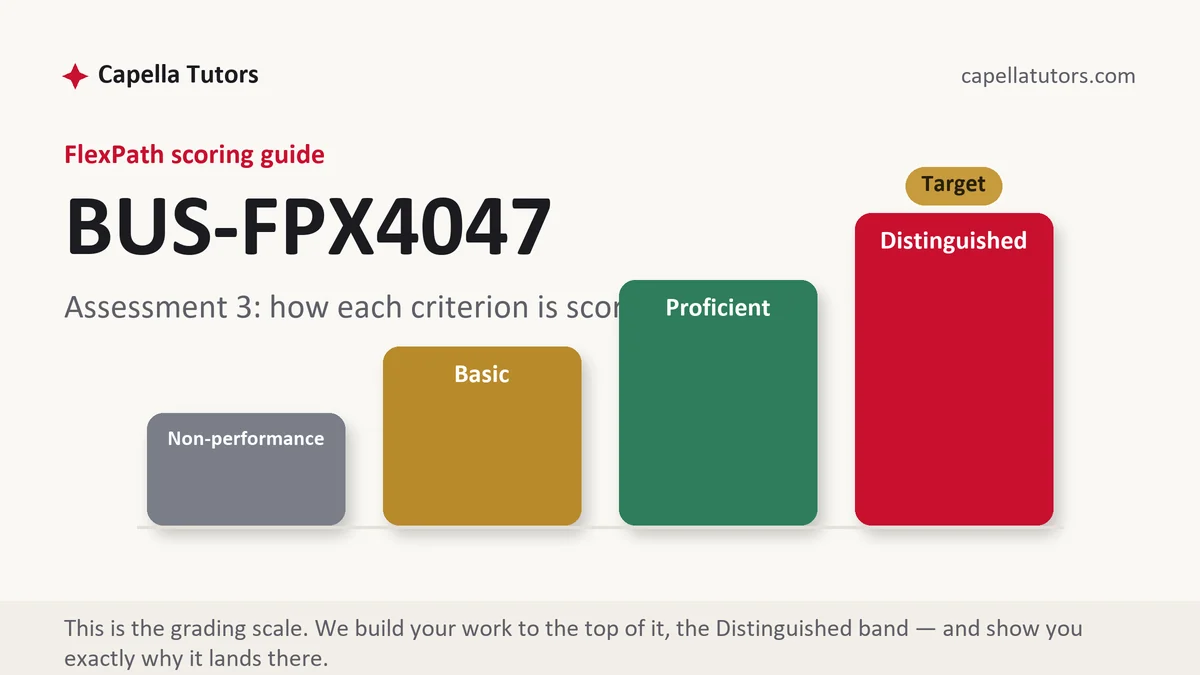
How BUS FPX 4047 Assessment 3 is scored
There is no letter grade in FlexPath, only four levels against each criterion, and reading those levels as instructions is the whole method:
| Level | What it means on an evaluation plan |
|---|---|
| Distinguished | Each level of evaluation is treated as its own question with an instrument, a timing and a named collector, the cost side includes participant time at a loaded rate, and the paper says what else could explain a movement in the business measure. That last admission is usually written into the criterion. |
| Proficient | Measures at more than one level with instruments and timing attached, and a defensible cost figure. Complete, one row below the top. |
| Basic | A feedback form at the end of the session, described as the evaluation, with a general intention to monitor results later. |
| Non-performance | A required level is not addressed at all, or no cost figure appears where the guide asks for one. A missing element floors that criterion by itself. |
Treat the evaluation levels as separate questions rather than as a ladder. The four-level model is universally taught and has been criticised for implying a causal chain the evidence does not support, since a warm reaction does not reliably produce learning and learning does not reliably produce behaviour change unless opportunity, supervision and tools are all in place.
The BUS FPX 4047 Assessment 3 method, step by step
-
Turn the criteria into headings, then plan the evaluation before the programme
An evaluation designed after delivery can only use whatever data happens to exist. Decide now what will be measured, so the baseline gets captured before anybody is trained, and say in the paper that this is why the sequence matters.
-
Measure learning against the objectives, not against the content
A pre and post assessment on the objectives is straightforward and it is the level students most often underbuild. Use the same instrument both times, state who administers it, and say what score counts as having met the objective.
-
Design the behaviour check with a person attached
Behaviour requires somebody to look at the job weeks later, which means agreeing now who looks, at what, and with which checklist. Without a name and a date against it, this level is an intention rather than a plan, and the criterion can tell the difference.
-
Tie the results level back to the gap statement
The business measure you evaluate is the one you named when you established the need, unchanged. Say how often it reports, who owns the report, and what size of movement would count as success rather than noise.
-
Cost it properly and be honest about the return
Participant time at a loaded hourly rate is usually the largest single item and the one most often left out. Put the costs on one side with their sources, the estimated benefit on the other with its basis declared, and describe the result as an estimate under stated conditions.
-
Name the rival explanations, then self-score
Other things will change while the programme runs, so say what they are: a new system, a staffing change, seasonal volume, a supervisor turnover. The strongest design available to most organisations is a comparison across groups trained at different times, which costs nothing extra. Then score the draft against each criterion in turn and lift anything that is not yet at the top level.
A structure that maps to the criteria
The targets below are the shape our tutors plan an evaluation deliverable around; your own guide governs, and a heavily weighted criterion should get more room.
| Section | What it must do | Guide |
|---|---|---|
| What is being evaluated | The programme, its objectives, the population trained, and the gap it was built to close. | ~200 words |
| Reaction and learning | Instruments, timing, who administers them, and what counts as meeting each objective. | ~250 words |
| Behaviour on the job | The observation checklist, who looks, when, how often, and what happens if the behaviour is absent. | ~250 words |
| Results | The business measure, its reporting frequency, its owner, and the movement that would count as success. | ~250 words |
| Cost and estimated return | Every cost component including participant time at a loaded rate, the benefit basis, and the arithmetic shown. | ~300 words |
| Threats to attribution and references | What else could explain a movement, the comparison design used, and APA both ways. | ~200 words |
Annotated sample excerpt
An original model excerpt from our team, showing the costing move that separates a plan from a hope. Read the arithmetic and rebuild it on your own figures.
Trellis Medical Billing Services processes about 4,850 claims a month at a first-pass denial rate of 11.2 percent, which is 543 denials, and each one takes a specialist roughly 22 minutes to rework at a loaded rate of 27.50 dollars an hour, or 10.08 dollars a denial and about 5,473 dollars a month.1 The programme aims at 8 percent, which would be 388 denials, a reduction of 155 a month worth roughly 1,562 dollars, against a delivery cost of 4,100 dollars made up of 26 participants for four hours at the same loaded rate, 900 dollars of facilitator time and 340 dollars of materials.2 That is a payback near 2.6 months on the stated assumptions, and the assumptions are the weak point: the practice is also replacing its clearinghouse in the same quarter, so the evaluation compares the two teams trained in March against the two trained in June rather than treating any improvement as the programme's alone.3
- 1Volume, rate, count, minutes and a loaded hourly rate, converted into a cost per unit and a monthly total. Every step is shown, so a reviewer can repeat the arithmetic rather than trusting it.
- 2The target is stated as a rate and then converted back into units and dollars, and the delivery cost is itemised with participant time included. Leaving participant time out is the most common way these figures get quietly wrong.
- 3The payback is given and immediately qualified, and a comparison across groups trained at different times is used instead of a before and after. Naming the rival explanation is the move the top row is describing.
The full premium sample for your exact assessment, written fresh to your scoring guide and issue, is free to request. Study it, revise it into your own voice, and submit work you understand.
The five mistakes that cost Distinguished
- Evaluation stopping at the feedback form. Reaction data measures enjoyment, which correlates weakly with learning, and the criteria are asking whether behaviour on the job changed.
- Participant time left out of the cost. It is normally the largest single item, and a cost figure without it understates the programme by more than everything else combined.
- Behaviour measured by nobody in particular. A level with no named observer, no checklist and no date is an aspiration, and the criterion is written to catch exactly that.
- A return figure presented as a finding. Published training returns often rest on benefit estimates supplied by the people who ran the programme, so state yours as an estimate under declared conditions.
- Attribution assumed. Other things change while a programme runs, and a paper that never names them is claiming credit it has not established.
Pre-submission checklist
- Baseline data identified before delivery, not after
- Learning measured against the objectives with the same instrument twice
- A named observer, a checklist and a date for the behaviour level
- The results measure identical to the one in the original gap statement
- Every cost component listed, participant time included at a loaded rate
- Rival explanations named, with the comparison design stated
Evaluation plan to write?
Send the programme, the original gap statement and the criteria. We build the instruments level by level, itemise the cost including participant time, produce the return estimate with its assumptions visible and name the threats to attribution. Your first premium sample is free.