This manual is for BUS FPX 3050 Assessment 2, start to submission. By the second deliverable the course usually stops asking you to write about communication and asks you to produce some: a memo, a briefing, or a script for a named audience, with an analysis beside it explaining the channel and structure choices. The document is then marked on two counts, first on whether it works for its reader and second on whether it shows you can put the course concepts to use. Below is the running order our tutors use, a structure taken from the criteria, and an annotated excerpt of the artifact itself. Handing it across is available too, with a premium original sample written to your guide inside 24 to 48 hours and free revisions until the criteria are met. Capella's catalog lists the course as BUS-FPX3050, and some courserooms print BUS3050; both point to this same Assessment 2. In current courserooms this assessment typically appears as "Responding to Conflict".
One honesty note before the manual: Capella revises courses and scoring guides over time, so always write to the exact scoring guide attached to your assessment in the courseroom. The course identity above is verified on capella.edu; the method and structure below are our tutors' approach to it, not Capella's official rubric text.
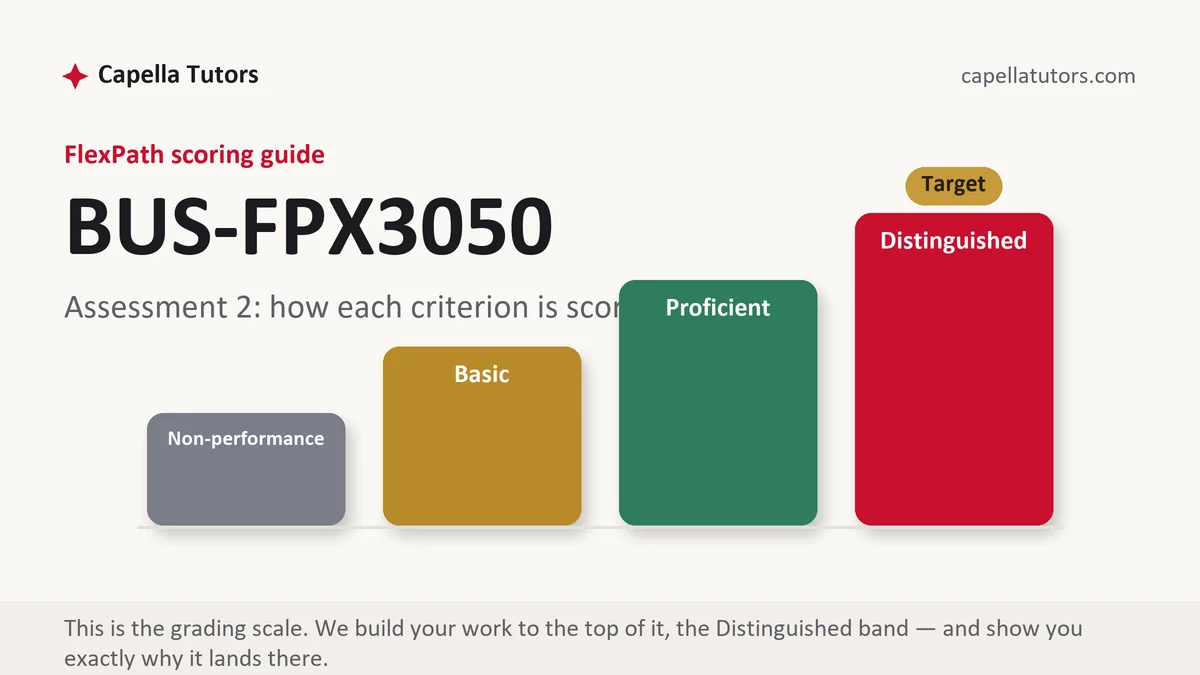
How BUS FPX 3050 Assessment 2 is scored
Each criterion in FlexPath lands on one of four levels, and no letter grade is issued at any stage. The level text is the specification:
| Level | What it means on a produced artifact |
|---|---|
| Distinguished | A document that stands unaided, showing what is wanted, why, and by when inside the opening screen, plus an analysis grounding every channel choice in richness and permanence. The first screen is where the level gets decided. |
| Proficient | A competent document for the right audience, with the design choices explained after the fact rather than argued. |
| Basic | An artifact aimed at the evaluator rather than at the reader the scenario names, opening on academic framing a shift supervisor abandons in one line. |
| Non-performance | The artifact the prompt asked for is missing, or it addresses an audience the scenario does not contain. |
Read the verb in the prompt and obey it literally. Create, draft, and prepare mean the document is the deliverable; analyze and evaluate mean the essay is. Many prompts want both, and the safe order is the finished artifact first, followed by the section defending every choice inside it.
The BUS FPX 3050 Assessment 2 method, step by step
-
Outline from the guide and find the verb
Turn each criterion into a heading, then read the prompt for the verb that says what has to exist at the end. Produce that thing first, in full, and write the analysis around it afterwards rather than the other way round.
-
Write down the audience's first objection
Before drafting a line, finish the sentence: the first thing this audience will think is ___. Whatever fills that blank goes into the opening paragraph of the artifact, answered, because an unanswered objection is what stops people reading.
-
Choose the channel on richness and permanence
Rich channels carry tone and allow correction, and suit ambiguous or loaded messages. Lean channels hold detail exactly and leave something on file, which fits anything every person has to receive in the same words. Say which property this message needs more, then sequence the channels rather than picking one.
-
Put the decision in the subject line
The subject line is the only part guaranteed to be read. It should carry the decision and, where the audience has something at stake, the reassurance, so that a reader who never opens the message still holds the right information.
-
Cost one thing, because almost nobody does
Attendees times hours times a loaded hourly rate turns a format choice into a budget argument, and comparing two delivery formats on paid time is a calculation the criteria will reward. Then say what has to be true for the saving to be real.
-
Attach a measure, then self-score
Name what would be counted, from what baseline, over what window, and add the result that would tell you the message failed. Then read the artifact aloud, mark the draft against each criterion, and revise anything short of the top column.
A structure that maps to the criteria
Targets below are our tutors' planning figures for an artifact deliverable, not Capella rules. The artifact itself should be as long as its audience needs and no longer.
| Section | What it must do | Guide |
|---|---|---|
| Situation and audiences | The setting, the message needing to travel, and every audience with what it risks and what it will say first. | ~250 words |
| The artifact | The memo, briefing, or script itself, formatted for the named audience and able to stand alone. | ~300 words |
| Channel justification | Richness, permanence, sequence, and why this audience needs this route in this order. | ~250 words |
| Structure justification | Why the subject line, the opening, and the ask are arranged the way they are. | ~200 words |
| Cost and measurement | The paid time a format consumes, the measure that will be tracked, and its baseline. | ~200 words |
| Ethics and references | What is withheld and on what stated ground, with current APA both ways. | ~150 words |
Annotated sample excerpt
An original excerpt from our team, written as the artifact itself for a three-store boutique retailer announcing an online pilot to floor staff who assume it threatens their hours.
Subject: The online pilot starts 14 September, and your floor hours are not changing.1 From 14 September, Verity and Vine will list about 300 of our 2,400 items on a trial web store, packed from the Rosewood stockroom by two people already on payroll and already on their current schedules. No store hours change, no floor rosters change, and no headcount changes during the pilot.2 Two things are being asked of you this week. Flag any item you think sells better online than it does on the floor, and send Priya one sentence on the question customers ask you most about buying from us at home. Both by Friday 5 September.3
- 1The subject line carries the decision and the reassurance together, so a reader who never opens the message still leaves with the fact that matters most to them.
- 2The objection is answered in the first paragraph, in three short parallel clauses, before it has a chance to organize itself into a rumor.
- 3The ask is specific, addressed to a named person, and dated, which is the difference between a memo and an announcement.
The full premium sample for your exact assessment, written fresh to your scoring guide and issue, is free to request. Study it, revise it into your own voice, and submit work you understand.
The five mistakes that cost Distinguished
- An essay submitted where a memo was requested. The verb in the prompt decides what has to exist, and a graceful analysis does not satisfy create.
- An artifact addressed to the grader. Academic framing in the opening line tells the real audience this was not written for them.
- A subject line that names a topic. Update on the online channel carries no decision and no reassurance, so nothing survives an unopened message.
- Channel chosen on preference. Argue it from how much the route carries and how long it lasts, and put both halves in the justification.
- An ask with no owner and no date. Requests that name nobody and nothing arrive nowhere.
Pre-submission checklist
- The prompt's verb identified and the artifact it demands actually produced
- The audience's first objection written down, then answered in the opening paragraph
- A subject line carrying the decision, and the reassurance where one is needed
- Channel choice justified on richness and permanence, with a sequence
- One format decision costed in paid hours, with the condition for the saving stated
- A measure, a baseline, a window, and the result that would signal failure
Memo or briefing due?
Send the scenario, the audience, and the criteria. We write the artifact for the people who actually have to read it, then the analysis that defends every choice in it. The first premium sample is yours free.