This manual is for BUS FPX 3050 Assessment 1, start to submission. Communication, Ethics, and a Command Decision asks you to analyze a real leadership scenario in which a commander or executive had to communicate under pressure, such as a captain reporting a disease outbreak on a ship: Part 1 analyzes the ethical communication issues, the audiences and the choices made; Part 2 asks you to write the public communication the situation required. The grade turns on ethical reasoning about communication. Retelling the event scores lower than analyzing who needed what information, what duties conflicted, and how the message should be framed. Below is the method our tutors use, a structure that maps to the criteria, and an annotated sample excerpt. Prefer to hand it off? A premium original sample for this exact assessment comes back in 24 to 48 hours, revised free until it meets the guide. Capella's catalog lists the course as BUS-FPX3050, and some courserooms print BUS3050; both point to this same Assessment 1. In current courserooms this assessment typically appears as "Communication, Ethics, and a Command Decision".
One honesty note before the manual: Capella revises courses and scoring guides over time, so always write to the exact scoring guide attached to your assessment in the courseroom. The course identity above is verified on capella.edu; the method and structure below are our tutors' approach to it, not Capella's official rubric text.
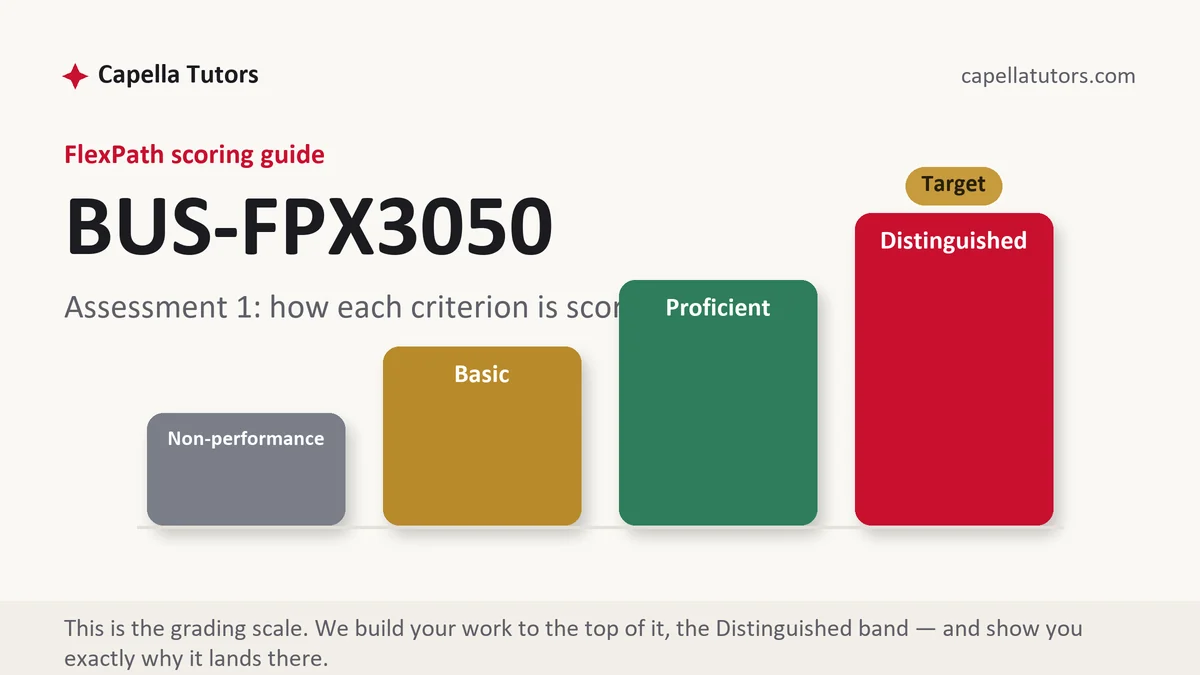
How BUS FPX 3050 Assessment 1 is scored
FlexPath does not use letter grades. Each criterion in the scoring guide lands on one of four levels, and the level descriptions are the real writing brief:
| Level | What it means on an ethics and communication analysis |
|---|---|
| Distinguished | The scenario is summarized accurately, ethical issues and competing duties are analyzed, audiences and channels are considered, and the public communication is clear, honest and suited to its readers. |
| Proficient | The analysis is accurate, but the communication piece is general. |
| Basic | The paper retells the scenario with little analysis. |
| Non-performance | Part 1 or Part 2 is missing. |
Use the scenario your courseroom provides and complete both parts.
The BUS FPX 3050 Assessment 1 method, step by step
-
Summarize the scenario
What happened and the decision the leader faced.
-
Identify the ethical issues
Duty to the crew or employees, chain of command, public safety and transparency.
-
Analyze the communication choices
Who was told what, through which channels, and the consequences.
-
Apply ethical frameworks
Duties, consequences or principles of ethical communication.
-
Write the public communication
A clear, honest statement for the public.
-
Check tone and accuracy
No speculation, clear next steps.
A structure that maps to the criteria
Word counts are planning targets our tutors use, not Capella rules; follow the length and format your scoring guide states.
| Section | What it must do | Guide |
|---|---|---|
| Part 1: analysis of the scenario | Ethical issues and choices. | ~300 words |
| Part 2: public communication | The statement. | ~200 words |
| References | Sources. | as needed |
Annotated sample excerpt
An original model excerpt from our team, written to show the register that reaches the top of the guide. Learn the moves, then write your own version.
The captain faced two duties that pulled in opposite directions: to follow the chain of command, which favored waiting for superiors to act, and to protect the crew, which demanded that the outbreak be addressed at once.1 By sending his concerns in an email that copied people outside his direct chain, he chose speed and safety over procedure, and the message later reached the press.2 The ethical question is less whether he was right to raise the alarm than whether a more controlled channel existed that would have protected both the crew and the command's ability to respond.3
- 1Identifies the competing duties.
- 2Analyzes the communication choice and its consequence.
- 3Frames the ethical question precisely.
The full premium sample for your exact assessment, written fresh to your scoring guide and topic, is free to request. Study it, revise it into your own voice, and submit work you understand.
The five mistakes that cost Distinguished
- Retelling the event. Analyze the ethics.
- One duty only. Show the conflict.
- Skipping Part 2. Write the public communication.
- Speculation in the statement. Stick to verified facts.
- No sources. Cite reports of the event.
Pre-submission checklist
- Scenario summarized
- Ethical issues analyzed
- Communication choices evaluated
- Frameworks applied
- Public communication written
- References
Want the communication ethics analysis written?
Send the scoring guide and any materials from your courseroom. Our team returns a premium original communication ethics analysis in 24 to 48 hours, revised free until it meets the guide.