This manual is for BUS FPX 3050 Assessment 3, start to submission. Communicating a Team Contract Video Script asks you to write the script for a short video in which you, as a leader, present a team contract to your team: why the contract exists, the expectations it sets for communication, collaboration, decision making and conflict, and how the team will hold itself accountable. The grade turns on communicating for the medium. A script that sounds natural when spoken, and makes each expectation concrete, scores above a document read aloud. Below is the method our tutors use, a structure that maps to the criteria, and an annotated sample excerpt. Prefer to hand it off? A premium original sample for this exact assessment comes back in 24 to 48 hours, revised free until it meets the guide. Capella's catalog lists the course as BUS-FPX3050, and some courserooms print BUS3050; both point to this same Assessment 3. In current courserooms this assessment typically appears as "Communicating a Team Contract Video Script".
One honesty note before the manual: Capella revises courses and scoring guides over time, so always write to the exact scoring guide attached to your assessment in the courseroom. The course identity above is verified on capella.edu; the method and structure below are our tutors' approach to it, not Capella's official rubric text.
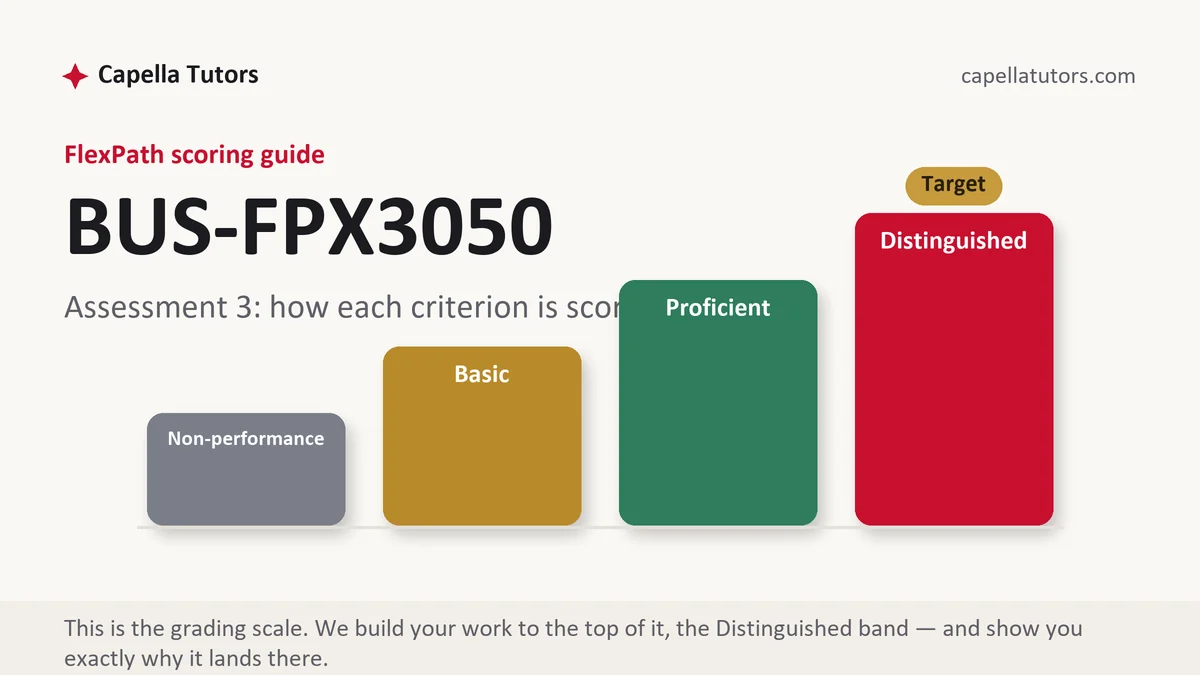
How BUS FPX 3050 Assessment 3 is scored
FlexPath does not use letter grades. Each criterion in the scoring guide lands on one of four levels, and the level descriptions are the real writing brief:
| Level | What it means on a team contract video script |
|---|---|
| Distinguished | The script is conversational and suited to video, the purpose of the contract is clear, expectations are specific, accountability is addressed, and the tone builds commitment. |
| Proficient | The script is complete, but some expectations are vague. |
| Basic | The script reads like a written document. |
| Non-performance | The contract expectations or accountability are missing. |
Check the time limit for the video in your courseroom and write to that length.
The BUS FPX 3050 Assessment 3 method, step by step
-
Open personally
Why you are addressing the team on video.
-
Explain the purpose
What the contract is for.
-
Set communication norms
Channels, response times, meetings.
-
Set collaboration and decision norms
How decisions are made and shared.
-
Address conflict and accountability
How disagreements are raised and commitments checked.
-
Close with commitment
Ask for agreement and next steps.
A structure that maps to the criteria
Word counts are planning targets our tutors use for a script; follow the time limit your courseroom sets.
| Section | What it must do | Guide |
|---|---|---|
| Opening | Personal address and purpose. | ~75 words |
| Contract expectations | Communication, collaboration and decisions. | ~250 words |
| Conflict and accountability | How the team stays on track. | ~125 words |
| Closing | Commitment and next steps. | ~75 words |
Annotated sample excerpt
An original model excerpt from our team, written to show the register that reaches the top of the guide. Learn the moves, then write your own version.
Here's what I'm asking of all of us when it comes to communication.1 If something is urgent, call or message directly, and if it can wait a day, put it in the team channel so everyone sees it; and let's agree to answer team messages within one working day, even if the answer is just that you're working on it.2 That way nobody is left guessing, and we spend our meetings deciding things instead of catching up.3
- 1Speaks naturally, as in a video.
- 2Makes the norms specific and easy to follow.
- 3Explains the benefit to the team.
The full premium sample for your exact assessment, written fresh to your scoring guide and topic, is free to request. Study it, revise it into your own voice, and submit work you understand.
The five mistakes that cost Distinguished
- Reading a document aloud. Write for speech.
- Vague expectations. Make each one concrete.
- No accountability. Explain how commitments are checked.
- Too long. Respect the time limit.
- No call to action. Ask for commitment.
Pre-submission checklist
- Conversational script
- Purpose explained
- Specific expectations
- Conflict and accountability
- Within the time limit
- Commitment requested
Want the team contract script written?
Send the scoring guide and any materials from your courseroom. Our team returns a premium original team contract script in 24 to 48 hours, revised free until it meets the guide.