This manual is for BUS FPX 2062 Assessment 2, start to submission. Assessment 2 in BUS FPX 2062, Finance Fundamentals, usually moves from single calculations to the way cash behaves across a year. The assessment typically gives you a business whose money arrives unevenly and asks how much it needs, when it needs it, and what it should do about the gap. The criteria want a cash position computed month by month, a working capital measure with a comparison attached, and a break-even saying how much volume the plan requires. Hand it over instead and an original premium sample is with you inside 24 to 48 hours, revised at no charge until your criteria are cleared. Capella's catalog lists the course as BUS-FPX2062, and some courserooms print BUS2062; both point to this same Assessment 2.
One honesty note before the manual: Capella revises courses and scoring guides over time, so always write to the exact scoring guide attached to your assessment in the courseroom. The course identity above is verified on capella.edu; the method and structure below are our tutors' approach to it, not Capella's official rubric text.
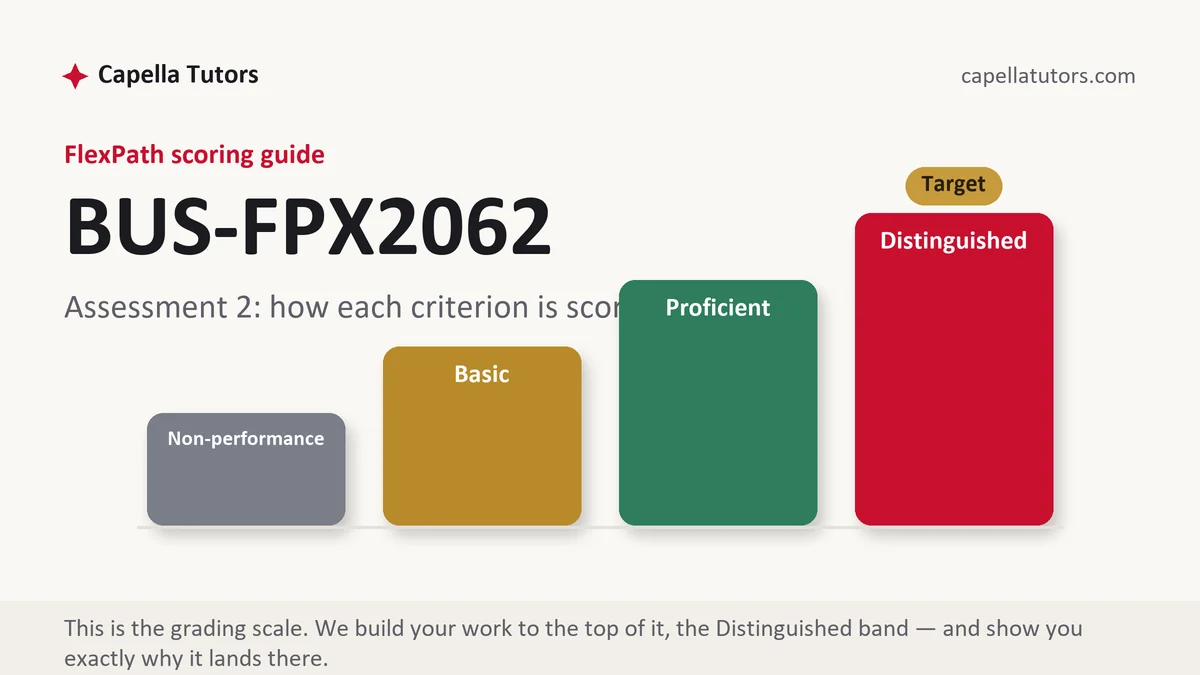
How BUS FPX 2062 Assessment 2 is scored
Criteria in this course are graded by description, so read them as instructions. Each one lands at a level, and the top description is where the extra move is always written down:
| Level | What it means on a working capital and cash flow deliverable |
|---|---|
| Distinguished | Cash projected by month rather than by year, the deepest point identified with its date, a break-even computed on contribution, and financing sized to the actual gap instead of rounded up. |
| Proficient | Cash flow projected accurately and the shortfall identified, with the measures correctly computed. Complete, and it stops before sizing the answer. |
| Basic | An annual total showing a profitable year and no month-by-month view, so the shortfall never appears at all. Extremely common on seasonal scenarios. |
| Non-performance | No projection, or a working capital measure quoted with nothing to compare it against, which leaves the criterion without an object. |
Profit and cash are different questions, and a seasonal business is where the difference becomes visible. A year that ends with net income can still run out of money in February, so a criterion asking about liquidity is asking for a month-by-month view rather than a stronger version of the income statement.
The BUS FPX 2062 Assessment 2 method, step by step
-
Project cash by month, not by year
Build twelve columns carrying receipts, payments, opening balance, and closing balance. An annual summary hides the exact thing the assessment is testing, and a criterion about timing cannot be answered from a total.
-
Separate the sale from the collection
Revenue is recorded when it is earned and cash arrives when the customer pays, so shift receipts by the terms your scenario gives you. A business collecting in thirty days has a month of work sitting outside its bank account at all times.
-
Compute the cash conversion cycle
Days of inventory plus days of receivables minus days of payables, in that order, with the arithmetic in the body. The result is a number of days the business is funding itself, and it explains the shortfall better than any adjective.
-
Find the trough and the date it happens
Read down the closing balance row and name the lowest point and the month it falls in. That figure, not the annual total, is what any borrowing has to cover, and stating it with its date is what the top column usually describes.
-
Break the off-season offering even
Fixed costs divided by contribution per unit gives the volume that has to sell before anything is earned. Show the division, then say whether the scenario makes that volume plausible, because a break-even nobody assesses for realism is only arithmetic.
-
Size the financing to the gap, then self-score
Match the instrument to the shape of the need: a line of credit for a trough that reverses, term debt for something that does not. Say what it costs for the months it is drawn. Then mark your draft against the guide criterion by criterion and lift anything under the top level.
A structure that maps to the criteria
Sizes below are the planning targets our tutors use on a cash flow deliverable, not Capella rules; a criterion asking for a full twelve-month exhibit will take the space it needs.
| Section | What it must do | Guide |
|---|---|---|
| The question and the answer | What the business needs to know about its cash, and the answer with the figure that drives it. | ~130 words |
| Assumptions | Volumes, prices, collection terms, payment terms, and fixed costs, each with its origin. | ~200 words |
| Monthly cash projection | Receipts, payments, and closing balance for every month, with the trough marked. | table plus ~250 words |
| Working capital measures | The cash conversion cycle and a liquidity measure, each with a comparison. | ~250 words |
| Break-even and the off-season | Fixed costs over contribution per unit, and whether the required volume is realistic. | ~250 words |
| Financing, sources, format | The instrument, the amount, what it costs while drawn, and current APA sourcing. | ~200 words |
Annotated sample excerpt
One original excerpt from our team, showing a seasonal shortfall sized rather than described. Use the shape of the reasoning and supply your own figures.
Blue Ledge Pool Service earned $61,000 on $840,000 of revenue and still cannot pay its bills in March, because overhead of $34,000 a month runs all twelve months while receipts from November through March average about $9,000.1 Those five months therefore consume $25,000 of cash each, or $125,000 in total, and against an opening balance of $71,000 on the first of November the closing position bottoms out at negative $54,000 in late March, which is the figure any financing has to cover rather than the annual profit.2 A winter cover-and-inspection package priced at $260 against $95 of variable cost contributes $165, so closing even half the $125,000 gap takes 379 packages, and 379 sales against an account base of 610 means 62 percent of every customer buying one, which is not a plausible winter, so the honest recommendation is a $75,000 line of credit costing roughly $1,270 in interest across the five months it is drawn, with the package sized to reduce the draw rather than replace it.3
- 1Opens on the contradiction between a profitable year and an empty account, which is the point of the deliverable, and gives both figures immediately.
- 2Multiplies the monthly gap out, carries it against an opening balance, and names the trough with its month. That figure is what the financing question is really about.
- 3Tests the operating fix with a break-even, rejects it on the arithmetic rather than on instinct, and prices the alternative. Rejecting your own idea with numbers is the move the top column describes.
The full premium sample for your exact assessment, written fresh to your scoring guide and issue, is free to request. Study it, revise it into your own voice, and submit work you understand.
The five mistakes that cost Distinguished
- An annual projection where a monthly one belongs. A total for the year cannot show a shortfall that opens in February and closes in June, and the timing is what the criterion is about.
- Sales treated as receipts. Cash arrives when the customer pays, and a projection ignoring collection terms is an income statement under a different heading.
- A shortfall described instead of sized. The deepest closing balance and the month it falls in are two facts, and financing sized without them is a guess.
- Break-even computed on price. Fixed costs divide by contribution per unit, and using price instead understates the volume required by whatever the variable cost is.
- Financing named without a cost. A line of credit has a rate and a period drawn, and multiplying the two takes one line and answers a criterion on its own.
Pre-submission checklist
- Twelve monthly columns with opening and closing cash in each
- Receipts shifted for collection terms and payments shifted for supplier terms
- The cash conversion cycle computed in the body with its three components
- The trough named with its month and used to size any borrowing
- Break-even computed on contribution per unit and assessed for realism
- The instrument, the amount, and the interest cost while drawn, in current APA
Cash flow projection due and the months will not add up?
Send the scenario figures, the terms your prompt gives, and the criteria. The sample comes back with twelve months projected, the trough named, and the break-even shown on contribution, with a second reader rebuilding every column. Turnaround stays inside 24 to 48 hours, and revisions run free until the criteria are satisfied.