This manual is for BUS FPX 2062 Assessment 3, start to submission. Assessment 3 in BUS FPX 2062, Finance Fundamentals, is usually the deliverable where the arithmetic has to end in a decision somebody will act on. The assessment typically presents a firm with two ways to pay for something and asks which one it should choose and why. Criteria at this stage want the cost of each option expressed on the same basis, a recommendation stated in the opening paragraph, and the threshold at which the answer reverses. Prefer to hand it off? An original premium sample comes back within 24 to 48 hours and keeps being revised, at no charge, until the guide is met. Capella's catalog lists the course as BUS-FPX2062, and some courserooms print BUS2062; both point to this same Assessment 3.
One honesty note before the manual: Capella revises courses and scoring guides over time, so always write to the exact scoring guide attached to your assessment in the courseroom. The course identity above is verified on capella.edu; the method and structure below are our tutors' approach to it, not Capella's official rubric text.
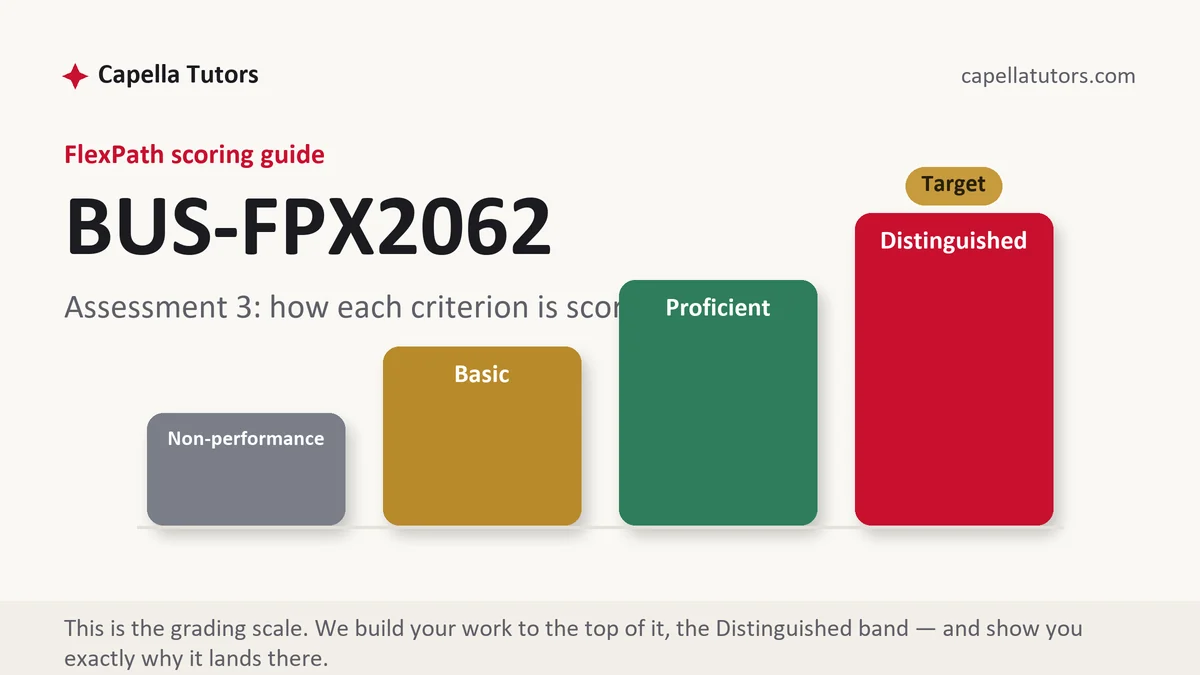
How BUS FPX 2062 Assessment 3 is scored
Nothing in this course is averaged. Each criterion is placed at one of four levels on its own, so a paper can sit at the top on the arithmetic and at the bottom on the recommendation:
| Level | What it means on a financing decision deliverable |
|---|---|
| Distinguished | Both options converted to an annualized cost on the same basis, the verdict in the opening paragraph, the reversal point stated as a rate, and the risk the recommendation carries named. |
| Proficient | Both options costed correctly and a recommendation given with support. Right, and without the threshold and the risk that reach the top. |
| Basic | The two options described, the cheaper one preferred on the strength of its headline rate, and no common basis established. Where most first drafts land. |
| Non-performance | One option never costed, or a recommendation offered with no calculation behind it, which caps the criterion whatever the prose does. |
Comparability is the criterion behind the criterion. A discount expressed as a percentage of an invoice and a loan expressed as an annual rate are not comparable until both are annualized, and doing that conversion explicitly is usually the highest-value paragraph in this deliverable.
The BUS FPX 2062 Assessment 3 method, step by step
-
State the decision and the verdict in the first paragraph
An executive reader wants the answer and the number driving it before the method. Put both up front, then spend the rest of the paper earning them. A memo that withholds the recommendation until the last page has answered the criteria in the wrong order.
-
Put both options on one basis
Convert every cost to an annualized percentage before comparing anything. Fees, discounts, and terms all become rates, and the paragraph doing that conversion is where a reader sees whether you understand the question.
-
Include the costs that are easy to leave out
Commitment fees on an unused facility, the working capital tied up by longer terms, the discount forgone by paying late. A comparison of the two headline numbers alone misses whichever cost the prompt buried.
-
Show the arithmetic once, in the body
Give the formula, run it for the first option, then present the second in the same shape so the two can be read side by side. An appendix protects nobody, and a criterion asking for reproducible work means work in the text.
-
Find the rate at which the answer flips
Say what the firm's borrowing rate would have to be for the other option to win. A threshold is more useful than a verdict, because it tells the reader how much room the decision has, and it is usually written into the top column in some form.
-
Name what the recommendation risks, then self-score
Every financing choice buys something and gives something up, whether that is flexibility, a supplier relationship, or headroom on a facility. One paragraph. Then mark the draft against the guide yourself and rewrite anything below the top level.
A structure that maps to the criteria
The sizes below are how our tutors budget a financing decision memo, not a Capella requirement; a guide separating calculation from recommendation deserves more room in sections three and five.
| Section | What it must do | Guide |
|---|---|---|
| Decision and recommendation | The choice being made, the options available, and the answer with the figure behind it. | ~150 words |
| Assumptions and inputs | Terms, rates, fees, volumes, and the source and date of each external figure. | ~200 words |
| Cost of the first option | The arithmetic converting it to an annualized cost, shown in the text. | ~250 words |
| Cost of the second option | The same conversion for the alternative, in the same shape so the two compare. | ~250 words |
| Comparison, threshold, and risk | The two costs side by side, the rate at which the answer reverses, and what the choice risks. | ~350 words |
| Conclusion, sources, format | The decision restated with its condition, every rate dated, in current APA. | ~150 words |
Annotated sample excerpt
An original excerpt from our team showing two financing options converted to the same basis and a threshold stated. Take the method and run it on the terms your own prompt supplies.
Harvest Lane Market buys $180,000 a month on terms of 2/10 net 30, and the question is whether to pay on day 10 with borrowed money or on day 30 and let the discount go.1 Forgoing a 2 percent discount to keep the money 20 extra days costs 2 divided by 98, or 2.04 percent for those 20 days, which annualizes to 37.2 percent once it is multiplied by the 18.25 twenty-day periods in a year, while the co-op's line of credit costs 9.25 percent, so the two options are not close on a common basis.2 In dollars, borrowing the discounted $176,400 for 20 days at 9.25 percent costs $894 against a discount worth $3,600, a net gain of $2,706 a month or about $32,500 a year, and the answer only reverses if borrowing were to cost more than roughly 37 percent, so the recommendation is to draw on the line and pay early, accepting that the facility then carries less headroom for the seasonal purchasing the co-op does in the autumn.3
- 1States the decision in one sentence with the terms inside it, so a reader who knows the subject can predict what the next paragraph has to do.
- 2Does the annualization out loud, in the text, rather than quoting a rule of thumb. The clause naming the number of periods is what makes the 37.2 percent checkable.
- 3Converts the percentages back into dollars, states the reversal threshold, and names what the recommendation gives up. Three moves, one paragraph, and a criterion answered for each.
The full premium sample for your exact assessment, written fresh to your scoring guide and issue, is free to request. Study it, revise it into your own voice, and submit work you understand.
The five mistakes that cost Distinguished
- Percentages compared over different lengths of time. Two percent for twenty days and nine percent for a year are not comparable, and a paper that fails to annualize has answered a different question.
- The headline rate treated as the whole cost. Fees, unused-facility charges, and the working capital a longer term ties up all belong in the comparison the criterion asks for.
- Arithmetic exiled to an appendix. Work a reader has to go looking for is work the criterion cannot credit, and the calculation belongs where the argument is.
- A verdict with no reversal point. Naming the rate at which the other option wins tells the reader how much room the decision has, and it takes one sentence.
- A recommendation that gives up nothing. Every financing choice costs flexibility somewhere, and a memo reporting only upside reads as advocacy rather than analysis.
Pre-submission checklist
- The recommendation and its driving figure in the opening paragraph
- Both options converted to an annualized cost on the same basis, in the text
- Fees, forgone discounts, and tied-up working capital included, not only headline rates
- The comparison also expressed in dollars for the period the prompt covers
- The rate or threshold at which the answer reverses, stated plainly
- What the recommendation risks, and every rate dated in current APA
Financing memo due and the two options will not compare?
Send the terms, the rates your prompt supplies, and the scoring guide. The memo comes back with both options annualized in the text, the verdict in the first paragraph, and the reversal threshold stated, after a reviewer has rebuilt the arithmetic independently. Delivery holds at 24 to 48 hours with free revision until the guide is met.