This manual is for BUS FPX 2062 Assessment 1, start to submission. In current courserooms, Assessment 1 of Finance Fundamentals is a midpoint exam of problems and short-answer questions: calculating required returns from risk premiums, the responsibilities of a chief financial officer, how financial markets and economic factors affect firms, time value of money calculations and related concepts from the first half of the course. The grade turns on correct calculations and clear explanations. Show your work and explain what each answer means. Below is the method our tutors use, a structure that maps to the criteria, and an annotated sample excerpt. Prefer to hand it off? A premium original sample for this exact assessment comes back in 24 to 48 hours, revised free until it meets the guide. Capella's catalog lists the course as BUS-FPX2062, and some courserooms print BUS2062; both point to this same Assessment 1. In current courserooms this assessment typically appears as "Midpoint Exam".
One honesty note before the manual: Capella revises courses and scoring guides over time, so always write to the exact scoring guide attached to your assessment in the courseroom. The course identity above is verified on capella.edu; the method and structure below are our tutors' approach to it, not Capella's official rubric text.
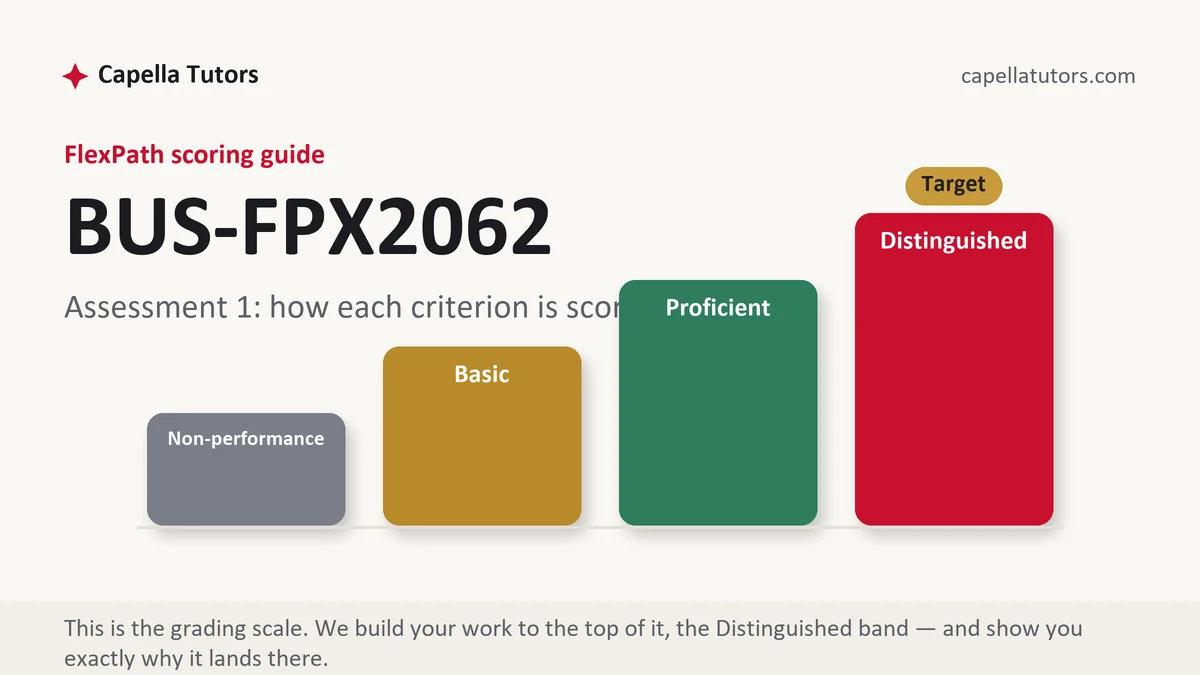
How BUS FPX 2062 Assessment 1 is scored
FlexPath does not use letter grades. Each criterion in the scoring guide lands on one of four levels, and the level descriptions are the real writing brief:
| Level | What it means on the midpoint exam |
|---|---|
| Distinguished | Every problem is solved correctly with work shown, short answers are accurate and specific, and results are interpreted in plain language. |
| Proficient | Most answers are correct, but some explanations are thin. |
| Basic | Several calculations are wrong or unexplained. |
| Non-performance | Questions are unanswered. |
Answer every question in the exam document and show formulas or calculator steps.
The BUS FPX 2062 Assessment 1 method, step by step
-
Read every question first
Note which are calculations and which are short answers.
-
Build required returns
Add the risk-free rate, inflation premium and risk premiums as the question sets them out.
-
Explain the CFO's role
Planning, capital structure, investment decisions and reporting.
-
Solve time value problems
Present and future value with the correct periods and rates.
-
Explain market concepts
How interest rates and economic conditions affect firms.
-
Check and interpret
Verify each answer and say what it means.
A structure that maps to the criteria
The exam document in your courseroom sets the questions; answer every part.
| Section | What it must do | Guide |
|---|---|---|
| Calculation questions | Work shown. | exam document |
| Short-answer questions | Specific explanations. | exam document |
| References | If required. | as needed |
Annotated sample excerpt
An original model excerpt from our team, written to show the register that reaches the top of the guide. Learn the moves, then write your own version.
The required return on the security is the sum of its components: a real risk-free rate, an inflation premium of 2.10 percent, a default risk premium of 3.25 percent, and any liquidity or maturity premiums the question gives.1 Adding them in that order makes the calculation transparent, and each premium compensates the investor for a specific risk.2 If the answer comes to about 9 percent, that is the minimum return an investor should accept for holding this security rather than a risk-free bond.3
- 1Shows the components of the calculation.
- 2Explains why each premium exists.
- 3Interprets the result.
The full premium sample for your exact assessment, written fresh to your scoring guide and topic, is free to request. Study it, revise it into your own voice, and submit work you understand.
The five mistakes that cost Distinguished
- No work shown. Show every step.
- Wrong periods or rates. Match them in time value problems.
- Vague short answers. Be specific.
- Results without meaning. Interpret each answer.
- Skipping questions. Answer every one.
Pre-submission checklist
- Every question answered
- Calculations correct with work
- Short answers specific
- Results interpreted
- Exam document used
- References if required
Want the midpoint exam answers written?
Send the scoring guide and any materials from your courseroom. Our team returns a premium original midpoint exam answers in 24 to 48 hours, revised free until it meets the guide.