This manual is for BUS-FPX2061 Assessment 2, start to submission. Assessment 2 in BUS-FPX2061, Accounting Fundamentals, is usually where cash accounting and accrual accounting stop agreeing. The assessment typically gives you an unadjusted trial balance or a scenario carrying items earned or incurred but not yet paid, and asks for the adjustments and the statements that follow from them. The criteria want each adjustment tied to the concept requiring it and traced onto both statements it touches, with the four statements articulating rather than merely appearing. Prefer to hand it off? A premium original sample arrives in 24 to 48 hours with free revision until it clears the guide. Your courseroom may print this as BUS FPX 2061 Assessment 2 or BUS2061 Assessment 2; it is the same deliverable, and BUS-FPX2061 Assessment 2 is what this manual walks through.
One honesty note before the manual: Capella revises courses and scoring guides over time, so always write to the exact scoring guide attached to your assessment in the courseroom. The course identity above is verified on capella.edu; the method and structure below are our tutors' approach to it, not Capella's official rubric text.
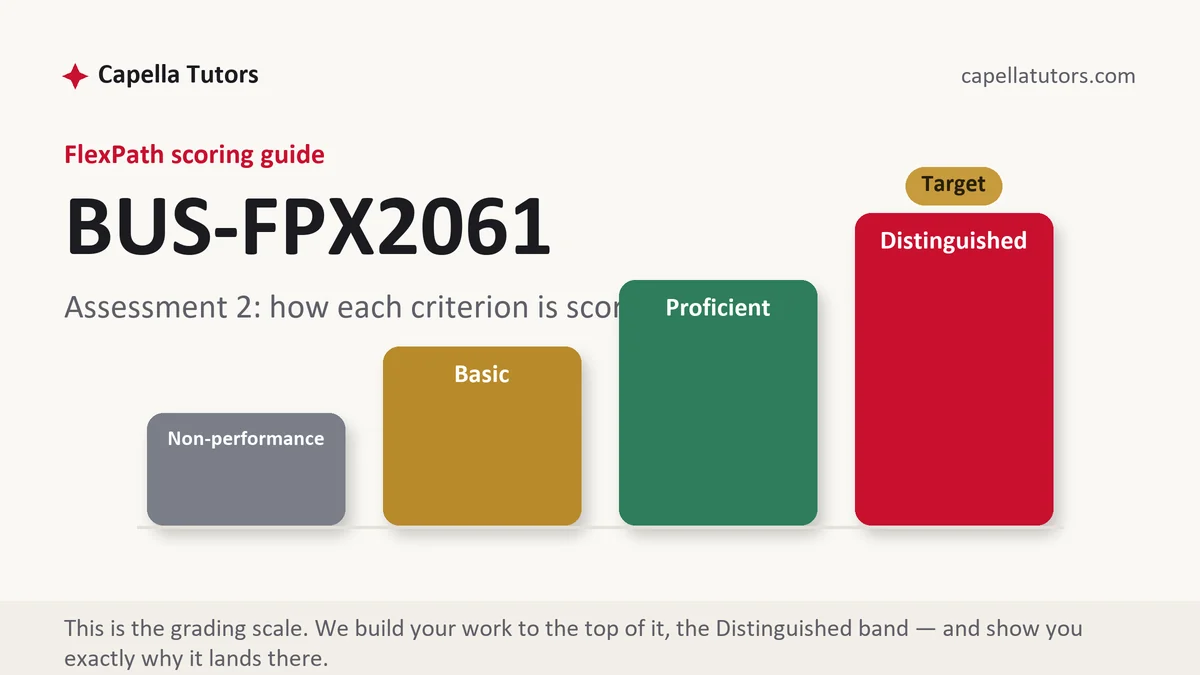
How BUS-FPX2061 Assessment 2 is scored
Everything is scored by description in FlexPath. Your evaluator walks the criteria one at a time and picks the level your work matches, which makes the top description a checklist you can write against:
| Level | What it means on an adjusting entries and statements deliverable |
|---|---|
| Distinguished | Each adjustment named with the concept behind it, traced onto both statements it changes, the four statements shown to articulate, and the gap between the cash story and the accrual story stated in dollars. |
| Proficient | The adjustments recorded correctly and the statements prepared accurately from them. Right, and it never says out loud what the adjustments did to the month. |
| Basic | Some adjustments made, others missed, and statements that look finished until net income is traced. Where most first submissions land. |
| Non-performance | No adjustments appear at all, so the statements report what the bank account did and nothing about the period the heading claims. |
The joins between the statements are worth checking first and last. Net income leaves the income statement and enters retained earnings, that ending figure appears on the balance sheet, and ending cash agrees with the cash line at the top of it. Breaking any one of those is visible in seconds to a reader who knows where to look.
The BUS-FPX2061 Assessment 2 method, step by step
-
Sort the unadjusted items into four buckets
Accrued revenue, accrued expense, prepaid expense expiring, and unearned revenue being earned. Every adjustment in a deliverable this size belongs to one of the four, and naming the bucket before writing the entry stops you guessing at accounts.
-
Write the concept beside each adjustment
Revenue recognized when it is earned, expense matched to the period that consumed it. One clause per adjustment referring to the concept is often what the criterion is literally asking for, and it costs nothing to include.
-
Trace every adjustment onto two statements
Each one changes an income statement line and a balance sheet line. Say which two. An adjustment recorded and never followed through is the most common reason a balance sheet stops balancing in this course.
-
Build the statements in order and carry the numbers
Income statement, then retained earnings, then balance sheet, then cash flow, using ending figures rather than opening ones. Done in that order the articulation happens on its own; done in any other order you will chase a difference for an hour.
-
Quantify the gap between cash and accrual
Add up what the period looks like on cash and what it looks like on accrual, then state the difference as a number. That one sentence demonstrates the concept the whole assessment is built on, and a definition of accrual accounting does not.
-
Run the balance check, then self-score
If the balance sheet is out, look for a one-sided adjustment first, then a prepaid or payable recorded twice, then check whether the amount you are out is exactly twice a figure in the ledger, which means an amount went to the wrong side. Then mark the draft against the guide yourself.
A structure that maps to the criteria
Section sizes below are our tutors' planning targets for an adjusting-entries deliverable, not Capella rules; the statements take what they take and the prose flexes around them.
| Section | What it must do | Guide |
|---|---|---|
| Period and unadjusted position | The business, the period, and the trial balance or scenario figures you are starting from. | ~150 words |
| The adjustments | Each adjustment as an entry, with the concept requiring it named beside it. | table plus ~300 words |
| Effect on the statements | The two lines each adjustment changes, and the direction of the change. | ~250 words |
| The four statements | Income statement, retained earnings, balance sheet, and cash flow prepared in that order. | tables plus ~200 words |
| Cash against accrual | The period on a cash basis, the period on an accrual basis, and the difference in dollars. | ~250 words |
| Interpretation, sources, format | What the adjusted statements let the owner conclude, referred to the standard, in current APA. | ~250 words |
Annotated sample excerpt
An original excerpt from our team showing two adjustments that arrive with their reasoning and their consequences attached. Use the shape, not the numbers.
Fifth Ward Workspace paid $9,600 in July for twelve months of insurance, so $800 of that policy expired during September whether or not anyone wrote a check, and the entry debits insurance expense $800 and credits prepaid insurance $800, which lowers September income and lowers an asset at the same time.1 The $7,200 collected in August for six-month desk memberships that began on the first of September is earned at $1,200 a month, so the adjustment moves $1,200 out of unearned revenue and into membership revenue, leaving $6,000 still owed as space the members have paid for and not yet used.2 Together the two entries raise September revenue by $1,200 and September expense by $800, a net $400 improvement to income that arrives without a dollar of cash changing hands, which is the distinction between the accrual month and the cash month stated in one figure.3
- 1Names the amount, the entry, and both lines it moves. The clause about the check is the concept being demonstrated rather than defined.
- 2Converts the liability at a rate the reader can verify and states what is left behind. That remaining balance is a figure the balance sheet needs and most drafts never mention.
- 3Adds the two effects, reports the net, and says what the net means. Ending on the cash comparison answers the criterion the assessment is built around.
The full premium sample for your exact assessment, written fresh to your scoring guide and issue, is free to request. Study it, revise it into your own voice, and submit work you understand.
The five mistakes that cost Distinguished
- An adjustment recorded on one side only. A debit with no matching credit is the single most common reason a balance sheet in this course refuses to balance.
- Statements prepared out of order. Building the balance sheet before retained earnings means carrying a figure you have not computed yet, and the hour that follows is spent hunting a difference you created.
- Net income that never reaches equity. Income has to be closed into retained earnings and the ending figure has to appear on the balance sheet, or the set stops describing one business.
- Concepts defined instead of demonstrated. A paragraph explaining what accrual accounting means earns less than one entry shown with its two effects and its dollar consequence.
- A prepaid expired for the wrong number of months. Count the months the period actually consumed, since a policy bought mid-year expires for part of the first period and drafts routinely charge a full year or a full month out of habit.
Pre-submission checklist
- Every unadjusted item sorted into accrual, prepaid, unearned, or depreciation
- Each adjustment carrying the concept that requires it in the same line
- Both statement lines named for every adjustment, with the direction of the change
- Statements built in order, income closed to retained earnings, ending cash agreeing
- The cash-basis and accrual-basis pictures compared with a number
- Units and period stated, and any treatment referred to the standard in current APA
Adjustments due and the balance sheet is out?
Send the unadjusted trial balance or the scenario, plus the criteria. A reviewer on the file does nothing but rebuild the statements and confirm they articulate before anything reaches you. Premium original sample in 24 to 48 hours, free revision until the guide is met, and evaluator comments come back through the same route at no cost.