This manual is for BUS FPX 2061 Assessment 3, start to submission. Completing the Accounting Cycle asks you to finish the cycle through questions and problems: how revenues and expenses are reported under the cash and accrual bases, recording normal and adjusting entries with examples, book value and depreciation, extending account balances to the statements, the current ratio and trend analysis, and the correct order of the cycle's steps. The grade turns on accuracy. Correct adjusting entries and calculations, explained in plain language, score the top column. Below is the method our tutors use, a structure that maps to the criteria, and an annotated sample excerpt. Prefer to hand it off? A premium original sample for this exact assessment comes back in 24 to 48 hours, revised free until it meets the guide. Capella's catalog lists the course as BUS-FPX2061, and some courserooms print BUS2061; both point to this same Assessment 3. In current courserooms this assessment typically appears as "Completing the Accounting Cycle".
One honesty note before the manual: Capella revises courses and scoring guides over time, so always write to the exact scoring guide attached to your assessment in the courseroom. The course identity above is verified on capella.edu; the method and structure below are our tutors' approach to it, not Capella's official rubric text.
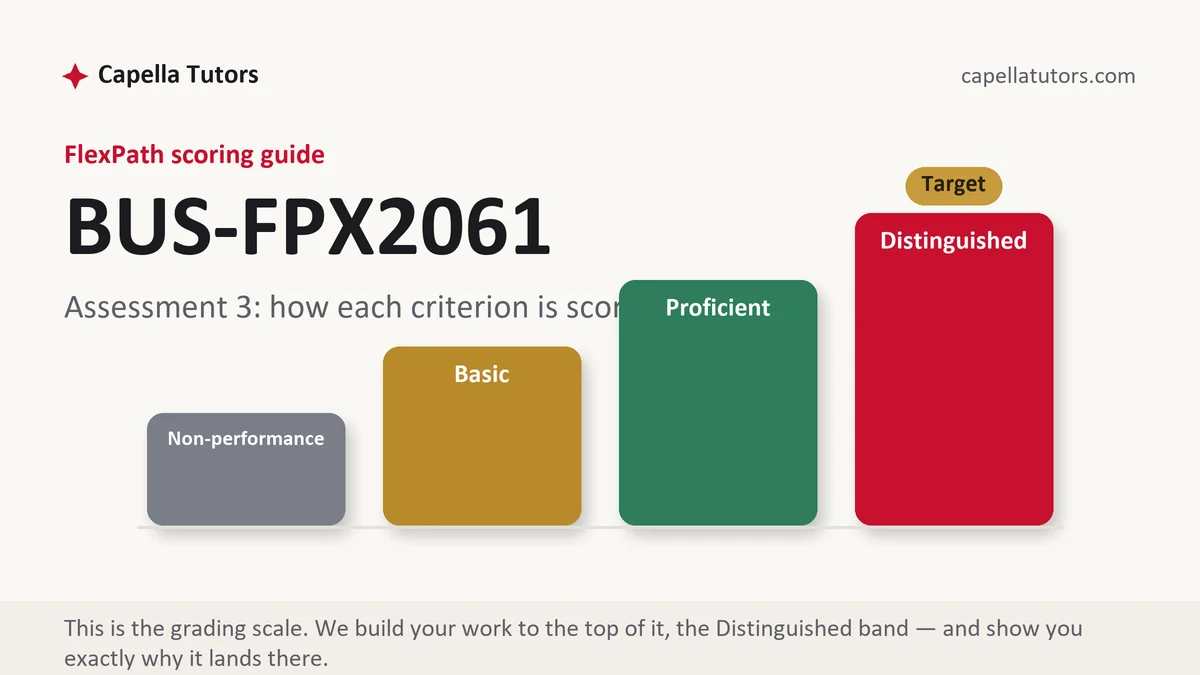
How BUS FPX 2061 Assessment 3 is scored
FlexPath does not use letter grades. Each criterion in the scoring guide lands on one of four levels, and the level descriptions are the real writing brief:
| Level | What it means on completing the accounting cycle |
|---|---|
| Distinguished | Cash and accrual reporting are contrasted correctly, adjusting entries are accurate with examples, depreciation and book value are calculated correctly, ratios are computed and interpreted, and the cycle is sequenced correctly. |
| Proficient | Answers are accurate, but interpretation is brief. |
| Basic | Some entries or calculations are wrong. |
| Non-performance | Questions are unanswered. |
Use the template and show calculations for depreciation and ratios.
The BUS FPX 2061 Assessment 3 method, step by step
-
Contrast cash and accrual
When revenue and expense are recognized under each.
-
Record adjusting entries
Accruals, deferrals and depreciation, with examples.
-
Calculate depreciation and book value
Cost minus accumulated depreciation.
-
Extend balances
Which accounts go to the income statement and which to the balance sheet.
-
Compute the current ratio
Current assets over current liabilities, and what a trend shows.
-
Sequence the cycle
Put the steps in the correct order.
A structure that maps to the criteria
The template in your courseroom sets the questions; answer every part.
| Section | What it must do | Guide |
|---|---|---|
| Questions 1 to 3 | Cash versus accrual and adjusting entries. | template |
| Questions 4 to 5 | Depreciation and extending balances. | template |
| Questions 6 to 7 | Current ratio and cycle sequence. | template |
| References | As required. | as needed |
Annotated sample excerpt
An original model excerpt from our team, written to show the register that reaches the top of the guide. Learn the moves, then write your own version.
At the end of the month, the company has earned 1,200 dollars of interest on a note receivable that it has not yet received in cash.1 Under the accrual basis, the adjusting entry debits Interest Receivable and credits Interest Revenue for 1,200 dollars, so the revenue appears in the month it was earned.2 Under the cash basis, nothing would be recorded until the cash arrives, which is why accrual statements give a truer picture of a period's performance.3
- 1Sets up the situation requiring adjustment.
- 2Records the adjusting entry correctly.
- 3Contrasts it with the cash basis.
The full premium sample for your exact assessment, written fresh to your scoring guide and topic, is free to request. Study it, revise it into your own voice, and submit work you understand.
The five mistakes that cost Distinguished
- Confusing bases. Check when each recognizes revenue.
- Missing adjustments. Record accruals and deferrals.
- Depreciation errors. Show the calculation.
- Ratios without meaning. Interpret the result.
- Wrong sequence. Check the order of steps.
Pre-submission checklist
- Cash and accrual contrasted
- Adjusting entries correct
- Depreciation and book value
- Balances extended
- Current ratio interpreted
- Cycle sequenced
Want the accounting cycle answers written?
Send the scoring guide and any materials from your courseroom. Our team returns a premium original accounting cycle answers in 24 to 48 hours, revised free until it meets the guide.