How to write BUS-FPX2061 Assessment 1

The short answer

This manual is for BUS-FPX2061 Assessment 1, start to submission. Assessment 1 in BUS-FPX2061, Accounting Fundamentals, is usually the deliverable where events become records. The assessment typically hands you a list of transactions for a small business and asks for the entries, the ledger or trial balance they produce, and a short explanation of what each entry does. The criteria look for entries that balance individually, account titles used consistently, and a reason written out for the debit rather than assumed. If the week has gone, hand it over: a premium original sample comes back in 24 to 48 hours, revised free until it meets your guide. Your courseroom may print this as BUS FPX 2061 Assessment 1 or BUS2061 Assessment 1; it is the same deliverable, and BUS-FPX2061 Assessment 1 is what this manual walks through.

One honesty note before the manual: Capella revises courses and scoring guides over time, so always write to the exact scoring guide attached to your assessment in the courseroom. The course identity above is verified on capella.edu; the method and structure below are our tutors' approach to it, not Capella's official rubric text.
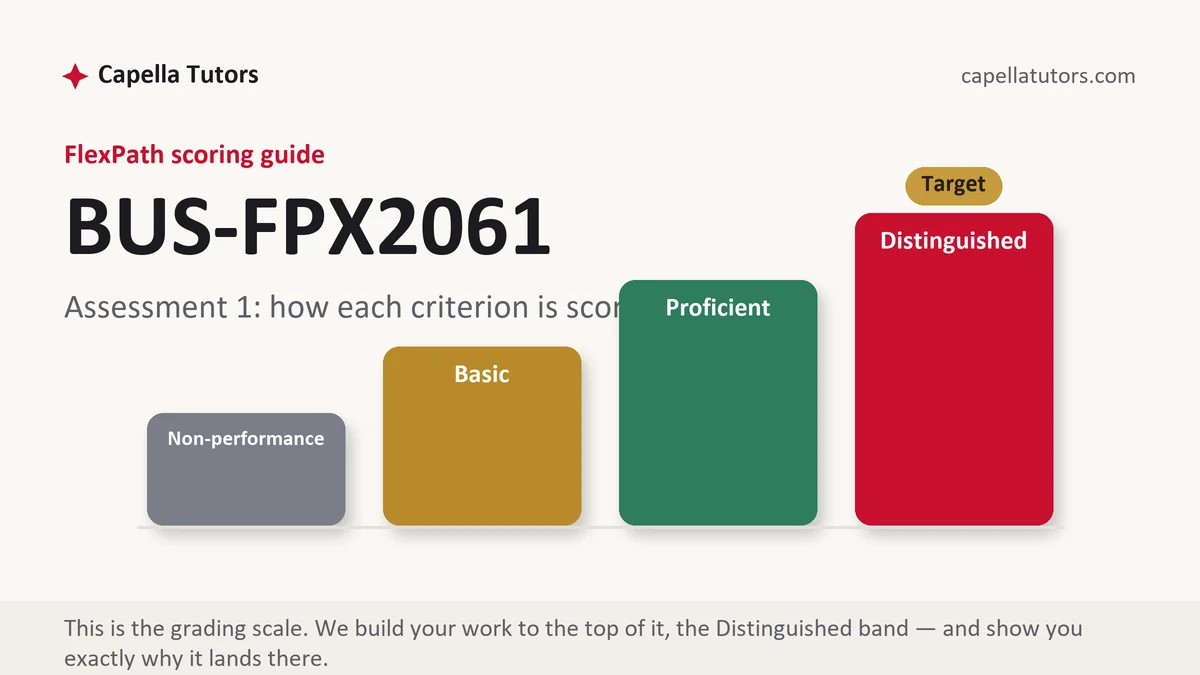
BUS-FPX2061 Assessment 1 grading scale at Capella FlexPath, the criterion levels this assessment is scored on, from Capella Tutors
How Capella FlexPath grades BUS-FPX2061 Assessment 1, visualized by Capella Tutors.

How BUS-FPX2061 Assessment 1 is scored

No percentages appear anywhere in this course. Each criterion lands on one of four levels, and the difference between the top two is usually a sentence of explanation rather than a correction:

LevelWhat it means on a transactions and entries deliverable
DistinguishedEvery entry balanced, the two real-world changes behind it named, the accounting equation shown to hold after the set, and the one transaction most open to a different treatment flagged.
ProficientEntries recorded correctly with the right accounts and amounts, and totals that foot. Accurate, and silent about why each entry looks the way it does.
BasicEntries that mostly balance, with account titles drifting between the ledger and the narrative and no reasoning attached. The usual first attempt.
Non-performanceA required transaction is never recorded, or debits and credits do not equal within an entry. Absent or unbalanced puts the criterion at the floor.

Presentation carries marks here that students expect to be free. Consistent account titles, a stated period, footed columns, and figures in the narrative matching figures in the tables are all things an evaluator checks quickly, and losing them is the cheapest way to lose a criterion in this course.

The BUS-FPX2061 Assessment 1 method, step by step

  1. Set the entity, the period, and the units first

    One line at the top naming the business, the month or quarter being reported, and whether amounts are in dollars or thousands. Every later figure inherits that line, and a table with no period attached raises a question you do not want asked.

  2. Describe each transaction in plain words before naming accounts

    Say what actually changed in the world: cash came in and an obligation was created, a service was delivered and a customer now owes. The accounts follow from that sentence, and reversing the order is how debits and credits get reversed.

  3. Record the entry and test it twice

    The left column equals the right column inside the entry, and after the entry assets still equal liabilities plus equity. Two tests, ten seconds, and they catch most of what goes wrong in a set this size.

  4. Watch the three transactions that trip everybody

    Money received for work not yet done is a liability, not revenue. An owner contribution is equity, not income. Buying an asset on credit changes two accounts and touches no cash at all. Each of those turns up in most transaction lists in this course.

  5. Build the trial balance and prove it

    Post the entries, foot both columns, and show the totals agreeing. If they do not, divide the difference by nine before doing anything else, since an even result points at a transposed figure rather than a missing entry.

  6. Write the sentence the criteria want, then self-score

    Add a short paragraph saying what the set of entries shows about the month, in the owner's language rather than the ledger's. Then mark your own draft against the guide criterion by criterion and rewrite anything below the top level.

A structure that maps to the criteria

These are the planning sizes our tutors use for a transactions deliverable, not a Capella requirement; the tables will take the space they take and the prose targets bend around them.

SectionWhat it must doGuide
Entity, period, and basisThe business, the period covered, the units, and the basis of accounting in use.~100 words
Transaction analysisEach event described in plain words, with the two things that changed identified.~300 words
Journal entriesThe entries themselves, balanced individually, with dates and consistent account titles.table plus ~200 words
Ledger or trial balanceThe postings, and a trial balance with both columns footed and equal.table plus ~150 words
Explanation of treatmentsWhy each debatable entry was recorded the way it was, and what the alternative would do.~250 words
Interpretation, sources, formatWhat the month shows the owner, with any treatment referred to the standard, in current APA.~250 words

Annotated sample excerpt

An original model excerpt from our team, showing how an entry gets explained rather than merely presented. Take the pattern and apply it to the transactions your own prompt supplies.

Sample excerpt: a deposit and an owner contribution Original model · Capella Tutors

Willow Bend Grooming opened in March with a $12,000 cash contribution from its owner, which increases cash and increases owner's equity, because money the owner puts in is not something the business earned and never touches revenue.1 The $8,400 van conversion purchased on account records as an increase in equipment and an increase in accounts payable, so the accounting equation holds at $20,400 of assets against $8,400 of liabilities plus $12,000 of equity even though no cash moved on that transaction.2 The $2,750 collected for grooming already performed is revenue, while the $600 taken for a package of six future appointments is unearned revenue, a liability that becomes revenue at $100 an appointment as each groom is delivered, and treating that $600 as March income would overstate the month by exactly that amount.3

  • 1States what increases and what increases with it, then adds the reason. The clause about revenue is what separates a recorded entry from an explained one.
  • 2Proves the equation after the entry with actual totals, and notes that cash was untouched. Both moves answer criteria most drafts leave to inference.
  • 3Handles the deposit correctly and prices the error the wrong treatment would cause. Naming the size of the misstatement is the detail the top column tends to describe.

The full premium sample for your exact assessment, written fresh to your scoring guide and issue, is free to request. Study it, revise it into your own voice, and submit work you understand.

Get the full sample free

The five mistakes that cost Distinguished

  • A customer deposit posted to revenue. Cash taken for appointments that have not happened yet creates an obligation, and the entry treating it as earned makes the first month look better than it was.
  • An owner contribution run through income. Money the owner puts in is equity, and routing it through revenue makes a business look profitable on the strength of its own funding.
  • Account titles that change between the table and the prose. Equipment in one place and van in another reads as two accounts, and reconciling them is not the evaluator's job.
  • A trial balance presented without being proved. Two columns and no footing leaves the reader to add up your work, and the criterion treats that as an accuracy problem.
  • Entries listed with no reasoning attached. The top column describes a student who can say why the debit sits where it does, and that is a clause for each entry, not an essay.

Pre-submission checklist

  • Entity, period, and units stated before the first figure
  • Each transaction described in plain words before its accounts are named
  • Every entry balanced individually, with dates and consistent account titles
  • The accounting equation shown to hold after the set, with totals
  • Deposits, owner contributions, and credit purchases handled correctly
  • A closing paragraph in the owner's language, and current APA on any standard cited

Transaction set due and the columns will not agree?

Send the transaction list, the trial balance if you have one, and the scoring guide. One of the eight people on the file does nothing except re-add the totals and check that the narrative matches the tables. A premium original sample comes back in 24 to 48 hours, and revision runs free until the guide is satisfied.

Keep going

Online now