This manual is for BUS FPX 2012 Assessment 1, start to submission. Establishing a Positive Work Environment asks you to write as a leader to your team, usually as a memo or message, about creating and maintaining a positive work environment: why a positive culture matters, how you will encourage team participation, and the specific practices that will support it, often with a summary table. The grade turns on leadership in action. A message that names concrete practices and invites the team in scores above one that praises positivity. Below is the method our tutors use, a structure that maps to the criteria, and an annotated sample excerpt. Prefer to hand it off? A premium original sample for this exact assessment comes back in 24 to 48 hours, revised free until it meets the guide. Capella's catalog lists the course as BUS-FPX2012, and some courserooms print BUS2012; both point to this same Assessment 1. In current courserooms this assessment typically appears as "Establishing a Positive Work Environment".
One honesty note before the manual: Capella revises courses and scoring guides over time, so always write to the exact scoring guide attached to your assessment in the courseroom. The course identity above is verified on capella.edu; the method and structure below are our tutors' approach to it, not Capella's official rubric text.
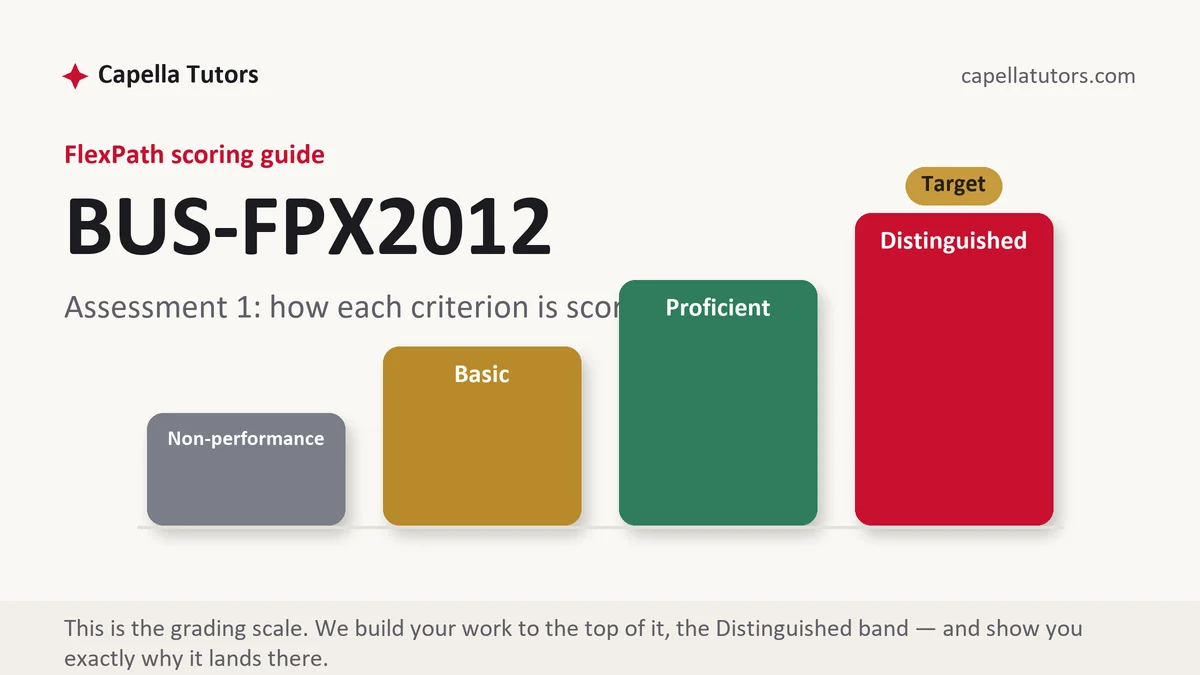
How BUS FPX 2012 Assessment 1 is scored
FlexPath does not use letter grades. Each criterion in the scoring guide lands on one of four levels, and the level descriptions are the real writing brief:
| Level | What it means on a positive work environment message |
|---|---|
| Distinguished | The importance of a positive culture is supported with evidence, participation strategies are specific, practices are concrete and realistic, the tone suits the team, and the summary table is complete. |
| Proficient | The message is clear, but practices are general. |
| Basic | The message praises positivity with few specifics. |
| Non-performance | The participation strategies or the summary table is missing. |
Write in the format the courseroom asks for and speak directly to your team.
The BUS FPX 2012 Assessment 1 method, step by step
-
Open with purpose
Why you are writing and what you want from the team.
-
Explain why culture matters
Engagement, retention and performance, with evidence.
-
Invite participation
How team members will shape the culture, such as feedback sessions.
-
Name practices
Recognition, clear expectations, workload balance, open communication.
-
Complete the summary table
Each practice with its purpose and owner.
-
Close warmly
Next steps and an invitation to respond.
A structure that maps to the criteria
Word counts are planning targets our tutors use, not Capella rules; follow the length and format your scoring guide states.
| Section | What it must do | Guide |
|---|---|---|
| Opening | Purpose of the message. | ~50 words |
| Importance of a positive workplace culture | With evidence. | ~100 words |
| Encouraging team participation | How the team contributes. | ~100 words |
| Practices and summary table | Concrete practices in a table. | ~100 words plus table |
| Closing | Next steps. | ~50 words |
Annotated sample excerpt
An original model excerpt from our team, written to show the register that reaches the top of the guide. Learn the moves, then write your own version.
Starting next month, each team meeting will end with ten minutes for anyone to raise a problem or an idea, and I will report back on every item at the following meeting.1 I am also asking two volunteers to join me in planning how we recognize good work, because recognition means more when it reflects what the team values rather than what I assume.2 Studies of workplace engagement show that people who feel heard are more likely to stay and to put in extra effort, so these steps are as much about our results as about how we feel.3
- 1States a concrete participation practice with follow-through.
- 2Shares ownership with team members.
- 3Supports the approach with evidence.
The full premium sample for your exact assessment, written fresh to your scoring guide and topic, is free to request. Study it, revise it into your own voice, and submit work you understand.
The five mistakes that cost Distinguished
- Praise without practices. Name specific actions.
- A one-way message. Invite participation.
- No evidence. Support why culture matters.
- Incomplete table. Fill every entry.
- Wrong tone. Write to your team directly.
Pre-submission checklist
- Purpose stated
- Importance supported with evidence
- Participation strategies
- Concrete practices
- Summary table complete
- Appropriate tone
Want the team message written?
Send the scoring guide and any materials from your courseroom. Our team returns a premium original team message in 24 to 48 hours, revised free until it meets the guide.