This manual is for BUS FPX 2012 Assessment 3, start to submission. The closing deliverable in Leadership Fundamentals usually asks for a development plan, and a plan is graded on whether it could visibly fail: an action, a frequency, a period, a barrier, and a measure that moves if the plan works. Below is the method our tutors use for it, a structure that maps to the criteria, and an annotated sample excerpt. Want it taken off your hands? A premium original sample for this exact assessment comes back in 24 to 48 hours, revised free until it meets the guide. Capella's catalog lists the course as BUS-FPX2012, and some courserooms print BUS2012; both point to this same Assessment 3.
One honesty note before the manual: Capella revises courses and scoring guides over time, so always write to the exact scoring guide attached to your assessment in the courseroom. The course identity above is verified on capella.edu; the method and structure below are our tutors' approach to it, not Capella's official rubric text.
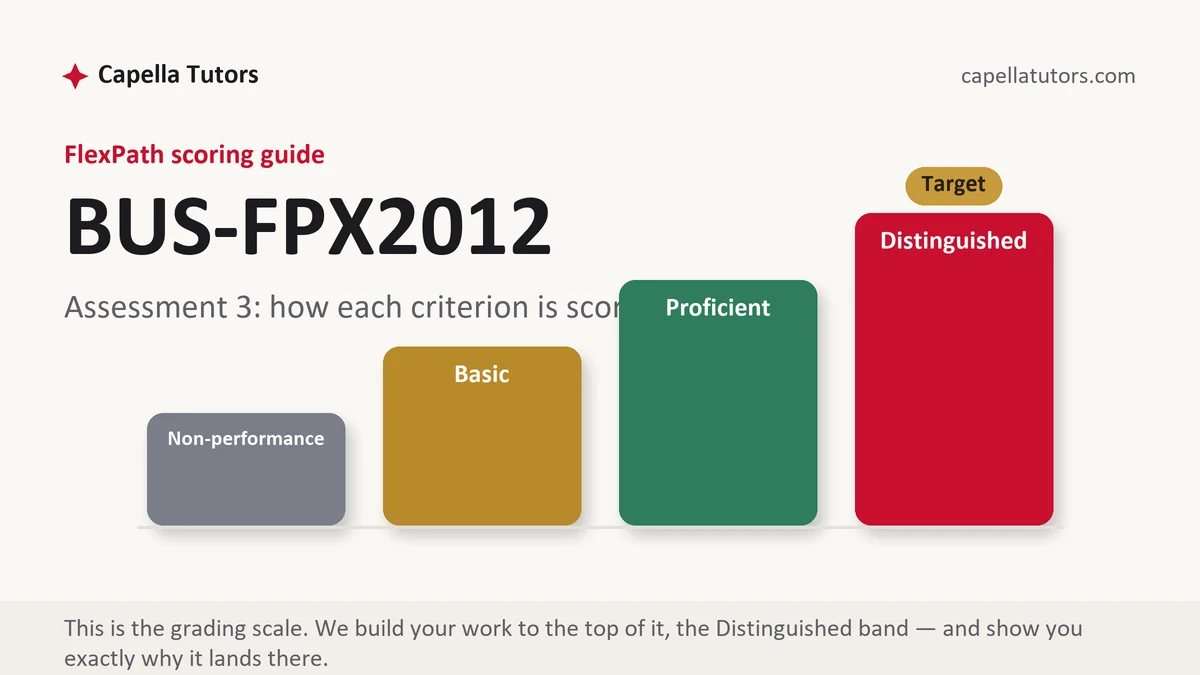
How BUS FPX 2012 Assessment 3 is scored
There are no letter grades in FlexPath. Each criterion on the scoring guide lands on one of four levels, and the level language is the writing brief:
| Level | What it means on a leadership development plan |
|---|---|
| Distinguished | Every goal is dated and measurable, each carries a barrier with a mitigation that is not simply more effort, and the plan states in advance what result would count as failure. The goals trace back to identified gaps rather than to general ambitions. |
| Proficient | Goals, actions, and timeframes are all present and sensible, with measures written loosely enough that success could be claimed either way. |
| Basic | Well-intentioned aims such as communicating better or listening more, with development activities attached and nothing that could be checked in ninety days. |
| Non-performance | A required element absent, most often the barriers row or the measure, which turns the plan into a statement of intent. |
The test is simple. If the plan cannot fail, it cannot be evaluated, and evaluators score it as what it is. A goal that would look identical whether or not you did anything has not been written yet.
The BUS FPX 2012 Assessment 3 method, step by step
-
Trace each goal back to a gap already on the page
A development plan that introduces new weaknesses in its final section reads as invented. Take the gaps from the analysis or the instrument results you already reported, and name the one you are working on in the first sentence of each goal.
-
Write the action as behavior somebody could watch
Not becoming more approachable, but holding a fifteen-minute individual conversation with each direct report every second week. The difference is that an observer with a calendar could confirm the second one happened, which is what makes it gradable.
-
Attach a frequency and a closing date
How often, starting when, ending when. A quarter is usually the right horizon for an undergraduate plan, long enough for a measure to move and short enough that the end date falls inside a period you can describe.
-
Choose a measure that already exists
Escalation counts, turnover in a team, overtime hours, missed handoffs, or a repeat of the same inventory all work, and all of them have a baseline you can print. Inventing a new measurement for the plan means having no prior figure to compare against.
-
Give each goal a real barrier and a mitigation with teeth
Time constraints alone reads as a placeholder, and faculty see it in most submissions. Name the specific thing that will interfere, such as a seasonal peak or a role that will absorb the hours, and say what you will drop or delegate to protect the commitment.
-
Write the failure condition, then self-score and submit
State the result that would tell you the plan did not work, before you start. Then mark every row yourself against the guide and submit early in the week, allowing for the two business days an evaluation can take.
A structure that maps to the criteria
These lengths are planning targets our tutors use for a closing leadership deliverable at this level, not Capella rules; expand as your own guide requires.
| Section | What it must do | Guide word target |
|---|---|---|
| Introduction | Your role, the team, the gaps carried forward, and the horizon the plan covers. | ~150 words |
| The gaps restated | Each development need traced to the evidence that established it, briefly, without reopening the analysis. | ~225 words |
| Goals and actions | Each goal with its observable action, frequency, start date, and closing date, one goal per paragraph. | ~400 words |
| Measures and baselines | The existing figure each goal will move, its current value, and the value that would count as success. | ~275 words |
| Barriers and mitigations | The specific interference expected for each goal and what you will drop or hand off to protect it. | ~275 words |
| Failure conditions and sources | What would tell you the plan did not work, plus original leadership works and journals in current APA. | ~175 words |
Annotated sample excerpt
An original model excerpt from our team, showing the register that scores at the top of the guide. It is study material: learn the moves, then write your own version.
The gap identified earlier is that installation problems reach me as interruptions rather than as anything anyone raised in advance, and at Verdant Office Interiors I now coordinate six installers across roughly nine jobs a month.1 The action is a standing fifteen-minute conversation with each installer every second week, beginning the first week of October and running through December, in which the only agenda item is what they expect to go wrong on their next job.2 The measure already exists in our scheduling notes as unplanned site callbacks, which ran to nineteen across the last quarter; success is twelve or fewer over the plan period, the barrier is the November showroom refit that will take two of my own days a week, and I will hand the material ordering for that month to the warehouse lead rather than let the conversations lapse.3
- 1The goal opens by naming the gap it came from, so nothing in the plan appears out of nowhere.
- 2An action an observer could verify from a calendar, with a frequency, a start, and an end. The single agenda item keeps it from becoming a general intention.
- 3An existing measure with a printed baseline, a stated success threshold, a specific barrier, and a mitigation that gives something up. All four in one sentence.
The full premium sample for your exact assessment, written fresh to your scoring guide and issue, is free to request. Study it, revise it into your own voice, and submit work you understand.
The five mistakes that cost Distinguished
- Goals with no number and no date. A commitment that cannot be checked in ninety days is an intention, and the row is written to separate the two.
- Gaps invented in the final section. Development needs that never appeared in the analysis make the plan look assembled to fill a heading.
- A measure with no baseline. Without a prior figure there is nothing for the new one to be compared against.
- Time named as the only barrier. Every plan is short of time, which is why that answer tells the evaluator nothing about yours.
- Mitigations that cost nothing. Trying harder is not a mitigation; dropping a task or handing one off is.
Pre-submission checklist
- Every goal traced to a gap already established earlier in the paper
- Each action written as behavior an observer could confirm happened
- Frequency, start date, and closing date attached to every commitment
- Measures drawn from figures that already exist, each with its baseline printed
- A specific barrier per goal, with a mitigation that gives something up
- A stated failure condition, references matched both ways, self-scored Distinguished
Want this assessment done with backup?
Send the prompt, the scoring guide, and the gaps or results you are building the plan on. A team of eight returns a premium original sample with every goal dated, measured, and bounded by a barrier, inside 24 to 48 hours, revised until it clears the guide.