This manual is for BUS FPX 2012 Assessment 2, start to submission. Transformational Leadership in New Product Launches asks you to apply leadership principles to an organizational change, such as launching a new product: describe the change, explain how a transformational leader would empower teamwork for innovation, identify the leadership traits and style required, and recommend strategies for collaboration, engagement and empowerment, often with supporting tables. The grade turns on applying transformational leadership to the change. Describing the theory scores lower than showing what the leader would actually do during the launch. Below is the method our tutors use, a structure that maps to the criteria, and an annotated sample excerpt. Prefer to hand it off? A premium original sample for this exact assessment comes back in 24 to 48 hours, revised free until it meets the guide. Capella's catalog lists the course as BUS-FPX2012, and some courserooms print BUS2012; both point to this same Assessment 2. In current courserooms this assessment typically appears as "Transformational Leadership in New Product Launches".
One honesty note before the manual: Capella revises courses and scoring guides over time, so always write to the exact scoring guide attached to your assessment in the courseroom. The course identity above is verified on capella.edu; the method and structure below are our tutors' approach to it, not Capella's official rubric text.
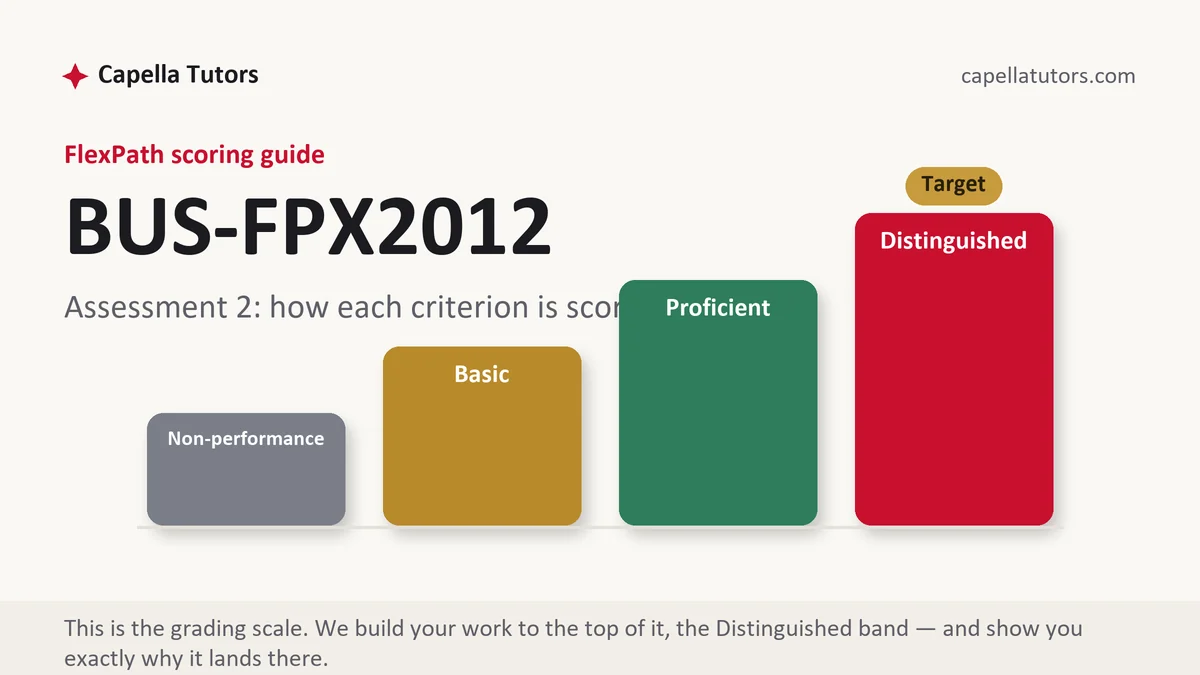
How BUS FPX 2012 Assessment 2 is scored
FlexPath does not use letter grades. Each criterion in the scoring guide lands on one of four levels, and the level descriptions are the real writing brief:
| Level | What it means on a transformational leadership paper |
|---|---|
| Distinguished | The change is described clearly, transformational leadership is explained accurately and applied to the launch, traits are specific, collaboration and engagement strategies are concrete, and tables are complete. |
| Proficient | All parts are accurate, but the application is general. |
| Basic | The paper explains the theory with little application. |
| Non-performance | The change, the strategies or the tables are missing. |
Choose a change you can describe concretely, real or from the courseroom scenario.
The BUS FPX 2012 Assessment 2 method, step by step
-
Describe the change
The product launch and what it requires from the team.
-
Explain transformational leadership
Idealized influence, inspirational motivation, intellectual stimulation and individualized consideration.
-
Apply it to teamwork
How the leader would empower the team to innovate.
-
Identify traits
Vision, communication, trust-building, with examples.
-
Recommend strategies
Cross-functional teams, shared goals, recognition.
-
Complete tables
As the courseroom requires.
A structure that maps to the criteria
Word counts are planning targets our tutors use, not Capella rules; follow the length and format your scoring guide states.
| Section | What it must do | Guide |
|---|---|---|
| Introduction | The change and purpose. | ~75 words |
| Describing the organizational change | What the launch involves. | ~125 words |
| Empowering teamwork for innovation | Leadership applied. | ~150 words |
| Leadership style and traits | With a table. | ~125 words |
| Collaboration, engagement and conclusion | Strategies, then references. | ~175 words |
Annotated sample excerpt
An original model excerpt from our team, written to show the register that reaches the top of the guide. Learn the moves, then write your own version.
For the launch, the leader's first move is to explain why the new product matters to customers and to the company's future, so the team sees the launch as a shared mission rather than a deadline.1 Intellectual stimulation comes next: engineers, marketers and sales staff meet in one working group and are asked to challenge the launch plan before it is fixed, which surfaces problems while they are still cheap to solve.2 Individualized consideration means the leader checks in with each member about what they need to contribute well, which research links to higher commitment during demanding change.3
- 1Applies inspirational motivation to the launch.
- 2Shows intellectual stimulation in a concrete practice.
- 3Applies individualized consideration with evidence.
The full premium sample for your exact assessment, written fresh to your scoring guide and topic, is free to request. Study it, revise it into your own voice, and submit work you understand.
The five mistakes that cost Distinguished
- Theory without application. Show what the leader does.
- Vague change. Describe the launch concretely.
- Traits without examples. Illustrate each trait.
- Generic strategies. Tie them to the launch.
- Incomplete tables. Complete every table.
Pre-submission checklist
- Change described
- Theory explained accurately
- Theory applied to teamwork
- Traits with examples
- Collaboration and engagement strategies
- Tables and references
Want the transformational leadership paper written?
Send the scoring guide and any materials from your courseroom. Our team returns a premium original transformational leadership paper in 24 to 48 hours, revised free until it meets the guide.