This manual is for BUS FPX 2007 Assessment 2, start to submission. Business Environment Analysis asks you to analyze an organization you choose: what it does, its mission and vision statements and their key components, the organizational structure that makes sense for it and why, and the internal and external factors in its business environment, often by answering a set of questions in the courseroom template. The grade turns on reasoning. Copying the mission statement scores little; explaining what it commits the organization to, and why a structure fits, scores the top column. Below is the method our tutors use, a structure that maps to the criteria, and an annotated sample excerpt. Prefer to hand it off? A premium original sample for this exact assessment comes back in 24 to 48 hours, revised free until it meets the guide. Capella's catalog lists the course as BUS-FPX2007, and some courserooms print BUS2007; both point to this same Assessment 2. In current courserooms this assessment typically appears as "Business Environment Analysis".
One honesty note before the manual: Capella revises courses and scoring guides over time, so always write to the exact scoring guide attached to your assessment in the courseroom. The course identity above is verified on capella.edu; the method and structure below are our tutors' approach to it, not Capella's official rubric text.
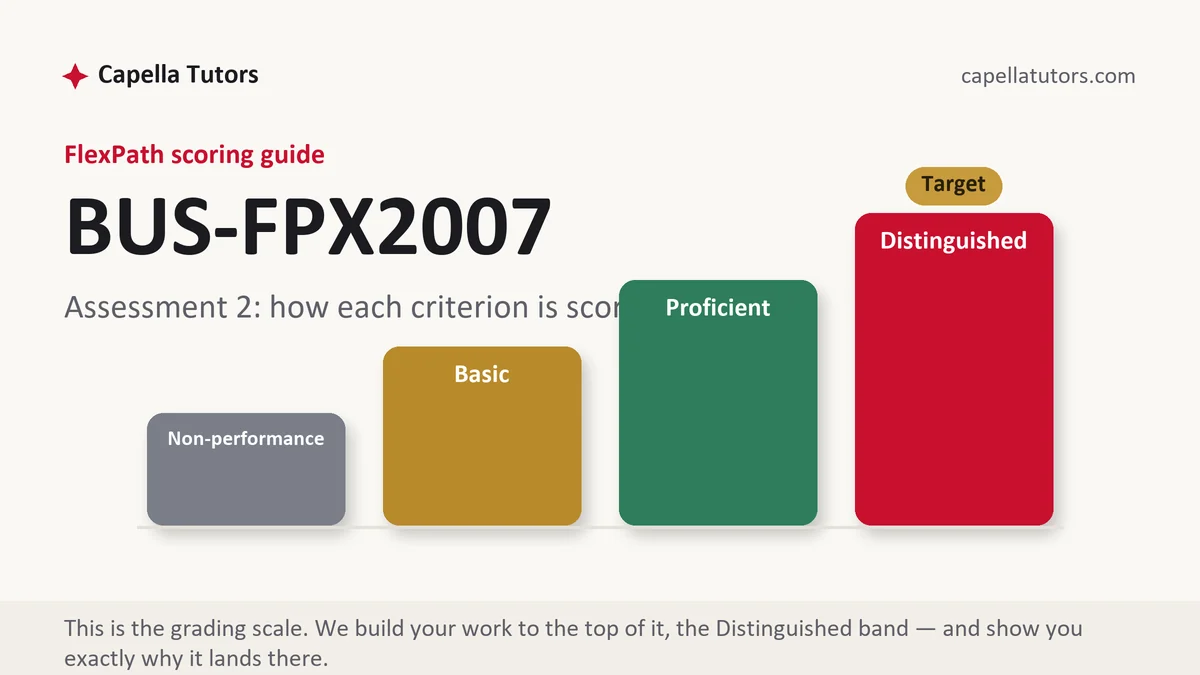
How BUS FPX 2007 Assessment 2 is scored
FlexPath does not use letter grades. Each criterion in the scoring guide lands on one of four levels, and the level descriptions are the real writing brief:
| Level | What it means on a business environment analysis |
|---|---|
| Distinguished | The organization is described accurately, mission and vision are analyzed for their components, the recommended structure is justified, environmental factors are specific, and sources are credible. |
| Proficient | All parts are accurate, but analysis of mission and structure is brief. |
| Basic | The paper describes the organization with little analysis. |
| Non-performance | The mission and vision, the structure or the environment analysis is missing. |
Choose a well-documented organization so you can cite its own statements and reports.
The BUS FPX 2007 Assessment 2 method, step by step
-
Choose the organization
A company with public information, such as a major retailer.
-
Describe it
What it does, its size and markets.
-
Analyze mission and vision
Purpose, values, customers and aspirations in each statement.
-
Recommend a structure
Functional, divisional or matrix, with reasons tied to the business.
-
Analyze the environment
Competitors, customers, economy, regulation and technology.
-
Cite sources
Company reports and credible business sources.
A structure that maps to the criteria
Word counts are planning targets our tutors use, not Capella rules; follow the length and format your scoring guide states.
| Section | What it must do | Guide |
|---|---|---|
| Chosen organization | What it is and does. | ~100 words |
| Mission and vision | Statements and their components. | ~150 words |
| Organizational structure | Recommended structure and reasons. | ~150 words |
| Business environment | Internal and external factors. | ~150 words |
| References | Current APA. | as needed |
Annotated sample excerpt
An original model excerpt from our team, written to show the register that reaches the top of the guide. Learn the moves, then write your own version.
A divisional structure suits the company better than a purely functional one, because it runs distinct businesses, stores, online sales and a pharmacy, that serve different customers and face different competitors.1 Divisions let each business set its own priorities and respond quickly, while shared functions such as finance and supply chain stay central to keep costs down.2 The trade-off is some duplication of effort, but for a company whose growth depends on competing online, faster decisions in that division are worth it.3
- 1Recommends a structure with a reason drawn from the business.
- 2Explains how it would work in practice.
- 3Weighs the trade-off and concludes.
The full premium sample for your exact assessment, written fresh to your scoring guide and topic, is free to request. Study it, revise it into your own voice, and submit work you understand.
The five mistakes that cost Distinguished
- Copying statements. Analyze what they mean.
- A structure without reasons. Tie it to the business.
- Vague environment. Name specific factors.
- Weak sources. Use company and credible business sources.
- Skipping template questions. Answer every question.
Pre-submission checklist
- Organization described
- Mission and vision analyzed
- Structure recommended and justified
- Environment analyzed
- Template questions answered
- References
Want the business environment analysis written?
Send the scoring guide and any materials from your courseroom. Our team returns a premium original business environment analysis in 24 to 48 hours, revised free until it meets the guide.