This manual is for BUS FPX 2007 Assessment 3, start to submission. Business Ethics and Social Responsibility asks you to examine two key functional areas of an organization, such as marketing and production, and how ethical principles and social responsibility guide their daily operations, with attention to the critical thinking managers use when ethical questions arise. The grade turns on specificity. Showing how an ethical principle changes a real decision in a named functional area scores above general statements that ethics matter. Below is the method our tutors use, a structure that maps to the criteria, and an annotated sample excerpt. Prefer to hand it off? A premium original sample for this exact assessment comes back in 24 to 48 hours, revised free until it meets the guide. Capella's catalog lists the course as BUS-FPX2007, and some courserooms print BUS2007; both point to this same Assessment 3. In current courserooms this assessment typically appears as "Business Ethics and Social Responsibility".
One honesty note before the manual: Capella revises courses and scoring guides over time, so always write to the exact scoring guide attached to your assessment in the courseroom. The course identity above is verified on capella.edu; the method and structure below are our tutors' approach to it, not Capella's official rubric text.
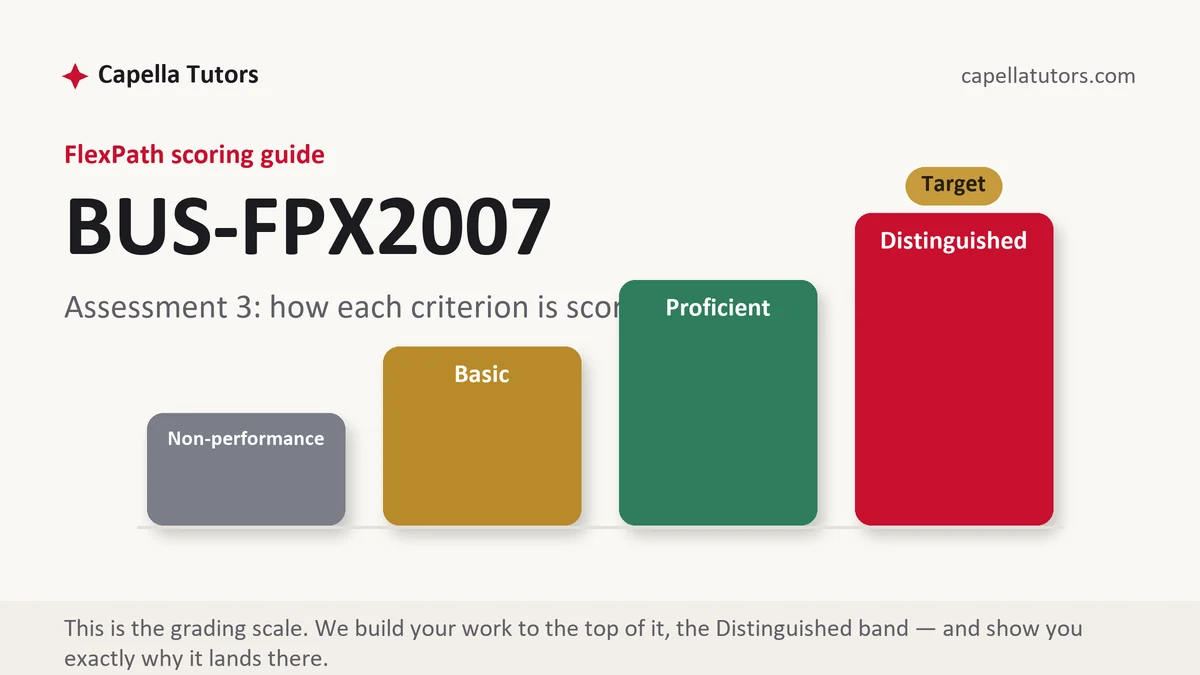
How BUS FPX 2007 Assessment 3 is scored
FlexPath does not use letter grades. Each criterion in the scoring guide lands on one of four levels, and the level descriptions are the real writing brief:
| Level | What it means on a business ethics paper |
|---|---|
| Distinguished | Two functional areas are described accurately, ethical principles are applied to their operations with examples, social responsibility is connected to business success, and critical thinking is shown in a decision. |
| Proficient | Both areas are covered, but examples are general. |
| Basic | The paper discusses ethics in general. |
| Non-performance | A functional area or the critical thinking discussion is missing. |
Use the same organization from Assessment 2 if your guide allows, so the analysis builds.
The BUS FPX 2007 Assessment 3 method, step by step
-
Choose two functional areas
For example marketing and production.
-
Describe each
What it does in the organization.
-
Apply ethical principles
Honesty in advertising, safety and sustainability in production.
-
Connect to social responsibility
How ethical practice affects reputation and results.
-
Show critical thinking
A decision where managers weighed competing interests.
-
Cite sources
Company reports and credible sources.
A structure that maps to the criteria
Word counts are planning targets our tutors use, not Capella rules; follow the length and format your scoring guide states.
| Section | What it must do | Guide |
|---|---|---|
| Introduction | Organization and purpose. | ~75 words |
| First functional area | Operations and ethical principles. | ~150 words |
| Second functional area | Operations and ethical principles. | ~150 words |
| Critical thinking | An ethical decision analyzed. | ~100 words |
| Conclusion and references | Close, then references. | ~75 words |
Annotated sample excerpt
An original model excerpt from our team, written to show the register that reaches the top of the guide. Learn the moves, then write your own version.
In production, the company's commitment to sustainability shows up as a concrete rule: suppliers must report their energy use, and those that miss reduction targets two years in a row lose preferred status.1 That rule applies the principle of responsibility to stakeholders beyond shareholders, and it costs money in the short term, since cheaper suppliers are passed over.2 Managers accept the cost because the company's customers increasingly choose brands on sustainability, which shows how an ethical principle and business success can point the same way.3
- 1Shows a principle as an operating rule.
- 2Names the principle and its cost.
- 3Connects ethics to business results.
The full premium sample for your exact assessment, written fresh to your scoring guide and topic, is free to request. Study it, revise it into your own voice, and submit work you understand.
The five mistakes that cost Distinguished
- Ethics in general. Tie principles to operations.
- One functional area. Cover two.
- No decision. Show critical thinking in a real choice.
- No sources. Cite company and credible sources.
- Ignoring costs. Acknowledge trade-offs.
Pre-submission checklist
- Two functional areas
- Ethical principles applied with examples
- Social responsibility linked to success
- Critical thinking shown
- Credible sources
- References
Want the business ethics paper written?
Send the scoring guide and any materials from your courseroom. Our team returns a premium original business ethics paper in 24 to 48 hours, revised free until it meets the guide.