This manual is for BUS FPX 2007 Assessment 1, start to submission. The opening deliverable in Introduction to Business Perspectives usually asks you to establish a business and judge the form it operates under, which means liability exposure, how the profit is taxed, how capital is raised, and how easily ownership transfers, applied to the situation in front of you rather than defined. Below is the method our tutors use for it, a structure that maps to the criteria, and an annotated sample excerpt. Rather hand it off? A premium original sample for this exact assessment comes back in 24 to 48 hours, revised free until it meets the guide. Capella's catalog lists the course as BUS-FPX2007, and some courserooms print BUS2007; both point to this same Assessment 1.
One honesty note before the manual: Capella revises courses and scoring guides over time, so always write to the exact scoring guide attached to your assessment in the courseroom. The course identity above is verified on capella.edu; the method and structure below are our tutors' approach to it, not Capella's official rubric text.
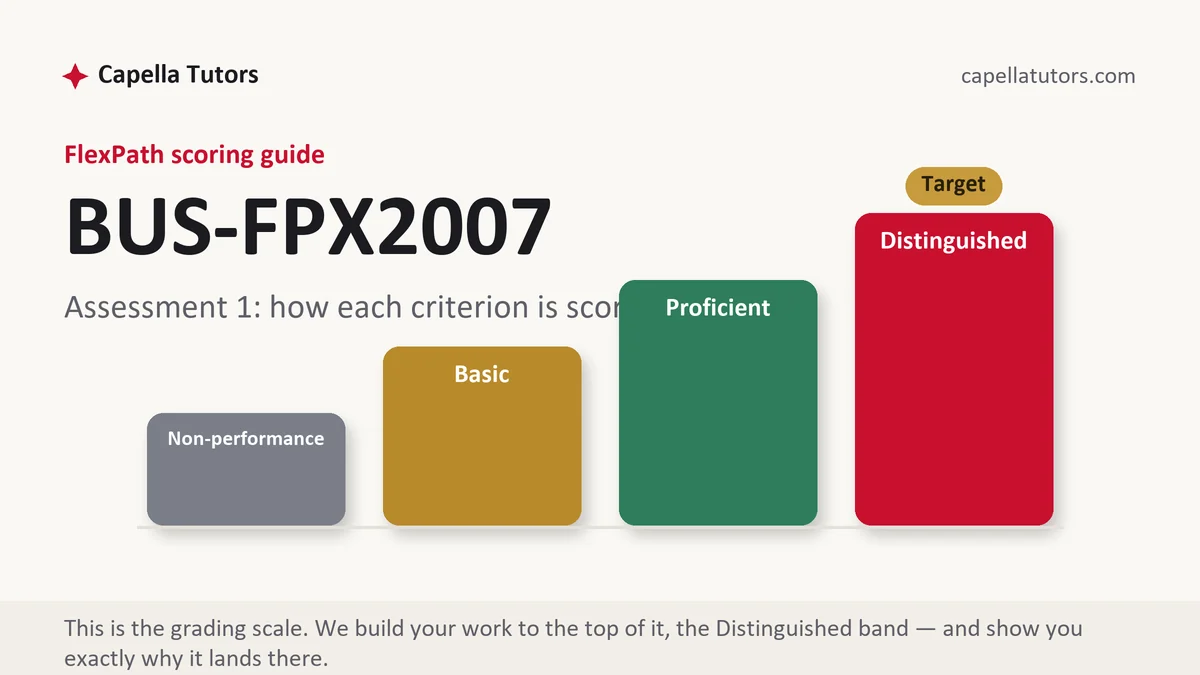
How BUS FPX 2007 Assessment 1 is scored
There are no letter grades in FlexPath. Each criterion on the scoring guide lands on one of four levels, and the level language is the writing brief:
| Level | What it means on a business and ownership form analysis |
|---|---|
| Distinguished | Scale and market are established from something other than the company's own description, and the legal form is judged on all four dimensions against this situation, with the rejected alternative weighed rather than ignored. |
| Proficient | The business is described accurately and the form is applied to the case, with one or two of the four dimensions treated more briefly than the criterion invites. |
| Basic | A competent profile of the business followed by textbook definitions of sole proprietorship, partnership, and corporation, with no verdict on the case. |
| Non-performance | The comparison is absent, or the only source for the firm is the firm. A criterion asking for evidence is not satisfied by the subject's own account of itself. |
Survey courses are graded on precision rather than coverage. History, founders, and product lines are context, and context is unpaid; the verdict on the form is the row that pays.
The BUS FPX 2007 Assessment 1 method, step by step
-
Take the guide apart before you choose the business
The count of criteria tells you the count of sections you owe, and the verbs tell you their weight. Choosing a company first and reading the criteria second is how students end up writing about a firm they cannot get numbers for.
-
Establish scale from outside the company
Headcount, revenue range, unit volumes, or locations, sourced from filings, industry data, or observations any customer could make. A firm describing itself is good evidence of what it wants believed and poor evidence that the description is accurate, and writing that distinction into the sentence turns a weak source into a usable one.
-
Judge the form on four dimensions, in order
Liability exposure, taxation of the profit, access to capital, and transfer of ownership. Take them one at a time and say what each means for this business specifically. Four short paragraphs beat one long paragraph that circles all four without landing on any.
-
Weigh the alternative you are rejecting
A recommendation to stay as is, or to convert, only reads as a judgment once the other option has been given its strongest case. State what the rejected form would have delivered and what it would have cost, in the same units.
-
Scan the outside conditions and rank them
Political, economic, social, technological, environmental, and legal conditions get filled with adjectives more often than with facts. Support each with something published, then rank them by how much they actually bind this business and defend the one at the top.
-
Self-score every row, then submit early in the week
Mark each criterion yourself as Distinguished, Proficient, Basic, or Non-performance and rewrite anything short of the top. Evaluations can take two business days, and in a self-paced term that is time you have already budgeted for the next course.
A structure that maps to the criteria
These lengths are planning targets our tutors use for an introductory business analysis, not Capella rules; expand wherever your own guide asks for more.
| Section | What it must do | Guide word target |
|---|---|---|
| Introduction | The business, what it sells and to whom, and the decision or question the paper resolves, in three or four sentences. | ~150 words |
| The business established | Scale, market, and operating pattern, each attributed to a source that is not the company's own marketing. | ~275 words |
| The current form | What the business operates as now and what that means for liability, tax, capital, and transfer, one at a time. | ~350 words |
| The alternative weighed | The form being considered, what it would deliver, what it would cost, and the verdict with a reason. | ~300 words |
| Outside conditions | The external factors that bind this business, evidenced and ranked, with the top one defended. | ~250 words |
| Sources and format | Filings or industry data, government economic series, and peer-reviewed business scholarship, current APA both ways. | as needed |
Annotated sample excerpt
An original model excerpt from our team, showing the register that scores at the top of the guide. It is study material: learn the moves, then write your own version.
Copper Kettle Streetside serves roughly 115 covers a day from one vehicle across five service days, at an average ticket near $14.50, and the two owners want a second truck working a separate lunch route by spring.1 Access to capital is the dimension that decides this, because a second vehicle and its buildout has to be financed against a business whose only substantial asset is the first truck, and a lender assessing two individuals trading under their own names is assessing their personal credit rather than an entity's balance sheet.2 Transfer of ownership pushes the same way: the current arrangement dissolves if either owner leaves, whereas membership interests in a limited liability company can be sold or divided without ending the business, which matters the moment a second route makes one owner's exit thinkable.3
- 1Scale arrives as covers, service days, and average ticket, so a reader can size the business without being told it is small.
- 2One dimension named and applied to this decision, not defined in general. The reason is financial, which is what makes it arguable.
- 3A second dimension pointing the same direction, tied to a concrete future event. Two dimensions agreeing is an argument; four dimensions listed is a definition.
The full premium sample for your exact assessment, written fresh to your scoring guide and issue, is free to request. Study it, revise it into your own voice, and submit work you understand.
The five mistakes that cost Distinguished
- A profile where an analysis was requested. Founding date and product range fill a page and answer no criterion on the guide.
- Forms defined instead of judged. Three textbook paragraphs on business structures cannot substitute for a verdict on the one in front of you.
- Only the company as a source. A business is not evidence that its own claims about itself are true.
- An outside scan of adjectives. Strong, moderate, and high are ratings, and a rating with no published fact behind it is unsupported.
- The rejected option never stated. A choice made without an alternative on the page is a preference wearing the clothes of a recommendation.
Pre-submission checklist
- Every criterion has its own heading and answers the heaviest verb in the row
- Scale and market established from filings, industry data, or observable facts
- Liability, taxation, capital, and transfer each treated separately and applied to this case
- The rejected form given its strongest case, with costs in the same units as the benefits
- External conditions supported by published evidence and ranked, with the top one defended
- References matched both ways in current APA, self-scored Distinguished on every row
Want this assessment done with backup?
Send the prompt, the scoring guide, and the company or scenario you were assigned. A team of eight returns a premium original sample built on retrievable numbers rather than on a marketing page, inside 24 to 48 hours, revised until it clears the guide.