This manual is for BUS FPX 1011 Assessment 3, start to submission. The closing deliverable in Management Fundamentals usually asks you to pull the course together around one management problem, and the controlling function is almost always what carries it: a standard set in advance, a measurement taken against it, a comparison, and a correction. Below is the method our tutors use for it, a structure that maps to the criteria, and an annotated sample excerpt. Rather delegate it? A premium original sample for this exact assessment comes back in 24 to 48 hours, revised free until it meets the guide. Capella's catalog lists the course as BUS-FPX1011, and some courserooms print BUS1011; both point to this same Assessment 3.
One honesty note before the manual: Capella revises courses and scoring guides over time, so always write to the exact scoring guide attached to your assessment in the courseroom. The course identity above is verified on capella.edu; the method and structure below are our tutors' approach to it, not Capella's official rubric text.
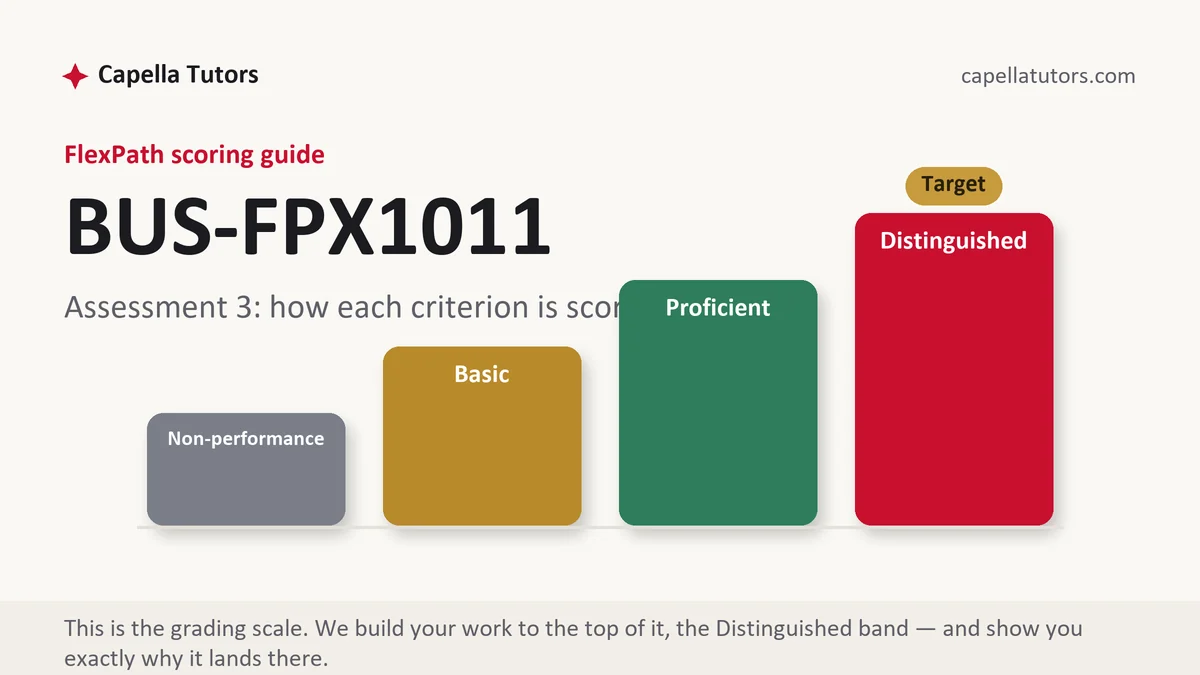
How BUS FPX 1011 Assessment 3 is scored
There are no letter grades in FlexPath. Each criterion on the scoring guide lands on one of four levels, and the level language is the writing brief:
| Level | What it means on a control and improvement plan |
|---|---|
| Distinguished | All four parts of the control loop are on the page with numbers in them, the corrective action is traced to a cause rather than to a symptom, and the plan says how it will know it failed. Synthesis rows also want the functions connected rather than sequenced. |
| Proficient | A standard, a measurement, and a correction, complete and defensible, with the cause identified in general terms rather than located. |
| Basic | Improvement reported after the fact with no standard set beforehand, which is a summary of the past rather than a control system. |
| Non-performance | The measurement or the standard is absent, so nothing in the plan can be compared with anything, and the criterion has nothing to grade. |
A final deliverable in an introductory course tends to carry a criterion asking you to integrate what came before. Integration means showing one function creating work for another, not writing a paragraph on each in order.
The BUS FPX 1011 Assessment 3 method, step by step
-
Rebuild the outline from the guide, then check the weighting
Criteria are not equal, and the heaviest row deserves the most words. Turn each into a heading, park the top-level wording beneath it, and give the row asking for a plan or a set of recommendations more space than the row asking for background.
-
Set the standard before you report any result
A standard is a target with a unit and a period attached: minutes per turnaround, defects per thousand, dollars per unit shipped. Write it down first, even if you are reconstructing it, because a control section that reports performance without a prior target has skipped the step the criterion is built on.
-
Measure, then compare in the same units
Take the actual figure across a stated window and put it beside the standard in identical units. A target in minutes compared against an outcome in hours is an arithmetic invitation to lose the row. Show the gap as both an absolute difference and a percentage where the percentage adds meaning.
-
Trace the gap to a cause you can point at
Staff not caring is not a cause. A step performed at the end of a shift by whoever is nearest, with no handover record, is a cause, because somebody could change it on Monday. Ask what happened immediately before the gap appeared, and keep asking until the answer names a process rather than a person.
-
Write the correction as a loop that closes
State the change, who makes it, when it starts, when it will be measured again, and what result would prove it worked. Then add the second measurement date. A correction with no re-measurement is a hope, and the controlling criterion is written to catch exactly that.
-
Connect the functions, then self-score and submit
Say plainly which planning decision created the standard, which organizing decision put the work where the gap appeared, and what the correction asks of the person leading the unit. Then mark every row yourself and leave room for the two business days an evaluation can take.
A structure that maps to the criteria
These lengths are planning targets our tutors use for a closing management deliverable at this level, not Capella requirements; follow your own guide where it asks for more.
| Section | What it must do | Guide word target |
|---|---|---|
| Introduction | The organization, the process being controlled, and the gap the paper closes, with the recommendation previewed in the last sentence. | ~125 words |
| The standard | The target, its unit, the period it covers, and where it came from, whether policy, contract, or your own reconstruction. | ~200 words |
| Measurement and comparison | The actual figures across a named window, set beside the standard in the same units, with the gap sized. | ~300 words |
| Cause | The process step producing the gap, evidenced rather than assumed, with one alternative explanation considered and set aside. | ~275 words |
| Correction and re-measurement | The change, its owner, its start date, the second measurement date, and the result that would count as success or failure. | ~275 words |
| Integration and references | How planning, organizing, and leading connect to this control, plus current APA sources matched both ways. | ~150 words |
Annotated sample excerpt
An original model excerpt from our team, showing the register that scores at the top of the guide. It is study material: learn the moves, then write your own version.
Pinecrest Self Storage sets a written standard of 45 minutes to return a vacated unit to rentable condition, measured from the moment a tenant's access code is deactivated, and the standard exists because a unit sitting dirty earns nothing while the site still pays for it.1 Across 132 turnovers at five sites between March and May, the average was 71 minutes, a gap of 26 minutes per unit, or roughly 57 minutes of lost rentable time for every two units released.2 The gap concentrates almost entirely in the wait for a supply cart, because each site keeps one stocked cart and the site manager restocks it at close of business rather than when it empties.3
- 1Standard, unit, starting event, and the business reason it exists, all before any result is reported. The loop is being built in the correct order.
- 2Measurement across a stated population and window, then the gap expressed two ways. The evaluator can redo the arithmetic, which is the point.
- 3The cause is a process step with a schedule attached, so a correction is obvious and cheap. Nobody is blamed, which is what keeps it analysis.
The full premium sample for your exact assessment, written fresh to your scoring guide and issue, is free to request. Study it, revise it into your own voice, and submit work you understand.
The five mistakes that cost Distinguished
- Reporting an outcome and calling it control. Without a target set in advance there is nothing to compare against, and the row collapses to the floor.
- A cause that is really a symptom. Slow turnarounds explain nothing; the cart nobody restocks until closing does.
- Mixed units in the comparison. Minutes against hours, or weekly against monthly, breaks the arithmetic the criterion is checking.
- No second measurement. A loop that never closes is a suggestion, and the controlling function is defined by the closing.
- Four functions in a row instead of connected. A synthesis criterion pays for the link between them, and paragraphs in sequence do not create one.
Pre-submission checklist
- A standard with a unit and a period, written before any result appears
- Measurement across a named population and window, in the standard's own units
- The gap sized in absolute terms and, where useful, as a percentage
- A cause naming a process step, with one rival explanation set aside
- A correction carrying an owner, a start date, a re-measurement date, and a failure condition
- Functions connected rather than listed, references matched both ways, self-scored Distinguished
Want this assessment done with backup?
Send the prompt, the scoring guide, and whatever figures you have for the process you want controlled, even rough ones. A team of eight returns a premium original sample with the loop closed and the arithmetic shown, inside 24 to 48 hours, revised until it clears the guide.