This manual is for BUS FPX 1011 Assessment 2, start to submission. In current courserooms, Assessment 2 of Management Fundamentals asks you to examine what an effective sales manager needs to raise a company's sales: the characteristics of an effective sales manager, the behaviors that motivate and direct a sales team, and the strategies that would increase results, often organized in tables with explanations. The grade turns on linking management to results. Characteristics and strategies that are tied to how they would raise sales score above general descriptions of good managers. Below is the method our tutors use, a structure that maps to the criteria, and an annotated sample excerpt. Prefer to hand it off? A premium original sample for this exact assessment comes back in 24 to 48 hours, revised free until it meets the guide. Capella's catalog lists the course as BUS-FPX1011, and some courserooms print BUS1011; both point to this same Assessment 2.
One honesty note before the manual: Capella revises courses and scoring guides over time, so always write to the exact scoring guide attached to your assessment in the courseroom. The course identity above is verified on capella.edu; the method and structure below are our tutors' approach to it, not Capella's official rubric text.
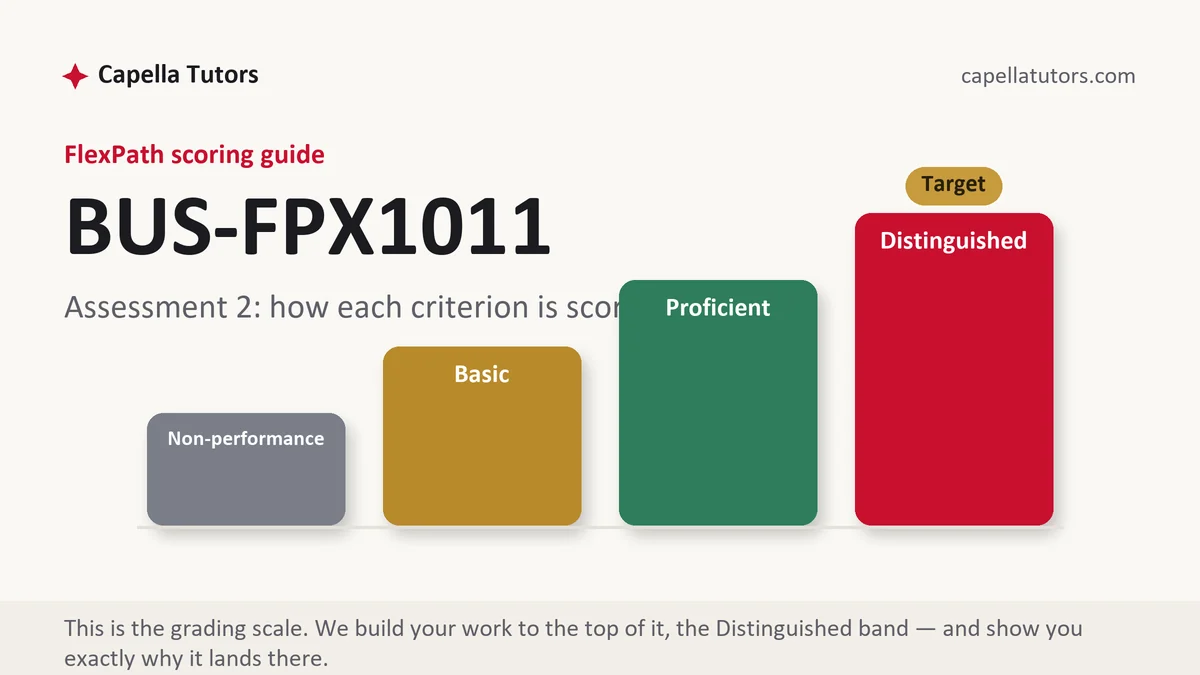
How BUS FPX 1011 Assessment 2 is scored
FlexPath does not use letter grades. Each criterion in the scoring guide lands on one of four levels, and the level descriptions are the real writing brief:
| Level | What it means on a sales manager analysis |
|---|---|
| Distinguished | Characteristics and behaviors are specific and supported, strategies are tied to sales outcomes with evidence, and the management functions are applied to the sales team. |
| Proficient | All parts are accurate, but links to sales results are general. |
| Basic | The paper describes good managers in general. |
| Non-performance | The characteristics, behaviors or strategies are missing. |
If your courseroom supplies tables, complete each with an explanation beside it.
The BUS FPX 1011 Assessment 2 method, step by step
-
Set the context
The company and its sales challenge.
-
Characteristics
Traits such as coaching ability and data literacy, with sources.
-
Behaviors
Setting targets, giving feedback, recognizing results.
-
Strategies
Territory planning, training, incentives, CRM use.
-
Link to results
How each strategy would raise sales.
-
Conclude
The most important actions for the manager.
A structure that maps to the criteria
Word counts are planning targets our tutors use, not Capella rules; follow the length and format your scoring guide states.
| Section | What it must do | Guide |
|---|---|---|
| Introduction | Company and sales challenge. | ~75 words |
| Characteristics of an effective sales manager | With sources, often a table. | ~175 words |
| Effective manager behaviors | Behaviors that drive the team. | ~175 words |
| Strategies for success | Strategies tied to results. | ~200 words |
| Conclusion and references | Close, then references. | ~75 words |
Annotated sample excerpt
An original model excerpt from our team, written to show the register that reaches the top of the guide. Learn the moves, then write your own version.
The strategy most likely to raise sales quickly is weekly one-to-one coaching built on each salesperson's pipeline data, because it targets the deals that are close to closing rather than the team average.1 Research on sales management consistently links regular coaching to higher win rates, especially for mid-level performers, who make up most of this team.2 The manager can measure the effect within a quarter by comparing each person's close rate before and after coaching begins.3
- 1Names a specific strategy and why it works.
- 2Supports it with evidence and targets the right group.
- 3Adds a measure, linking management to results.
The full premium sample for your exact assessment, written fresh to your scoring guide and topic, is free to request. Study it, revise it into your own voice, and submit work you understand.
The five mistakes that cost Distinguished
- General traits. Make characteristics specific to sales.
- Strategies without results. Explain how each raises sales.
- No evidence. Cite sources.
- Ignoring the team. Show how the manager directs people.
- Incomplete tables. Explain every entry.
Pre-submission checklist
- Context set
- Characteristics with sources
- Behaviors described
- Strategies tied to sales results
- Tables completed if required
- References
Want the sales manager analysis written?
Send the scoring guide and any materials from your courseroom. Our team returns a premium original sales manager analysis in 24 to 48 hours, revised free until it meets the guide.