This manual is for BUS FPX 1011 Assessment 1, start to submission. In current courserooms, Assessment 1 of Management Fundamentals puts you in a manager's role for a scenario, such as organizing a week of company activities: you describe the characteristics of effective managers, how a manager should behave toward the team, and the planning process, from goals to tasks and timelines, that would make the initiative succeed. The grade turns on applying management functions to the scenario. Lists of good qualities score lower than a plan that shows planning, organizing, leading and controlling in action. Below is the method our tutors use, a structure that maps to the criteria, and an annotated sample excerpt. Prefer to hand it off? A premium original sample for this exact assessment comes back in 24 to 48 hours, revised free until it meets the guide. Capella's catalog lists the course as BUS-FPX1011, and some courserooms print BUS1011; both point to this same Assessment 1.
One honesty note before the manual: Capella revises courses and scoring guides over time, so always write to the exact scoring guide attached to your assessment in the courseroom. The course identity above is verified on capella.edu; the method and structure below are our tutors' approach to it, not Capella's official rubric text.
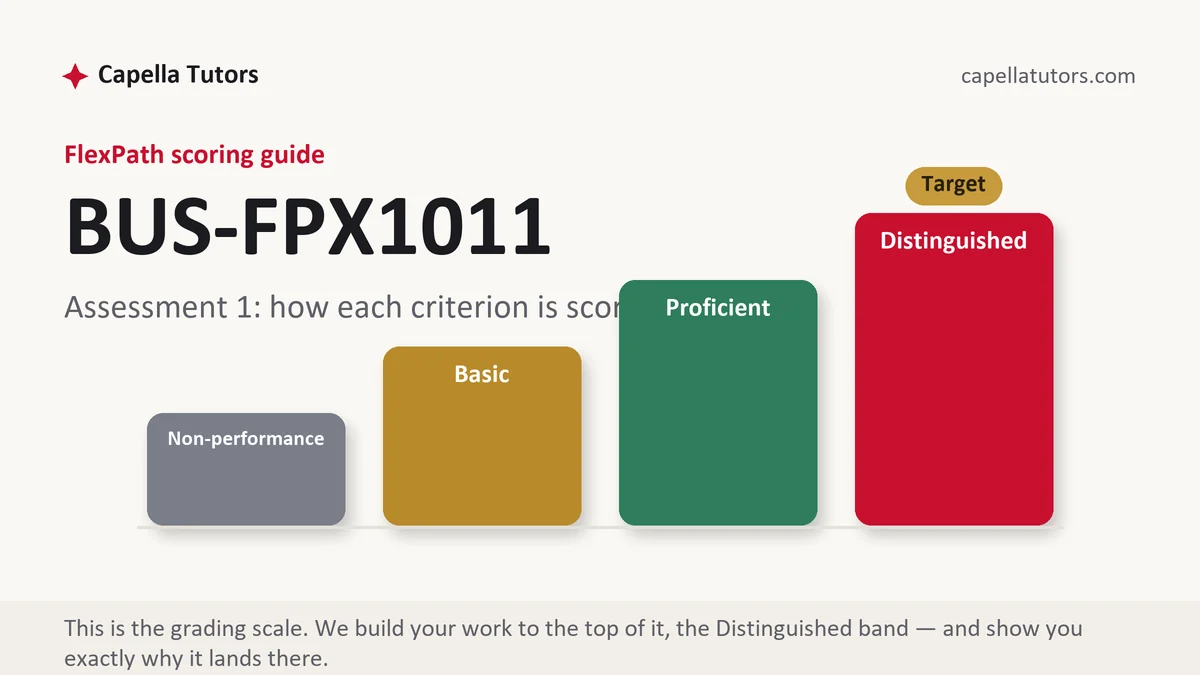
How BUS FPX 1011 Assessment 1 is scored
FlexPath does not use letter grades. Each criterion in the scoring guide lands on one of four levels, and the level descriptions are the real writing brief:
| Level | What it means on a management scenario paper |
|---|---|
| Distinguished | Effective management characteristics and behaviors are explained with sources and tied to the scenario, the planning process is specific with goals, tasks, roles and timeline, and the four functions of management are visible. |
| Proficient | All parts are accurate, but the plan is general. |
| Basic | The paper lists qualities with little connection to the scenario. |
| Non-performance | The characteristics, behaviors or planning process is missing. |
Use the scenario and any template your courseroom provides. Keep the plan concrete.
The BUS FPX 1011 Assessment 1 method, step by step
-
Read the scenario
What the manager must deliver, for whom and by when.
-
Describe effective managers
Two or three characteristics with sources.
-
Describe behaviors
How the manager should communicate, delegate and support the team.
-
Set goals
What success looks like for the initiative.
-
Plan tasks and roles
Who does what, with a timeline.
-
Add controls
How progress will be checked and problems handled.
A structure that maps to the criteria
Word counts are planning targets our tutors use, not Capella rules; follow the length and format your scoring guide states.
| Section | What it must do | Guide |
|---|---|---|
| Introduction | The scenario and the manager's task. | ~50 words |
| Characteristics of effective managers | With sources. | ~125 words |
| How managers should behave | Behaviors toward the team. | ~100 words |
| Planning process | Goals, tasks, roles and timeline. | ~150 words |
| Summary and references | Close, then references. | ~50 words |
Annotated sample excerpt
An original model excerpt from our team, written to show the register that reaches the top of the guide. Learn the moves, then write your own version.
The first planning step is to fix the goal: by the Friday of activity week, at least 70 percent of staff will have joined one event, measured by sign-in sheets.1 Organizing follows from that goal, so each department lead runs one event, the manager books rooms and budget two weeks ahead, and a shared calendar shows every event and its owner.2 Control is a short check-in each morning of the week, where leads report attendance and problems, so the manager can move resources before an event fails rather than after.3
- 1Sets a measurable goal.
- 2Organizes tasks and owners from the goal.
- 3Adds a control step, showing the management functions working together.
The full premium sample for your exact assessment, written fresh to your scoring guide and topic, is free to request. Study it, revise it into your own voice, and submit work you understand.
The five mistakes that cost Distinguished
- Qualities without the scenario. Tie each point to the task.
- A plan without owners. Assign roles.
- No timeline. Set dates.
- No controls. Say how progress is checked.
- No sources. Support claims about effective managers.
Pre-submission checklist
- Scenario understood
- Characteristics with sources
- Manager behaviors
- Goals, tasks, roles and timeline
- Controls
- References
Want the management scenario paper written?
Send the scoring guide and any materials from your courseroom. Our team returns a premium original management scenario paper in 24 to 48 hours, revised free until it meets the guide.