This manual is for BHA FPX 3112 Assessment 2, start to submission. The assessment usually asks you to compute something and then say what it means: an elasticity from a price change and the demand response that followed, or a patient's share of a bill under a stated benefit design. The coefficient is the easy half. The criterion lives in the sentence afterward, the one that tells a manager what to do about the number. The method follows, with a criterion-mapped structure and an annotated sample excerpt underneath it. Rather we worked the numbers? A premium original sample using your figures comes back in 24 to 48 hours, revised at no charge until the guide is satisfied. Capella's catalog lists the course as BHA-FPX3112, and some courserooms print BHA3112; both point to this same Assessment 2.
One honesty note before the manual: Capella revises courses and scoring guides over time, so always write to the exact scoring guide attached to your assessment in the courseroom. The course identity above is verified on capella.edu; the method and structure below are our tutors' approach to it, not Capella's official rubric text.
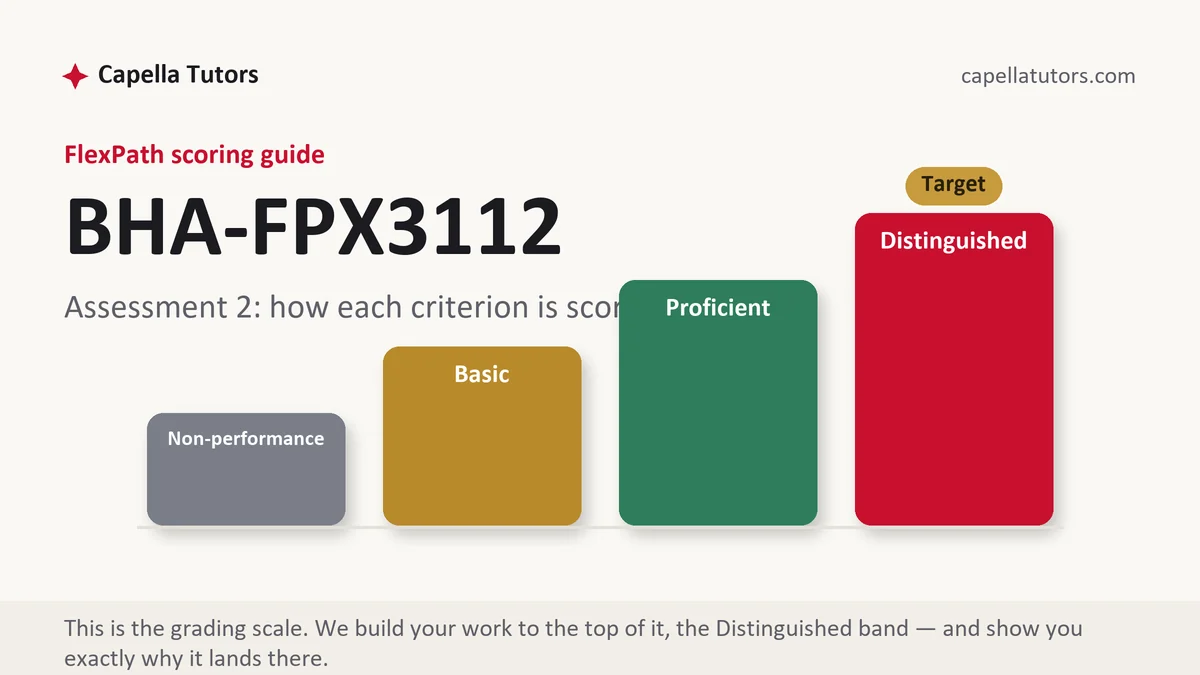
How BHA FPX 3112 Assessment 2 is scored
Criteria are scored on four levels in FlexPath, and the level text is what your section has to deliver:
| Level | What it means on a calculation and interpretation deliverable |
|---|---|
| Distinguished | The formula is visible, the signs are correct, the units are labeled, and every result is followed by one plain sentence a manager could repeat, including what the result implies the organization should stop doing. The criterion contains one additional move; find it and make it. |
| Proficient | The arithmetic is correct and interpreted accurately. Complete work whose consequence stays inside the calculation. |
| Basic | A coefficient reported with no sign, no units and no statement of what should happen next. |
| Non-performance | A required calculation is missing or unreadable. An absent computation cannot be graded, however well the surrounding prose reads. |
Inelastic demand is the usual finding in health care, and it has a consequence students often miss. If raising a price barely reduces use, then a price increase intended to discourage unnecessary visits has failed at that job while succeeding at collecting more money, and saying so is the analysis.
The BHA FPX 3112 Assessment 2 method, step by step
-
Criteria to headings, then set out the given figures
Copy the numbers the prompt supplies into a short table before you write anything, with a unit and a period beside each. Half the errors in this deliverable are transcription errors that survive because nobody ever laid the inputs out.
-
Compute the percentage changes separately
Work out the change in quantity and the change in price as their own figures, each against its own starting value, before dividing. Combining the two steps in one line is how the sign gets lost, and a positive elasticity for an ordinary service tells the reader the arithmetic went wrong.
-
Interpret the magnitude in words
Below one in absolute terms means use barely responds, above one means it responds more than proportionally. Say which side you landed on and what that implies for revenue, because the revenue direction is the part a manager actually needs.
-
Count what stopped happening
Convert the percentage response back into units: visits, prescriptions, tests. Then note that evidence on cost sharing has consistently found people reduce necessary and unnecessary care at similar rates rather than pruning wisely, which matters if the change was meant to be selective.
-
Run cost sharing in the right order
Deductible first, then coinsurance on what remains of the allowed amount, then check the running total against the out of pocket maximum. Show each step so the reader can follow it rather than trust it.
-
Write the manager's sentence, then self-score
Finish each calculation with one sentence naming the decision it supports. Then mark each criterion D, P, B or N, rewrite anything below D, and submit early in the week since an attempt can sit with an evaluator for two business days.
A structure that maps to the criteria
These are planning targets our tutors use for a calculation deliverable at this level rather than Capella rules; expand whichever section your guide treats as the core.
| Section | What it must do | Guide word target |
|---|---|---|
| The scenario and the inputs | The decision, the given figures, and a unit and period for each one. | ~200 words |
| The elasticity | Both percentage changes, the division, the coefficient with its sign, and the classification. | ~300 words |
| What it means for use and revenue | The units of service that stopped, and the direction of total collections. | ~250 words |
| Cost sharing worked | Deductible, coinsurance and the maximum applied in order, with each step shown. | ~250 words |
| Consequence and caution | The decision each figure supports, and what the evidence on cost sharing warns about. | ~250 words |
| References | Classic cost sharing evidence credited to its origin, federal series dated, current APA. | as needed |
Annotated sample excerpt
An original model paragraph from our team, at the register the guide rewards at the top. Study material: take the sequence and substitute your own inputs.
When the self-funded employer plan raised the member copay for virtual primary care visits from 15 dollars to 25 dollars, a 66.7 percent increase, monthly virtual visits across the covered group fell from 2,850 to 2,520, a decrease of 11.6 percent, giving an elasticity of negative 11.6 divided by 66.7, or about negative 0.17.1 Demand this inelastic means the increase raised collections rather than curbing use, since copay revenue moved from 42,750 dollars a month to 63,000, and it also means roughly 330 visits a month stopped happening.2 That is the number worth arguing about, because the evidence on cost sharing has consistently found that patients cut necessary and unnecessary care at similar rates, so a plan that wanted to discourage low value visits has instead discouraged visits, and the sponsor should decide which of those two outcomes it was buying.3
- 1Both percentage changes are computed against their own starting values, then divided, and the coefficient arrives with its sign intact.
- 2The classification is translated into a revenue direction and a count of visits, so the result has consequences rather than a label.
- 3The caution from the cost sharing literature is applied to this decision, and the closing clause hands the sponsor an actual choice.
The full premium sample for your exact assessment, written fresh to your scoring guide and issue, is free to request. Study it, revise it into your own voice, and submit work you understand.
The five mistakes that cost Distinguished
- An elasticity with no sign. The negative is part of the answer, and a positive coefficient for a normal service signals an arithmetic error.
- A coefficient with no consequence. The number is half a criterion, and the other half is what the organization should do about it.
- Percentage changes taken from the wrong base. Each change is measured against its own starting value, and mixing bases produces a plausible wrong answer.
- Coinsurance applied before the deductible. The order changes the patient's share, and the sequence is part of what is being graded.
- Insurance treated as a discount card. Pooling risk is the actual mechanism, and every selection argument in this course rests on it.
Pre-submission checklist
- Each criterion has a section, and every given figure is listed with a unit and a period
- Both percentage changes are shown before the division
- The coefficient carries its sign and is classified in words
- The response is converted into units of service and a revenue direction
- Cost sharing is applied in order with each step visible and the maximum checked
- Every result is followed by a manager's sentence, and each criterion self-scored D
Calculations due and the interpretation unclear?
Send the prompt with the figures and the scoring guide. The draft comes back with the formula shown, the sign checked, the units labeled and a plain interpretation attached to every result, because that last part is where the criterion actually sits. Inside 24 to 48 hours, revised free until the guide is met.