This manual is for BHA FPX 3112 Assessment 3, start to submission. The assessment usually asks for a recommendation with the economics under it, and the distinction that decides most of the criteria is between a saving and a shift. A saving means fewer real resources were consumed. A shift means the same resources were consumed and somebody else paid. Both can be legitimate goals, and a paper that cannot tell them apart has not analyzed anything. Below is how we approach it, the structure we use, and an annotated sample excerpt. Prefer to delegate the argument? A premium original sample for this exact deliverable returns inside 24 to 48 hours, with free revision until the criteria are met. Capella's catalog lists the course as BHA-FPX3112, and some courserooms print BHA3112; both point to this same Assessment 3.
One honesty note before the manual: Capella revises courses and scoring guides over time, so always write to the exact scoring guide attached to your assessment in the courseroom. The course identity above is verified on capella.edu; the method and structure below are our tutors' approach to it, not Capella's official rubric text.
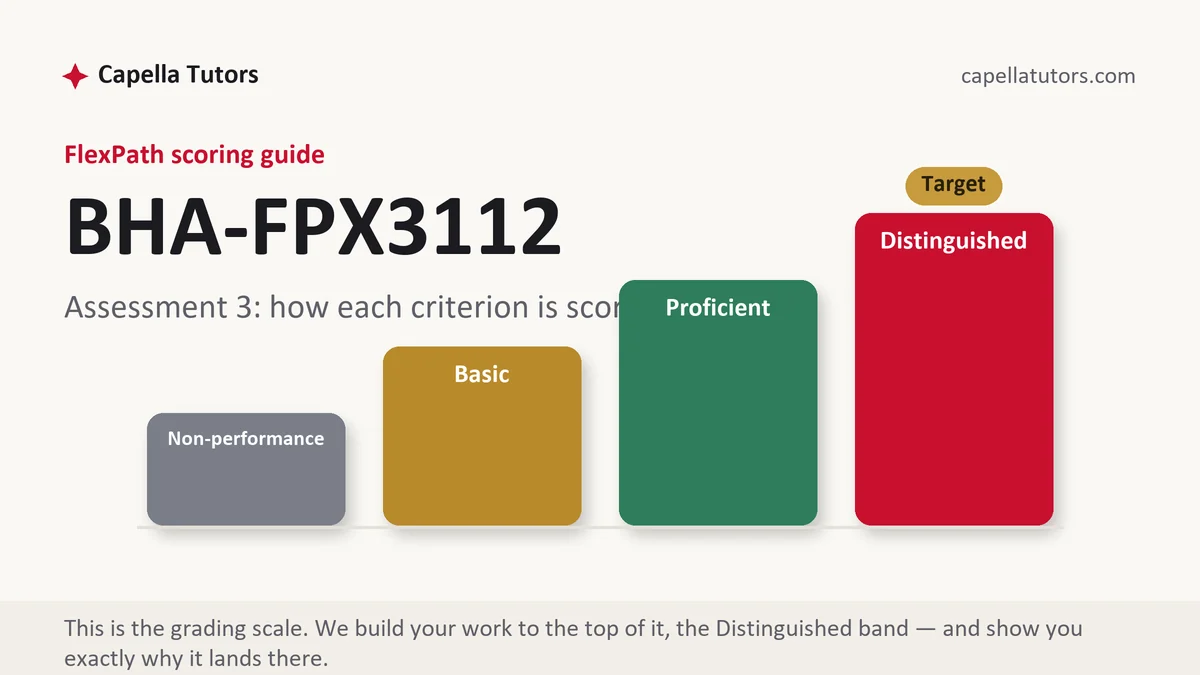
How BHA FPX 3112 Assessment 3 is scored
Every criterion in FlexPath is placed at one of four levels, and the level language is your specification:
| Level | What it means on a recommendation with an economic case |
|---|---|
| Distinguished | The recommendation names who gains, who pays and over what period, savings and shifts are distinguished explicitly, opportunity cost is stated, and one sensitivity line shows the case holding under a worse assumption. The criterion adds one move; find it and make it. |
| Proficient | The recommendation is supported and the reasoning is sound. Solid work that does not name whose ledger the benefit lands on. |
| Basic | A proposal described as cost effective, with prevention assumed to pay for itself and no party identified. |
| Non-performance | A required element is absent, most often the financial implication or the recommendation itself. An empty criterion cannot be argued back up. |
Prevention deserves the same discipline. It improves health reliably and saves money only sometimes, because screening a large population to find a small number of cases carries a cost of its own, and saying that plainly reads as sophistication rather than as pessimism.
The BHA FPX 3112 Assessment 3 method, step by step
-
Headings from the criteria, then the ledger question
Before writing, ask whose ledger every claim in your paper lives on: the organization, the payer, the patient, the employer or the family. A criterion asking you to analyze financial implications is asking exactly that, and answering it early keeps the argument honest.
-
Separate resources consumed from money moved
For each claimed benefit, say whether fewer hours, supplies or bed days were used, or whether the same work happened and a different party paid. A shorter stay can be either, and the paper has to state which one it is.
-
State the opportunity cost in the same units
Inside a fixed budget, the honest description of a choice is what the same dollars or the same hours would otherwise have bought. Name the alternative you are giving up, because a recommendation with no forgone option is not a decision.
-
Put the timeframe on the benefit
A cost avoided next month and a cost avoided in six years are not the same argument, particularly when the party paying now is not the party benefiting later. Say when the return appears and to whom, and note if the two parties differ.
-
Run one sensitivity line
Identify the assumption the case rests on and recompute at a less flattering value. Stating that the recommendation still holds if uptake reaches only two thirds of forecast is inexpensive to write and reliably persuasive.
-
Recommend in one sentence, then self-score
Close with a single sentence naming the action, the party acting, the period and the condition. Then mark each criterion D, P, B or N, rewrite anything below D, and submit early in the week to leave time for one revision.
A structure that maps to the criteria
Word counts here are planning targets our tutors use for a recommendation of this scope, not Capella requirements; expand whichever criterion the guide weights most.
| Section | What it must do | Guide word target |
|---|---|---|
| The decision | What is being proposed, for which service, and the period over which it would run. | ~200 words |
| Resources and money | What real resources change and what money merely moves, stated separately. | ~300 words |
| Who gains and who pays | Each party named, with the direction and rough size of the effect on each. | ~300 words |
| Opportunity cost | The alternative use of the same dollars or hours, and why this use beats it. | ~200 words |
| Sensitivity and recommendation | The key assumption flexed, the revised case, and the action in one sentence. | ~250 words |
| References | Spending and utilization series quoted with their year, policy sources framed as projections. | as needed |
Annotated sample excerpt
An original model paragraph from our team, pitched at the level the top column describes. Study material: take the reasoning pattern and apply your own case.
Moving eligible patients from inpatient completion of a two-week intravenous antibiotic course to home administration removes roughly nine bed days per patient at an estimated 640 dollars a day in variable cost, which is a genuine resource saving only if the bed is then used by another admission and the readmission rate holds.1 Part of the remaining benefit is a shift rather than a saving: nursing time moves to a home infusion contract at 210 dollars a visit, and a share of the work moves to a family member who now manages a line and a pump without being paid for it, which is a real cost that appears on no ledger the hospital reads.2 The hospital gains within the month, the plan gains only if the total episode cost falls, and the family bears an unpriced burden immediately, so the recommendation is conditional: proceed for patients with a documented caregiver and a stable line, and hold the case at two thirds of forecast uptake, where the bed day saving still covers the contracted visits.3
- 1The saving is quantified and then made conditional on the bed being refilled, which is the test that separates a resource saving from an accounting one.
- 2The shift is named as a shift, including the unpaid family labor most drafts leave out entirely. Naming it is what the analysis criterion pays for.
- 3Three parties, three timeframes, and a sensitivity line inside the recommendation sentence rather than tacked on after it.
The full premium sample for your exact assessment, written fresh to your scoring guide and issue, is free to request. Study it, revise it into your own voice, and submit work you understand.
The five mistakes that cost Distinguished
- A shift described as a saving. If the same work happened and a different party paid, no resources were freed and the claim is wrong.
- A saving with no payer named. Money lands on somebody's ledger, and the criterion wants to know whose.
- Prevention assumed to pay for itself. It improves health reliably and saves money selectively, and the difference belongs in the paper.
- Opportunity cost left out. Inside a fixed budget, a choice is only describable by what it displaces.
- No timeframe on the benefit. A return arriving in six years to a different payer is a weaker argument than one arriving next quarter.
Pre-submission checklist
- Each criterion has its own section, in the order the guide sets
- Every claimed benefit is labeled as a resource saving or as a transfer
- Each affected party is named with the direction and rough size of the effect
- The opportunity cost is stated in the same units as the benefit
- The benefit carries a timeframe, and any mismatch between payer and beneficiary is noted
- One sensitivity line included, and every criterion self-scored D before submission
Recommendation section to write?
Send the prompt and the scoring guide and tell us which change you are arguing for. The draft names who gains, who pays and over what period, separates resources consumed from money moved, and carries a sensitivity line on the assumption the case rests on. Back in 24 to 48 hours, revised without charge until each criterion is cleared.