This manual is for BHA FPX 3112 Assessment 1, start to submission. The assessment usually asks you to look at a health care market or a pricing question and reason about it economically, which starts with keeping four words apart: cost is what the organization spends to produce the service, charge is the list price, payment is what the payer sends after the contract applies, and out of pocket is the share the patient owes. A paper that slides between them has not made a stylistic error, it has lost the ability to say anything true. Below is the method our tutors run, a structure taken from the criteria, and an annotated sample excerpt. Prefer to hand the reasoning over? A premium original sample for this assessment lands inside 24 to 48 hours, revised free until every criterion is cleared. Capella's catalog lists the course as BHA-FPX3112, and some courserooms print BHA3112; both point to this same Assessment 1.
One honesty note before the manual: Capella revises courses and scoring guides over time, so always write to the exact scoring guide attached to your assessment in the courseroom. The course identity above is verified on capella.edu; the method and structure below are our tutors' approach to it, not Capella's official rubric text.
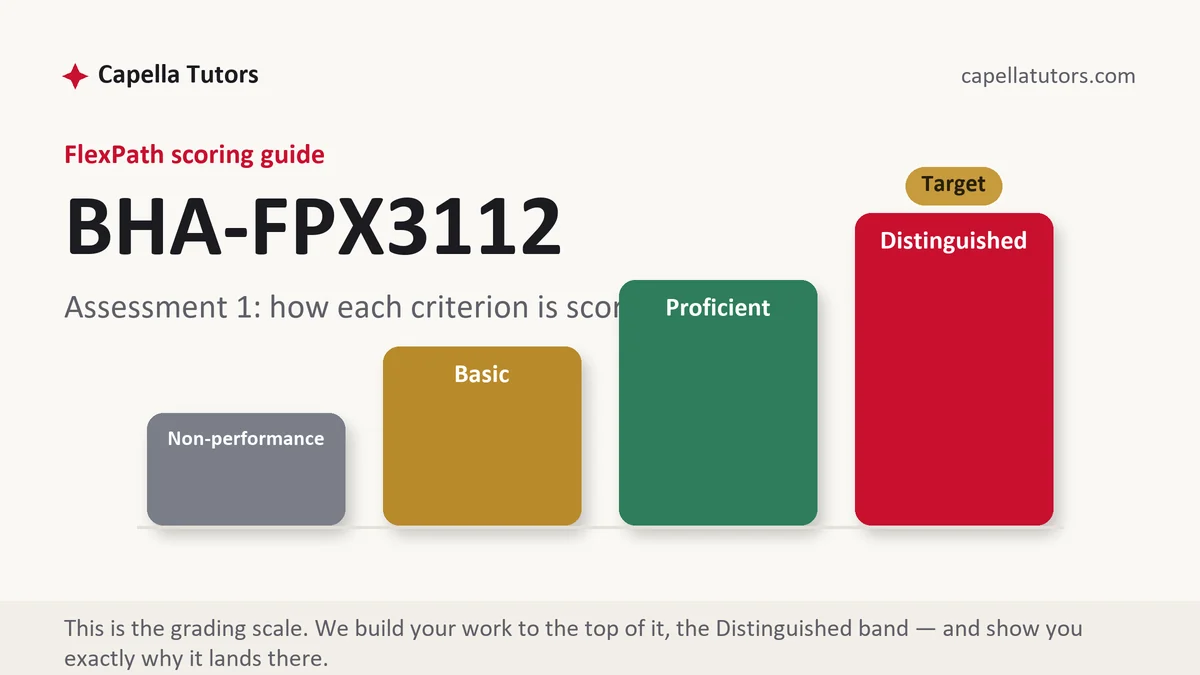
How BHA FPX 3112 Assessment 1 is scored
FlexPath scores each criterion at one of four levels, and the level wording is the nearest thing to a set of instructions:
| Level | What it means on a market and pricing analysis |
|---|---|
| Distinguished | The four money words stay separate and each carries a source, the market feature is named accurately rather than gestured at, the question is framed at the margin, and every figure has a unit and a period. There is always one more move written into the criterion; find it and make it. |
| Proficient | Concepts are defined correctly and applied to the scenario. Accurate work that does not reach a comparison with a conclusion. |
| Basic | The chargemaster price treated as the value of the service, with competition discussed as though the market behaved like any other. |
| Non-performance | A required element is absent, most often the application to the scenario. An empty criterion cannot be rescued by the section next to it. |
Undergraduate criteria in this course usually read explain, apply and analyze, and those verbs want different amounts of work. Explain wants the concept defined, apply wants it used on the scenario in front of you, and analyze wants a comparison with a conclusion attached.
The BHA FPX 3112 Assessment 1 method, step by step
-
Headings from the criteria, then the vocabulary fixed
Write the four money words at the top of your draft with the figure you will use for each, and check every later paragraph against that list. Most confused passages in this course are one substitution away from being correct.
-
Put a worked line early
Show one service with its charge, its contracted payment, its cost to deliver and what is left over. Four numbers in one sentence settle the vocabulary question for the whole paper and demonstrate the distinction faster than three paragraphs of definitions.
-
Frame the question at the margin
The economic question is never whether a service is valuable, it is whether one more unit of it is worth what the next unit costs. Rewrite the prompt into that form before you analyze anything, and the analysis criterion becomes much easier to satisfy.
-
Name the market feature precisely
Moral hazard is the extra use that follows from facing a lower price at the point of service, not an accusation of bad faith. Adverse selection is what happens when the people most likely to need coverage are the most likely to buy it. Information asymmetry means the supplier often tells the buyer what to purchase. Use the right one.
-
Say what constrains entry and supply
Licensure, certificate of need review and long training pipelines are why a shortage does not resolve the way an ordinary market's would. Where a state review process applies to your scenario, name it and say what it changes about who can compete.
-
Attach a unit to every figure, then self-score
Per visit, per member month, per case, per year. A number that could be any of those is where most of the lost marks in this course are hiding. Then grade each criterion D, P, B or N and rewrite anything below D.
A structure that maps to the criteria
The counts below are planning targets our tutors use on a market analysis at this level, not Capella rules; expand whichever criterion the guide clearly weights.
| Section | What it must do | Guide word target |
|---|---|---|
| The decision or question | The scenario stated as an economic problem, with the unit of service and the period defined. | ~200 words |
| Cost, charge and payment | The four figures kept apart for one named service, each with its source. | ~250 words |
| Demand and the payer's role | Who chooses, who pays, and how insurance changes the demand the organization faces. | ~300 words |
| Supply and entry | Licensure, review requirements, capital and workforce constraints on who can compete. | ~250 words |
| Analysis and position | The marginal question answered, with a conclusion and the assumption it rests on. | ~250 words |
| References | Classic results credited to their origin, federal series quoted with year, current APA. | as needed |
Annotated sample excerpt
An original model paragraph from our team, written where the top column of the guide sits. Study material: take the moves and run your own market through them.
A moderate complexity emergency visit at the proposed freestanding site would be charged at 2,650 dollars, is contracted with the largest commercial plan in the county at 1,120 dollars, and costs the operator an estimated 890 dollars to deliver once the facility fee, staffing and supplies are allocated, leaving 230 dollars of contribution per visit before the site's fixed base is touched.1 The 2,650 dollar figure matters only to a patient with no coverage and no negotiated rate behind them, and it is the number that will appear in local press coverage if the site opens.2 Entry here is not a matter of capital alone: the state's certificate of need review applies to the emergency department designation, both incumbent systems have standing to oppose the application, and the marginal question for the county is therefore not whether emergency capacity is valuable but whether the next unit of it is worth 890 dollars a visit when two existing departments run below their staffed capacity on weekday nights.3
- 1Charge, contracted payment, cost and contribution appear in one sentence with the allocation basis stated. The vocabulary problem is solved before the analysis starts.
- 2The charge is placed where it belongs, as the figure facing the uninsured and the press rather than as a measure of value.
- 3The review requirement is named and the question is reframed at the margin, with the incumbents' spare capacity supplying the comparison.
The full premium sample for your exact assessment, written fresh to your scoring guide and issue, is free to request. Study it, revise it into your own voice, and submit work you understand.
The five mistakes that cost Distinguished
- The charge line treated as the cost line. The chargemaster price is a negotiating artifact, and an argument built on it collapses on inspection.
- Market terms used loosely. Moral hazard, selection and asymmetry describe different mechanisms, and swapping them costs the accuracy criterion.
- A judgment instead of a marginal question. Whether care is valuable is not an economic question; whether the next unit is worth its cost is.
- Entry treated as free. Licensure and state review decide who can compete, and leaving them out describes a market that does not exist.
- Figures without units or periods. A number that could be per visit or per year is a number the evaluator cannot check.
Pre-submission checklist
- Every criterion has its own section, in the guide's order
- Cost, charge, payment and out of pocket are defined once and never swapped
- One worked line shows all four figures for a single named service
- The market feature is named precisely and applied to this scenario
- Entry constraints including any state review requirement are addressed
- Every figure carries a unit and a period, and each criterion is self-scored D
Economics assessment due?
Send the prompt, the scoring guide and any figures your instructor supplied, and those are the figures we use. One pass through the studio exists purely to recompute the arithmetic and confirm the interpretation attached to it is the right way round. Delivered in 24 to 48 hours, with revision free until the guide is satisfied.