This manual is for BHA FPX 3010 Assessment 1, start to submission. The assessment usually asks you to turn a concern into a question that can actually be searched, then to document the search that follows it: the databases, the terms and how you combined them, the filters, how many results you screened and what you kept. A topic cannot be answered and a question can, and almost every later criterion in this course inherits whichever one you started with. The method our tutors use follows, with a criterion-mapped structure and an annotated sample excerpt. Prefer to hand this one off? A premium original sample for this deliverable returns inside 24 to 48 hours, revised at no charge until the guide is cleared. Capella's catalog lists the course as BHA-FPX3010, and some courserooms print BHA3010; both point to this same Assessment 1.
One honesty note before the manual: Capella revises courses and scoring guides over time, so always write to the exact scoring guide attached to your assessment in the courseroom. The course identity above is verified on capella.edu; the method and structure below are our tutors' approach to it, not Capella's official rubric text.
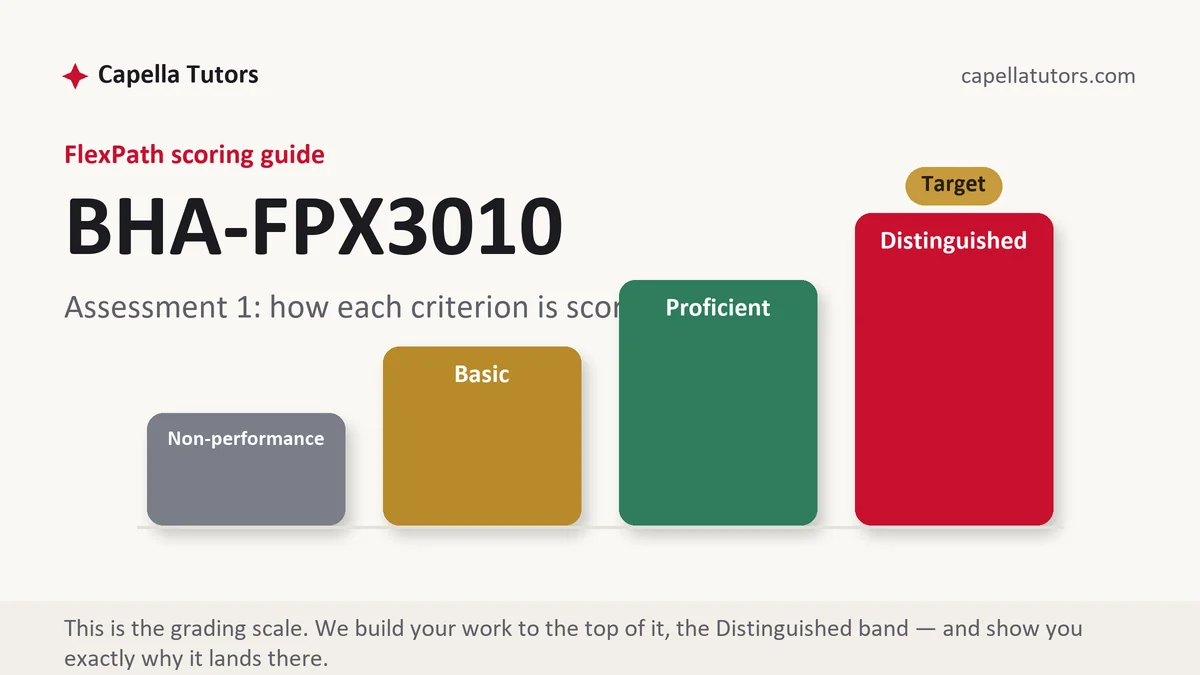
How BHA FPX 3010 Assessment 1 is scored
FlexPath scores criteria on four levels rather than awarding a grade to the paper, and the level wording is your brief:
| Level | What it means on a question and search deliverable |
|---|---|
| Distinguished | The question names a population, an intervention or exposure, a comparison, an outcome and a time frame, the search is reproducible from the description alone, and the write-up says what the search returned and what it failed to return. The criterion always wants one more move; find it and make it. |
| Proficient | The question is answerable and the search is described. Correct work whose search another student could not repeat exactly. |
| Basic | A topic stated as a question, followed by a list of articles found without any account of how. |
| Non-performance | A required element is missing, most often the search documentation. Nothing recovers a criterion that has no content under it. |
Administrative questions take the same shape as clinical ones even when nothing medical is being tested, and getting an administrative question into that form is one of the most reliable ways to earn the first criterion outright.
The BHA FPX 3010 Assessment 1 method, step by step
-
Criteria into headings, question at the top of the page
Give every criterion a section, then write your question and keep it visible while you work. Research assessments drift toward whatever the sources happen to discuss, and a question in view is the cheapest correction available.
-
Break the concern into its five parts
Population, intervention or exposure, comparison, outcome, time frame. Write each part on its own line before joining them into a sentence, because a part you cannot fill is usually a part you have not decided, and deciding it now saves the search from returning a field instead of a set of studies.
-
Turn the parts into search terms deliberately
Each concept becomes a group of synonyms joined with OR, and the groups are joined with AND. Add the controlled vocabulary the database uses alongside your own words, since a database index and a plain-language phrase rarely return the same set.
-
Run the search in a library database, not a search engine
The Capella databases covering nursing, allied health, biomedical literature and business let you filter for peer review and for a publication window, which a general web search cannot do. Record the database, the date you searched, and the exact string.
-
Screen in two passes and say what you excluded
Titles and abstracts first, then full text on whatever survives. Report the counts at each stage and give the reason articles fell out, because a criterion asking for a documented search is asking to see the funnel rather than the final list.
-
Read one full text before you commit, then self-score
Open the methods section of at least one result to confirm the question is answerable with the literature that exists. Then mark each criterion D, P, B or N and rewrite anything below D before submitting early in the week.
A structure that maps to the criteria
These counts are planning targets our tutors use for a question and search deliverable, not Capella rules; expand any section your guide clearly emphasizes.
| Section | What it must do | Guide word target |
|---|---|---|
| The concern | The administrative or clinical problem, its setting, and why it is worth investigating now. | ~200 words |
| The question | All five parts identified separately, then assembled into one sentence a database could act on. | ~250 words |
| Search strategy | Databases, controlled vocabulary and keywords, the combinations used, and the filters applied. | ~300 words |
| Screening and results | Counts at each stage, the reasons for exclusion, and what was retained. | ~250 words |
| What the search shows | Whether the literature can answer the question, and where the evidence is thin. | ~200 words |
| References | Retained studies in current APA, cited to the study rather than to a description of it. | as needed |
Annotated sample excerpt
An original model paragraph from our team, written at the level the top column describes. Study material: take the structure, then build your own question.
Among adult patients scheduled for routine restorative appointments at a federally qualified health center's dental clinic, does a two-way text reminder sent 48 hours before the visit, compared with the current single automated voice call, reduce the missed appointment rate over a six month period?1 The search combined three concept groups, one for the population, one for the reminder technology and one for attendance, each expanded with synonyms and with the subject headings each database applies, and it was run in CINAHL, PubMed and Business Source Complete on 14 July 2026 with filters for peer-reviewed English language work published since 2019.2 The three databases returned 214 records, 168 remained after duplicates were removed, 31 survived title and abstract screening, and 9 were retained after full text review, with the most common reason for exclusion being studies of reminder systems in inpatient rather than ambulatory settings.3
- 1All five parts are present in one sentence, and the comparison is the practice the clinic runs today rather than the absence of any reminder at all.
- 2Databases, concept groups, subject headings, search date and filters make the strategy reproducible, which is the criterion in a single sentence.
- 3The funnel is reported with counts at each stage and one stated reason for exclusion, which is what distinguishes a documented search from a bibliography.
The full premium sample for your exact assessment, written fresh to your scoring guide and issue, is free to request. Study it, revise it into your own voice, and submit work you understand.
The five mistakes that cost Distinguished
- A topic with a question mark on the end. Appointment attendance and technology cannot be searched, and every later criterion inherits the vagueness.
- No comparison group. A question with nothing to compare against cannot identify a relevant study, because the literature is organized around contrasts.
- A search nobody could repeat. Naming a database without the terms, the combinations and the filters leaves the criterion unanswered.
- General web results dressed as literature. A source found outside a library database is far more likely to sit in a journal that publishes for a fee.
- Screening counts left out. Without the funnel there is no evidence any screening happened, and the criterion is asking for exactly that evidence.
Pre-submission checklist
- Each criterion has its own section, in the order the guide sets out
- The question names a population, an intervention or exposure, a comparison, an outcome and a time frame
- Search terms are grouped by concept and joined with the database's own vocabulary
- Databases, search date, filters and exact combinations are all recorded
- Counts are reported at each screening stage with reasons for exclusion
- At least one full text read before committing, and every criterion self-scored D
Question and search due?
Tell us the concern your instructor approved and send the scoring guide. A research analyst builds the search first, so the strategy in your sample is one you could rerun and get the same set. Back in 24 to 48 hours, written to the top column, revised free until the guide is met.