This manual is for BHA FPX 3010 Assessment 2, start to submission. The assessment usually asks you to hold one study up to the light: name its design from the methods section rather than the abstract, describe who was in it and how they were selected, judge how much weight the result can carry, and say what it does and does not support for a setting like yours. Appraisal is a reading skill, and the criteria are written to test whether you read past the summary. What follows is the appraisal method, a structure built to the criteria, and an annotated sample excerpt. Would you rather we appraised it? A premium original sample on your assigned article comes back in 24 to 48 hours, with free revision until every criterion clears. Capella's catalog lists the course as BHA-FPX3010, and some courserooms print BHA3010; both point to this same Assessment 2.
One honesty note before the manual: Capella revises courses and scoring guides over time, so always write to the exact scoring guide attached to your assessment in the courseroom. The course identity above is verified on capella.edu; the method and structure below are our tutors' approach to it, not Capella's official rubric text.
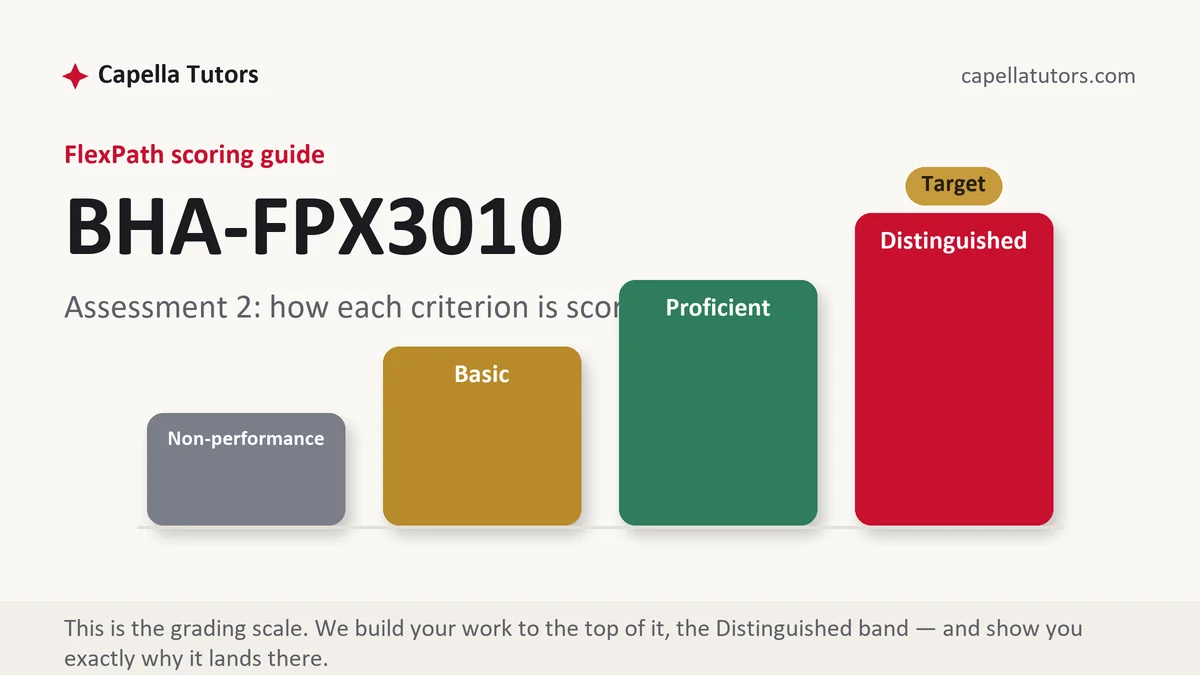
How BHA FPX 3010 Assessment 2 is scored
Each criterion in FlexPath sits at one of four levels, and the level text is the closest thing to a writing prompt you will be given:
| Level | What it means on a study appraisal |
|---|---|
| Distinguished | The design is named from the methods, the sampling and its limits are stated, the verbs match what the design can support, and the appraisal reaches a judgment about transferability with a reason attached. One extra move is written into the criterion; find it and make it. |
| Proficient | The design is identified correctly and the study is summarized accurately. Competent work that stops before judgment. |
| Basic | A summary of the abstract with the authors' own conclusion repeated as though it were an appraisal. |
| Non-performance | A required element is missing, most often the limitations or the sampling method. Nothing else in the section can compensate. |
Design decides the verb. A trial that randomized participants supports caused, a cohort followed forward supports was associated with and preceded, and a survey taken at one moment supports occurred together with. Matching the verb to the design quietly earns most of the appraisal criterion.
The BHA FPX 3010 Assessment 2 method, step by step
-
Build the outline from the criteria, then read the methods first
Give each criterion a heading, then open the article at the methods section rather than the abstract. The abstract reports the result and omits the design details the criteria are graded on, which is why appraisals written from abstracts read as thin from the first paragraph.
-
Name the design in one sentence and defend the naming
Say what kind of study it is and point to the sentence in the methods that establishes it. A review article written by an expert is not a systematic review, and a study that compared two clinics is not randomized simply because the outcomes differed.
-
Describe the sample as recruited, not as reported
Who was eligible, how they were selected, how many were approached and how many finished. Attrition matters as much as size, since a large study that lost a third of its participants may be less trustworthy than a small one that kept everybody.
-
Read the outcome measure before the result
Check what was actually counted and how it was ascertained, because two studies of the same topic often measure different things. A self-reported outcome and one taken from a record system are not interchangeable, and the difference belongs in your appraisal.
-
Judge weight rather than quality in the abstract
Say how much this study can carry for your question and why: the design, the setting, the population match, the recency and the funding or conflict statement if there is one. Weight is a comparative judgment, so name what would carry more.
-
Write the transferability sentence, then self-score
State what the finding supports in a setting like the one in your question and what it does not, arguing from the study's own setting rather than assuming it travels. Then grade each criterion D, P, B or N and rewrite whatever falls short.
A structure that maps to the criteria
These are planning targets our tutors apply to an appraisal of a single study, not Capella requirements, so expand whichever section your guide treats as the centerpiece.
| Section | What it must do | Guide word target |
|---|---|---|
| The study and the question | Full citation, the question the study asked, and how it relates to your own. | ~200 words |
| Design | The design named, the evidence for that naming, and what the design can establish. | ~250 words |
| Sample and setting | Eligibility, selection, size, attrition and the setting the work was conducted in. | ~250 words |
| Measures and findings | What was counted, how it was ascertained, and what the study reported in its own terms. | ~300 words |
| Weight and transferability | How much this evidence can carry, what would carry more, and what it supports for your setting. | ~250 words |
| References | The study cited directly in current APA, with any supporting sources matched both ways. | as needed |
Annotated sample excerpt
An original model paragraph from our team, written at the level the guide describes at the top. Study material: learn the moves and appraise your own article.
The methods section establishes this as a cluster randomized trial rather than a patient-level one: eighteen prenatal practices were allocated to group visits or to individual visits, and every patient within a practice received whatever that practice was assigned, which is why the authors adjusted for clustering when they analyzed the outcome.1 Of 1,062 participants enrolled across the eighteen sites, 934 remained at the primary outcome assessment, and the practices were recruited from two metropolitan health systems that had already expressed interest in group models, which is a selection condition the authors name and it limits how far the result travels.2 The design supports a causal verb, so the finding can be reported as an effect rather than as an association, and it carries more weight for a large urban practice than for a rural clinic with two prenatal providers and no room that seats ten.3
- 1The design is named and then proved from the methods, with the analytic consequence of clustering mentioned rather than skipped.
- 2Enrollment, retention and the recruitment condition all appear, so the reader can see what the sample is and where it came from.
- 3The verb is matched to the design and the transferability judgment is argued from setting, which is the sentence separating the top two columns.
The full premium sample for your exact assessment, written fresh to your scoring guide and issue, is free to request. Study it, revise it into your own voice, and submit work you understand.
The five mistakes that cost Distinguished
- Appraising the abstract. Sample, design and limitations live in the body of the article, and those are the criteria being graded.
- Calling a review article a systematic review. One follows a stated protocol and the other reflects an expert's reading, and they carry different weight.
- Claiming a study proved something. Support, suggest and consistent with are the available verbs, and each one gets checked against the design.
- Judging qualitative work by sample size. Twenty-two well-chosen interviews can be entirely adequate, and counting them is a category error.
- Transferability assumed rather than argued. A result from an academic medical center does not arrive intact at a critical access hospital without a reason.
Pre-submission checklist
- Every criterion has a section, and the article is cited in full at the start
- The design is named from the methods with the evidence for the naming shown
- Eligibility, selection, enrollment and attrition are all reported
- The outcome measure and how it was ascertained appear before the result
- Verbs match what the design can support, throughout the paper
- Transferability is argued from setting, and every criterion self-scored D
Article appraisal on the calendar?
Send the article your instructor assigned along with the scoring guide, and the sample will appraise that study rather than an easier substitute. A research analyst reads the full text before drafting begins, and a second reviewer checks that every verb matches the design. Returned inside 24 to 48 hours, and revised without charge until the appraisal criteria are met.