This manual is for BHA FPX 3010 Assessment 3, start to submission. The assessment usually asks you to report what evidence found and what may be done with it: results stated in absolute as well as relative terms, precision reported rather than implied, an application to a named setting, and an ethics section that addresses the project in front of you rather than the principles in general. Reporting honestly is the technical skill; ethics applied by name is the criterion most often answered with filler. Below is how our tutors work it, the structure we write to, and an annotated sample excerpt. Prefer to delegate it? A premium original sample for this deliverable arrives inside 24 to 48 hours and is revised free until the guide is met. Capella's catalog lists the course as BHA-FPX3010, and some courserooms print BHA3010; both point to this same Assessment 3.
One honesty note before the manual: Capella revises courses and scoring guides over time, so always write to the exact scoring guide attached to your assessment in the courseroom. The course identity above is verified on capella.edu; the method and structure below are our tutors' approach to it, not Capella's official rubric text.
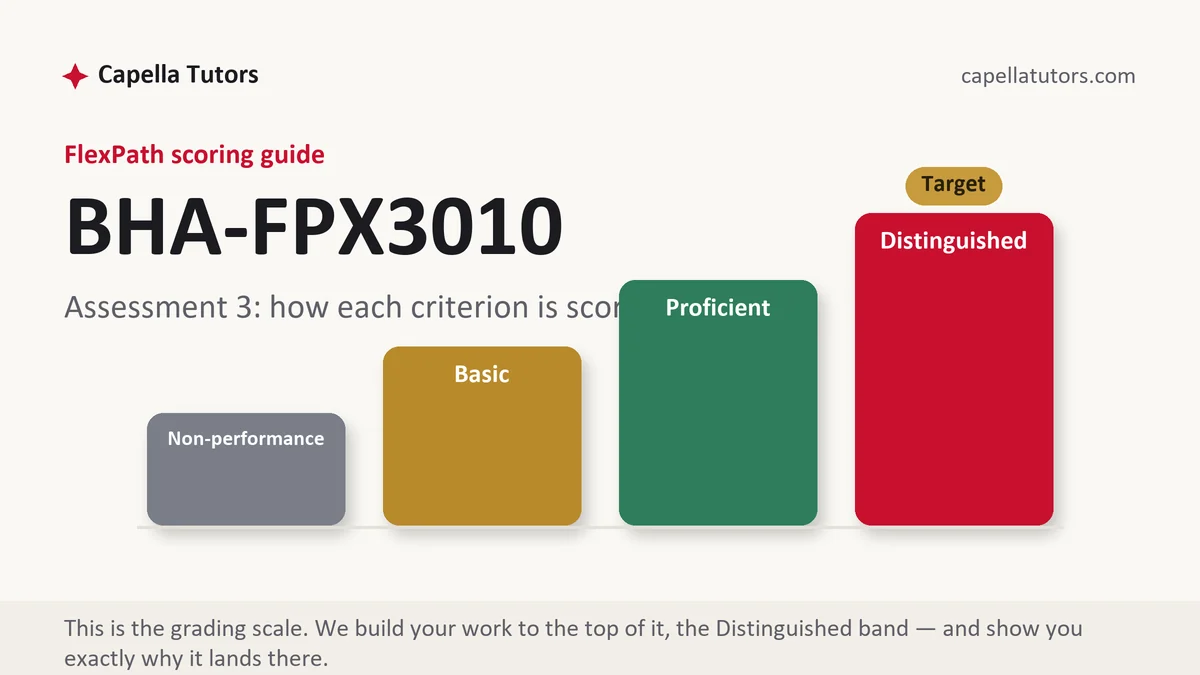
How BHA FPX 3010 Assessment 3 is scored
Criteria carry the grade in FlexPath and each one lands on a level whose language doubles as your instructions:
| Level | What it means on a findings and ethics deliverable |
|---|---|
| Distinguished | Absolute and relative effects are both reported with the interval and the design attached, the application names a setting and a limit, and the ethics section applies board review, consent and privacy to this specific project. The criterion always adds a step; find it and make it. |
| Proficient | Findings are reported accurately and ethics is addressed correctly. Sound work whose ethics stays at the level of principle. |
| Basic | A relative reduction quoted as the headline, an application that would suit any organization, and a paragraph about honesty and respect. |
| Non-performance | A required element is absent, most often precision or the privacy obligation. An empty criterion sits at the floor. |
A significance value says how unusual the data would be if there were no effect, and it says nothing about whether the effect is large enough to matter to a patient or to a budget. Writing that distinction into an undergraduate paper is unusual, and evaluators notice it.
The BHA FPX 3010 Assessment 3 method, step by step
-
Headings from the criteria, then the numbers before the prose
Give every criterion its own section, then extract the figures you will report and lay them out before you write a sentence around them. Results paragraphs written first and checked later are where the reporting criterion is usually lost.
-
Report the difference two ways in the same sentence
Give the absolute difference in percentage points and the relative change beside it. A large relative reduction on a small baseline sounds impressive and can amount to almost nothing, and a reader who only receives the relative figure has been misled without being lied to.
-
Attach the precision the study reported
Include the confidence interval around the effect, and say what it means when the interval is wide or crosses no difference. Precision converts a point estimate into a range of plausible truths, which is the honest version of any result.
-
Translate the effect into something countable
Say how many people would need the intervention for one outcome to change, or how many events a year the effect would represent in your setting. A figure a manager can hold is what turns reporting into application.
-
Apply the ethics rules to this project by name
Say whether a board would review it, what consent would have to look like for these participants, how identifiable information would be handled, and which side of the improvement and research boundary the work falls on. Then name who in a real organization decides that, since it is not the student's call.
-
State the limit, then self-score
Close by naming what the evidence cannot settle and what you would need to find out. Then mark every criterion D, P, B or N, rewrite anything under Distinguished, and submit early in the week to leave room for one revision.
A structure that maps to the criteria
Word counts below are planning targets our tutors use for a findings and ethics deliverable, not Capella rules; expand the section your guide weights most heavily.
| Section | What it must do | Guide word target |
|---|---|---|
| Question and evidence base | The question being answered and the studies that bear on it, with designs named. | ~200 words |
| What was found | Absolute and relative effects, the interval, and the authors' own caveats reported. | ~300 words |
| What it means in practice | The effect converted into people, events or dollars in a named setting. | ~250 words |
| Ethics for this project | Board review, consent, privacy and the improvement or research boundary, applied by name. | ~300 words |
| Limits and next steps | What the evidence cannot settle and what would have to be measured to settle it. | ~200 words |
| References | Primary studies cited directly, federal guidance cited to the agency, current APA both ways. | as needed |
Annotated sample excerpt
An original model paragraph from our team, at the register the top of the guide describes. Study material: take the reporting pattern and use your own figures.
In the retrospective comparison across the group's six orthopedic sites, same-day cancellations occurred in 8.7 percent of visits among patients who had exchanged at least one portal message in the prior week and in 11.9 percent among those who had not, an absolute difference of 3.2 percentage points and a relative reduction of about 27 percent.1 The reported interval around that difference ran from 1.4 to 5.0 percentage points, so the direction is reasonably firm and the magnitude is not, and the design is observational, which means portal use may be standing in for patients who are already more likely to attend.2 At the group's volume of roughly 26,000 visits a year, a genuine 3.2 point effect would represent about 830 fewer cancelled appointments, which is a figure a scheduling manager can weigh against the cost of the outreach that would be needed to produce it.3
- 1Both rates, the absolute difference and the relative change arrive together, so no reader takes away the flattering figure alone.
- 2Precision is reported and the design limit is named in the same breath, including the confounding explanation the data cannot rule out.
- 3The effect is converted into events a year in a named setting, with the conditional verb kept intact. That is application without overclaiming.
The full premium sample for your exact assessment, written fresh to your scoring guide and issue, is free to request. Study it, revise it into your own voice, and submit work you understand.
The five mistakes that cost Distinguished
- The relative figure alone. A twenty-seven percent reduction with no baseline behind it flatters the intervention and hides the size of the effect.
- No precision anywhere. A point estimate with no interval presents one number as though the study had settled the question.
- Significance mistaken for importance. A small value tells you about unusual data, not about whether anyone should change anything.
- Ethics written as principles. Respect, beneficence and justice have to be applied to this project, with the privacy obligation named.
- Application that fits anywhere. An implication a reader could paste into any paper is not an application, because nothing in it is about a setting.
Pre-submission checklist
- Every criterion has a labeled section, in the order the guide lists them
- Both rates, the absolute difference and the relative change appear together
- The reported interval is included and interpreted
- The effect is translated into people, events or dollars in a named setting
- Board review, consent, privacy and the improvement boundary are applied to this project
- Limits stated, primary studies cited directly, and every criterion self-scored D
Findings and ethics section due?
Send the studies, the scoring guide and the setting you are writing about. Our research analyst pulls the primary articles and reads past the abstracts, and one review pass exists to confirm that every figure and every verb matches the study it came from. Delivered inside 24 to 48 hours, with revision continuing free until every criterion is met.