This manual is for BHA FPX 3004 Assessment 2, start to submission. The assessment usually asks you to turn a quality problem into measurement: a defined set of indicators with numerators, denominators, time windows, data sources and benchmarks, presented so that a manager could read the result and act on it. Counting is not measuring, and the criteria are built to tell the difference. What follows is the method our tutors run on it, a structure built from the criteria, and an annotated sample excerpt. Rather hand it over? One premium original sample for this exact deliverable returns in 24 to 48 hours, revised free until the guide is cleared. Capella's catalog lists the course as BHA-FPX3004, and some courserooms print BHA3004; both point to this same Assessment 2.
One honesty note before the manual: Capella revises courses and scoring guides over time, so always write to the exact scoring guide attached to your assessment in the courseroom. The course identity above is verified on capella.edu; the method and structure below are our tutors' approach to it, not Capella's official rubric text.
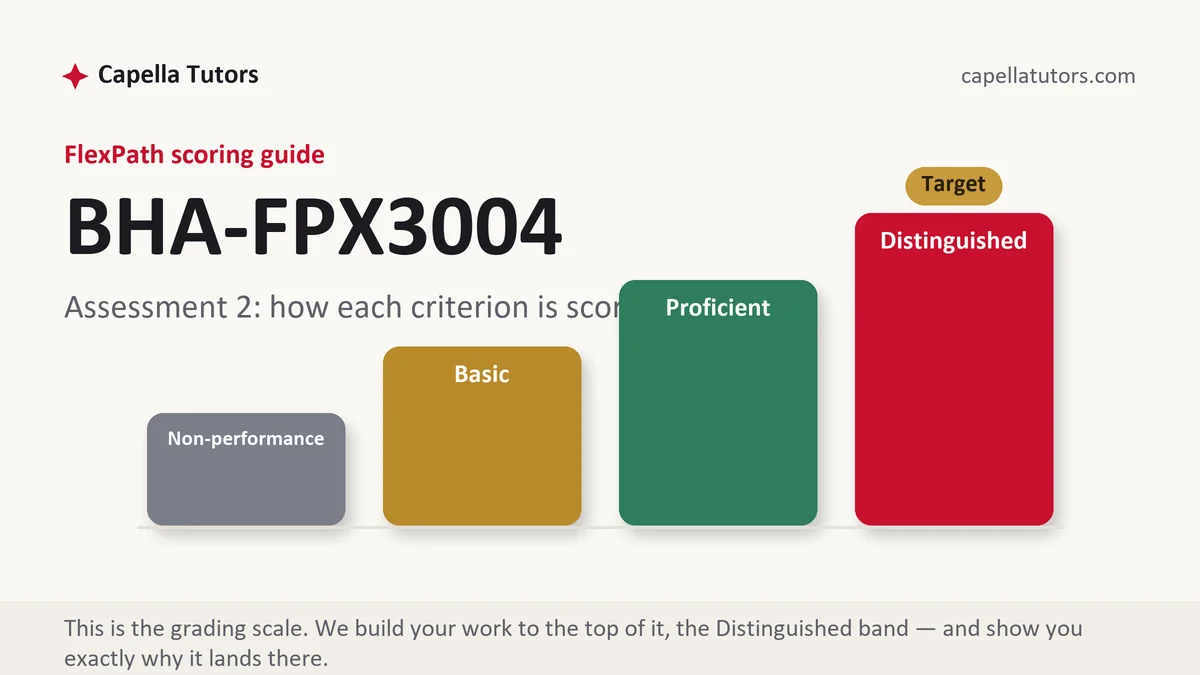
How BHA FPX 3004 Assessment 2 is scored
There are no letter grades in FlexPath. Every criterion lands on one of four levels, and the wording of the level is the specification you are writing to:
| Level | What it means on a measurement deliverable |
|---|---|
| Distinguished | Each indicator carries a numerator, a denominator, a window, a source and a comparison, the mix covers structure, process and outcome, and the write-up says what the reader should do when a figure moves. The criterion holds one further move inside it; find it and make it. |
| Proficient | Indicators are defined correctly and calculated correctly. Accurate, and still short of the top, usually because no interpretation is attached. |
| Basic | Counts presented as performance, with a benchmark quoted from somewhere and no denominator that matches it. |
| Non-performance | A required element is absent, most often the data source or the comparison period. Absent beats weak as a way to lose a criterion. |
The quiet skill being graded is restraint. A dashboard with six indicators that a department can collect beats a dashboard with twenty that nobody will ever populate, and saying why you dropped the other fourteen is itself an analysis.
The BHA FPX 3004 Assessment 2 method, step by step
-
Map the criteria to indicator slots
Before choosing anything to measure, list what the guide demands: how many indicators, which categories, whether a benchmark is required, whether a display is required. Then fill the slots. Students who choose measures first usually end up with four outcome measures and no process measure, which fails a criterion nobody read closely enough.
-
Define the denominator before the numerator
Decide who is eligible to be counted and over what period, then decide what counts as an event within that group. The denominator determines whether a comparison is possible at all, and choosing it second is how papers end up with rates that cannot be set against anything.
-
Mix structure, process and outcome deliberately
Structure describes what the organization has in place, process describes what was done to the patient, outcome describes what happened as a result. Outcomes move slowly, so a set built only on them will show nothing for two quarters. Say which of your measures is expected to move first and why.
-
Name a source and a collection method for every figure
Say where the number comes from, who pulls it, how often, and how long that takes. A measure specified without a source is a measure the organization cannot run, and a criterion asking for feasibility is asking for exactly this paragraph.
-
Attach a comparison, not a target pulled from air
Each indicator needs something to sit against: the unit's own prior period, a matched peer, a published state or national figure with its collection year, or a stated internal goal with the basis given. Then say plainly which comparison is fair and why the others are not.
-
Write the read, then self-score
Finish with a short interpretation of what a reader should conclude from each figure and what would trigger action. Then mark every criterion D, P, B or N yourself and rewrite anything below D. Submit early in the week, since a submitted attempt can sit with an evaluator for two business days.
A structure that maps to the criteria
Word counts are planning targets our tutors use for a measurement deliverable at this level, not Capella rules; expand where your scoring guide asks for more.
| Section | What it must do | Guide word target |
|---|---|---|
| Introduction and purpose | The service being measured, the decision the measurement supports, and who will read the result. | ~150 words |
| The measure set | Each indicator with its numerator, denominator, window, exclusions and category. | ~350 words |
| Data sources and feasibility | Where each figure comes from, who pulls it, how often, and what it costs in staff time. | ~200 words |
| Benchmarks and baseline | The comparison chosen for each indicator, its year and origin, and the current baseline value. | ~250 words |
| Interpretation and action | What a movement in each figure would mean and what the reader should do about it. | ~250 words |
| References | Measure specifications credited to their stewards, current APA, matched both ways. | as needed |
Annotated sample excerpt
An original model excerpt from our team, written at the register the top of the guide rewards. Read it as study material: the moves transfer, the sentences do not.
Indicator three measures timeliness in the general surgery service line of a 25-bed critical access hospital, defined as the proportion of scheduled first cases that enter the operating room at or before the posted start time, with the denominator limited to first cases on days the room was staffed and open.1 Across the four quarters ending in March the service ran 486 qualifying first cases, of which 291 started on time, a rate of 59.9 percent against an internal target of 80 percent.2 The figure is pulled monthly from the surgical scheduling module by the perioperative coordinator, takes roughly forty minutes to compile, and is reported beside a paired process measure, the proportion of cases with the pre-anesthesia record completed the day before surgery.3
- 1The denominator is stated with its exclusion in the same sentence, so a reader can recalculate the rate without guessing what was left out.
- 2Count, denominator, window and comparison arrive together. The gap is expressed as a rate against a stated target rather than as a judgment.
- 3Source, owner and effort make the measure feasible, and pairing it with a process measure means something will move before the outcome does.
The full premium sample for your exact assessment, written fresh to your scoring guide and issue, is free to request. Study it, revise it into your own voice, and submit work you understand.
The five mistakes that cost Distinguished
- A count wearing the word rate. Fourteen of anything is not a rate until a denominator and a window are attached to it.
- Benchmarks with no year. A national figure quoted without its collection period cannot be compared with a current quarter, and the evaluator will say so.
- All outcomes, no process. A set that measures only results will look flat for months and give a manager nothing to act on in the meantime.
- Measures nobody can pull. If no system holds the data and no role owns the extraction, the indicator is decorative.
- Numbers with no read. A table with no interpretation leaves the analysis criterion unanswered even when every figure is correct.
Pre-submission checklist
- Every criterion in the guide has a section, and every indicator slot the guide demands is filled
- Each indicator states numerator, denominator, window, exclusions and category
- Structure, process and outcome measures are all represented
- Every figure names a source, an owner and a collection frequency
- Each comparison carries its origin and its year, and the fairness of it is defended
- Self-scored D on every criterion, with the interpretation written before submission
Measurement plan due this week?
Send the scoring guide, the service you are measuring, and any figures the course handed you. Eight people build the deliverable, including a research analyst who pulls the measure specifications and two QA reviewers who recalculate every rate before it reaches you. Back in 24 to 48 hours, revised free until the guide is met.