This manual is for BHA FPX 3004 Assessment 1, start to submission. The assessment usually asks for a written analysis of one adverse event or performance problem in a health care setting, and the criteria want the event explained as the product of a system rather than the fault of the last employee who touched the work. That means a factual sequence first, contributing factors sorted across people, equipment, environment, policy and workload second, and a recommendation that answers the conditions you found rather than the person you found them around. What follows is the method our tutors apply to it, a structure keyed to the criteria, and an annotated sample excerpt. Prefer to hand it off? A premium original sample built to this prompt comes back in 24 to 48 hours, with revision free until the guide is cleared. Capella's catalog lists the course as BHA-FPX3004, and some courserooms print BHA3004; both point to this same Assessment 1.
One honesty note before the manual: Capella revises courses and scoring guides over time, so always write to the exact scoring guide attached to your assessment in the courseroom. The course identity above is verified on capella.edu; the method and structure below are our tutors' approach to it, not Capella's official rubric text.
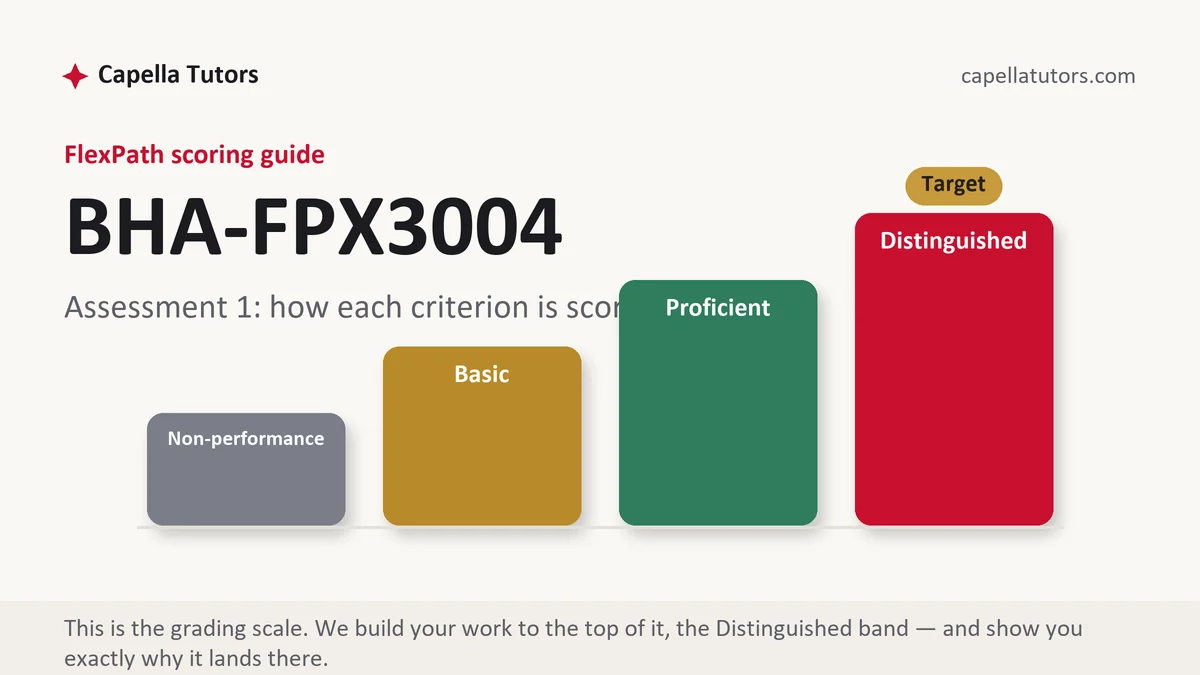
How BHA FPX 3004 Assessment 1 is scored
FlexPath has no letter grades. Each criterion on the scoring guide lands on one of four levels, and the level language tells you what to write:
| Level | What it means on an event analysis |
|---|---|
| Distinguished | The sequence is factual, the contributing factors reach past the individual into the conditions that produced the error, one factor is argued as the strongest with a reason, and the recommendation follows from that factor. One extra move is buried in the criterion wording; locate it and make it. |
| Proficient | The event is described accurately and the factors are identified completely. Correct, and one move short of the top of the guide, usually because nothing is ranked. |
| Basic | A narrative of what went wrong with an implied cause and a training recommendation attached. The most common landing spot for a first submission in this course. |
| Non-performance | A required element is absent, most often the systems analysis itself. Missing, not thin, is what puts a criterion on the floor. |
Two habits earn levels here and both are unglamorous. Write the sequence without adjectives, and separate what happened from why it happened into different sections, because a causal claim smuggled into a timeline gets graded twice and credited once.
The BHA FPX 3004 Assessment 1 method, step by step
-
Convert the scoring guide into headings first
Read the criteria before the prompt narrative. Each criterion becomes a heading in your outline, with its Distinguished sentence pasted underneath as the brief. Anything you write outside that outline is unpaid work, and the criterion that never received its own section is the one that scores lowest.
-
Choose an event you can actually reconstruct
Pick something with a sequence you can describe minute by minute, from your own workplace, from a published case, or from a scenario the course supplied. Vague events produce vague analysis. If you cannot say who did what and in what order, the causal criterion has nothing to hold.
-
Build the timeline before you build the argument
Write the sequence in the flattest language you own: times, roles, actions, what the setting was like that hour. No blame words, no conclusions. A reader should be able to disagree with your analysis later and still accept every sentence in the timeline as fact.
-
Work outward from the last hand to the conditions
Start at the final action and ask what made it available. Layered defenses with holes in them is the standard image, and the honest version of it names the packaging, the workflow step, the policy written for a different unit, and the workload on the shift. Then rank the factors and say which one you would remove first.
-
Give every source a job inside the argument
Three to five current sources, each earning its place: a federal safety agency for method or definitions, the accreditor for the expectation an accredited organization has to meet, and peer-reviewed research for the effect size. Put the citation inside the sentence doing the work, not stapled behind it.
-
Self-score, then hunt blame language
Mark each criterion D, P, B or N yourself and rewrite anything under D. Then read once for one thing only: every sentence that assigns fault to a person rather than describing a condition. Submit early in the week, since evaluation can take two business days and a Thursday attempt may sit until Monday.
A structure that maps to the criteria
Word counts are planning targets our tutors use for a typical event analysis at this level, not Capella rules; expand wherever your scoring guide asks for more.
| Section | What it must do | Guide word target |
|---|---|---|
| Introduction | Name the setting, the event type, and why an administrator should care, closing on what the paper will establish. | ~150 words |
| The event in sequence | Times, roles, actions and the conditions on the unit that day, written as fact with no interpretation. | ~250 words |
| Contributing factors | Factors sorted across people, equipment, environment, policy and workload, each tied to a point in the timeline. | ~350 words |
| The strongest factor, argued | Which condition you would remove first, why it carries more weight than the others, and what the evidence says about removing it. | ~250 words |
| Recommendation and accountability | One change with an owner by role, plus a defensible position on where learning ends and accountability begins. | ~200 words |
| References | Current APA, every citation matched both ways, agency material cited to the agency rather than to a summary. | as needed |
Annotated sample excerpt
An original model excerpt from our team, set at the register the top of the guide pays for. Read it for the moves, then write the version that is yours.
At 7:52 on a Tuesday, the outpatient draw station at a 140-bed community hospital held nine patients in a six-chair waiting area, with one of two scheduled phlebotomists present.1 Two patients with the same surname were registered eleven minutes apart, and the printer that produces specimen labels sits behind the chairs rather than at the drawing station, so labels for both encounters were printed together and carried across the room.2 The second tube reached the laboratory bearing the first patient's label, and the mismatch was identified only when a hematology result was flagged as inconsistent with the ordering clinician's expectation four hours later.3
- 1Opens with time, place and staffing as observable facts. No judgment, and the reader already has the conditions that will matter in the analysis.
- 2Names a design feature, the printer location, rather than a mistake. Conditions stated in the timeline can be attacked in the recommendation.
- 3Reports detection rather than fault, and quantifies the delay. Distinguished analyses are built on sentences that hold up even if the causal argument is wrong.
The full premium sample for your exact assessment, written fresh to your scoring guide and issue, is free to request. Study it, revise it into your own voice, and submit work you understand.
The five mistakes that cost Distinguished
- The incident report retold. Reproducing the narrative in the prompt with better grammar satisfies nothing, because the criteria pay for analysis rather than for summary.
- Stopping at the person. A recommendation to re-educate one employee tells the evaluator the systems criterion was not understood.
- Unranked factors. Eight contributing factors listed at equal weight is a list, and the criterion asks which one you would remove first.
- Blame language in the timeline. Words like careless, rushed or failed to convert a factual sequence into an accusation and cost the objectivity criterion.
- Consumer-grade sourcing. Health websites and vendor blogs read as Basic evidence next to a federal safety agency that takes ten minutes to search.
Pre-submission checklist
- Every scoring-guide criterion has its own labeled section, in the guide's order
- The timeline contains times, roles and conditions, and no causal claims
- Contributing factors reach past the individual into policy, design and workload
- One factor is named as the strongest, with a stated reason
- Three to five current sources, each doing a named job, matched both ways in APA
- Self-scored D on every criterion, and submitted early in the week
Want this assessment done with backup?
Send the scoring guide and the event you plan to analyze. A team of eight, including a research analyst and two QA reviewers, builds a premium original sample aimed at the Distinguished column and returns it in 24 to 48 hours, revising until it lands there. Bring us the case even if all you have is the prompt and a rough memory of what happened.