This manual is for BHA FPX 3004 Assessment 3, start to submission. The assessment usually asks for an improvement plan built around a change you would actually test: an aim with a number and a date, one change idea with an evidence base, a small test with a stated prediction, the measures that will tell you whether it worked, and a sustainment plan that survives the month everyone stops paying attention. The method below is the one our tutors use, with a criterion-mapped structure and an annotated sample excerpt behind it. Would you rather hand it off? A premium original sample written to this exact prompt lands in 24 to 48 hours, with free revision until the criteria are met. Capella's catalog lists the course as BHA-FPX3004, and some courserooms print BHA3004; both point to this same Assessment 3.
One honesty note before the manual: Capella revises courses and scoring guides over time, so always write to the exact scoring guide attached to your assessment in the courseroom. The course identity above is verified on capella.edu; the method and structure below are our tutors' approach to it, not Capella's official rubric text.
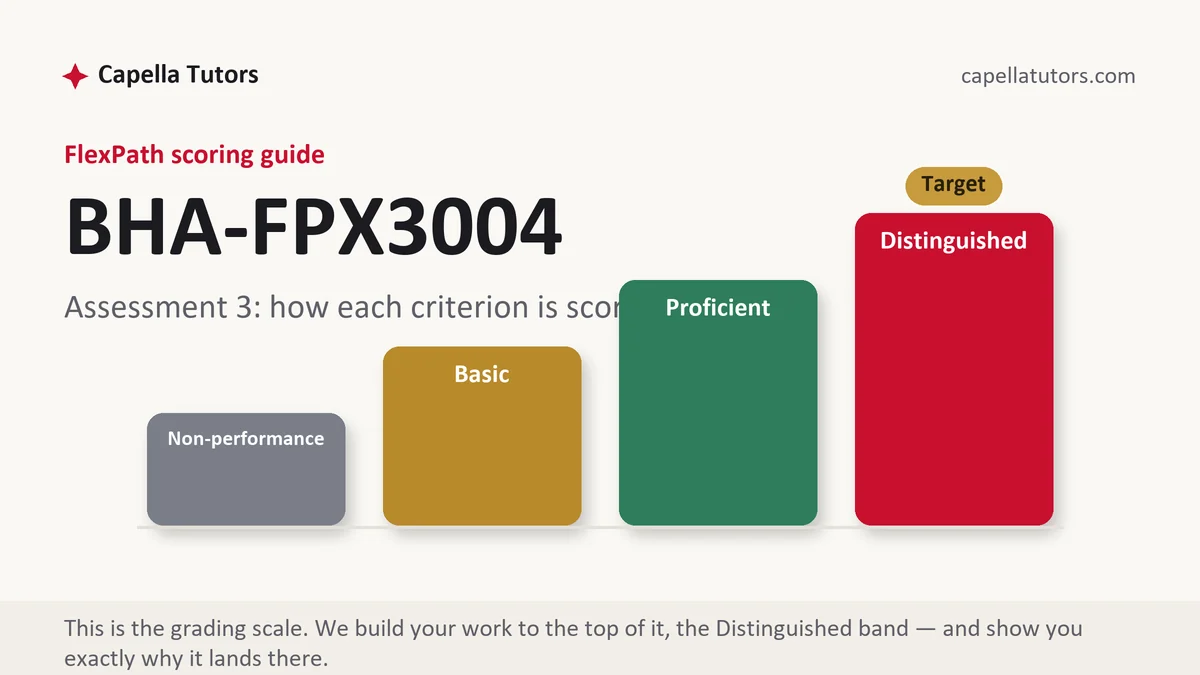
How BHA FPX 3004 Assessment 3 is scored
Nothing in FlexPath carries a letter grade. Each criterion lands on one of four levels, and the level text is the instruction set for the section:
| Level | What it means on an improvement plan |
|---|---|
| Distinguished | The aim is numeric and dated, the change is tested small with a prediction written before the test, the result is reported honestly including the ways delivery failed, and the next cycle responds to what was learned. The top column always asks for one extra move; find it and make it. |
| Proficient | Aim, change, measures and timeline are all present and coherent. Complete work that stops one step short of showing a cycle of learning. |
| Basic | A sensible idea proposed for the whole department at once, with education as the intervention and no measure attached. |
| Non-performance | A required element is absent, most often the measurement plan or the sustainment section. Omission is the cheapest way to lose a criterion. |
The counterintuitive part is scale. A two-week test on one shift reads as competence, and a hospital-wide rollout in the same paragraph reads as inexperience, because the criteria are written by people who have watched untested rollouts fail expensively.
The BHA FPX 3004 Assessment 3 method, step by step
-
Turn the guide into headings, then park the aim at the top
Give every criterion its own section, then write the aim statement and leave it visible while you draft. Improvement papers wander toward whatever the sources discuss, and a numeric aim at the top of the page is what keeps a plan from turning into an essay about quality.
-
Write an aim with a number, a population and a date
Finish this sentence before anything else: we will raise or reduce ___ from ___ to ___ among ___ by ___. If any blank holds an adjective, the aim is not usable, and every later criterion inherits the vagueness.
-
Pick one change, and say why that one
Choose a single change with a stated mechanism, then name the evidence behind it with the study setting attached. Education alone almost never holds, because it addresses knowledge when the problem is usually availability, sequence or default behavior.
-
Predict, then test small enough to be wrong cheaply
Write down what you expect to happen before the test runs, then size the test so being wrong costs almost nothing: one shift, one hallway, one clinician, two weeks. A prediction on the page is what turns a plan into a method the criteria can recognize.
-
Measure delivery as well as effect
Track whether the change actually happened, not only whether the result moved. A process measure that comes back at 40 percent of expected tells you the idea was never tested, which is a different finding from an idea that failed, and reporting that distinction is worth a level.
-
Plan the handover, then self-score
Say who owns the change once the project ends, which existing routine it lives inside, and when it gets reviewed. Then grade yourself criterion by criterion and rewrite anything under Distinguished. Submit early in the week to leave room for a revision inside the same session.
A structure that maps to the criteria
Word counts are planning targets our tutors use for an improvement plan at this level, not Capella rules; expand where your scoring guide asks for more.
| Section | What it must do | Guide word target |
|---|---|---|
| Problem and baseline | The gap stated as a rate with its denominator, window and source, and why it matters to patients. | ~200 words |
| Aim statement | The change in the measure, the population, the magnitude and the date, in one sentence. | ~100 words |
| The change and its evidence | What will be different in the work, the mechanism, and the studies supporting it with settings named. | ~300 words |
| The test cycle | The prediction, the test population and duration, who runs it, and the decision rule afterward. | ~250 words |
| Measurement plan | Process and outcome measures fully specified, plus one measure of unintended consequence. | ~250 words |
| Sustainment and references | The owner, the routine the change attaches to, the review date, and current APA throughout. | ~200 words |
Annotated sample excerpt
An original model excerpt from our team, pitched at the register the top column rewards. Study material: take the structure, write your own content.
Among patients presenting to this emergency department who have recorded a preferred language other than English, documented use of a qualified interpreter at the point of the initial clinician conversation will rise from 46 percent to 75 percent by the end of the second quarter.1 The first cycle tests one change on the evening shift only: the tablet interpreter cart is relocated from the supply alcove to the charting station, and the triage note is amended to prompt the language field before the visit reason field.2 The prediction, written before the test, is that documented interpreter use on that shift reaches 60 percent within two weeks, and that the limiting factor will be cart availability rather than clinician willingness.3
- 1The aim carries a population with an inclusion rule, a baseline, a target and a date. Everything downstream can now be checked against it.
- 2One shift, two concrete changes to where things sit and what the screen asks first. Nothing here depends on staff remembering a campaign.
- 3The prediction is specific enough to be wrong, and it names the mechanism the writer expects to bind. That sentence is what separates a method from an intention.
The full premium sample for your exact assessment, written fresh to your scoring guide and issue, is free to request. Study it, revise it into your own voice, and submit work you understand.
The five mistakes that cost Distinguished
- An aim without a number. Improving communication is a wish, and no measurement section can be built on top of it.
- Education as the whole intervention. Training addresses knowing, and most gaps at this level are about availability, sequence or what the default action happens to be.
- House-wide from day one. Scaling before evidence is the exact failure the test cycle exists to prevent, and the criterion is written to catch it.
- No measure of delivery. Without a process measure you cannot tell a failed idea from an idea nobody received.
- Sustainment as a sentence about culture. Name the owner, the routine it lives in, and the review date, or the criterion reads as unanswered.
Pre-submission checklist
- Each criterion has its own section, in the order the guide lists them
- The aim names a measure, a baseline, a target, a population and a date
- One change, with a mechanism and evidence whose settings are stated
- A prediction written before the test, and a test small enough to be affordable
- Process, outcome and unintended-consequence measures all specified
- Owner, host routine and review date named, and self-scored D throughout
Improvement plan on the calendar?
Send the scoring guide, the gap you want to close, and any baseline the course gave you. Eight people work the deliverable, including a research analyst for the evidence and two QA reviewers who check that the aim, the measures and the cycle all describe the same thing. Returned in 24 to 48 hours, and revised at no charge for as long as the guide demands.