This manual is for BHA FPX 3001 Assessment 2, start to submission. Assessment 2 of BHA FPX 3001, Essentials of the Healthcare System, turns from the payer map to the buildings. The assessment usually asks you to examine where care is delivered and why those settings exist in the form they do, and the criteria reward one connection above all others: a setting tied to the payment that sustains it. Facility types listed as a taxonomy is the Basic answer; a designation explained by the money that keeps the doors open is the upper-division version of the same content. Below is the method, a structure that follows the criteria one at a time, and an annotated sample excerpt. Rather have backup? A premium original sample arrives inside 24 to 48 hours, revised free until each criterion is met. Capella's catalog lists the course as BHA-FPX3001, and some courserooms print BHA3001; both point to this same Assessment 2.
One honesty note before the manual: Capella revises courses and scoring guides over time, so always write to the exact scoring guide attached to your assessment in the courseroom. The course identity above is verified on capella.edu; the method and structure below are our tutors' approach to it, not Capella's official rubric text.
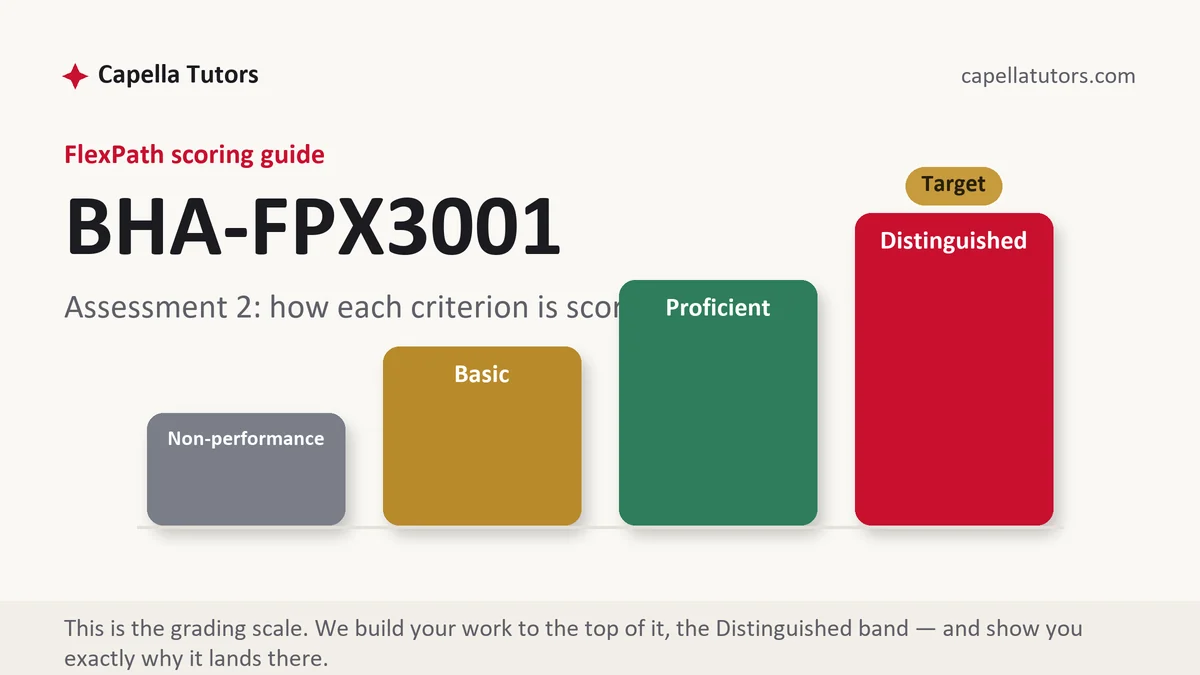
How BHA FPX 3001 Assessment 2 is scored
Nothing is averaged across criteria in FlexPath. Each one is scored against four levels, and the top level here asks for a connection the other levels do not:
| Level | What it means on a delivery setting analysis |
|---|---|
| Distinguished | Each setting is explained by what it is designed to handle and by the payment arrangement that sustains it, with the consequences of that arrangement for the community stated in specific terms. |
| Proficient | An accurate description of the settings and their roles, with payment mentioned separately from the setting it supports. |
| Basic | A correct taxonomy of facility types with a sentence about each, and no explanation of why any of them survives. |
| Non-performance | A setting central to the scenario is missing, or the analysis never connects delivery to financing at all. |
A useful question to hold over every paragraph: if the payment changed tomorrow, would this setting still exist in this form? Where the answer is no, you have found the thing the criterion wants explained. Where the answer is yes, say what else is holding it up, because that is analysis too.
The BHA FPX 3001 Assessment 2 method, step by step
-
Pick a setting with a designation attached
Designations come with rules, and rules are analyzable. A rural hospital operating under a special designation, a federally qualified health center, an ambulatory surgery center, and a hospice each carry eligibility conditions and a payment method, and those conditions give you something concrete to write about.
-
Get the eligibility conditions right
Bed limits, average length of stay, distance from another facility, governance requirements, and the services that must be available around the clock are the kinds of conditions that define a designation. State them accurately and plainly, because an upper-division criterion will notice a designation described from impression.
-
Explain the payment method, not just the payer
Cost-based payment, a fixed amount per admission, a per-visit rate, a per-diem, and a capitated payment behave differently, and the difference is the whole explanation for why a setting exists. Say which one applies and what behavior it encourages.
-
Show what the setting cannot do
Every designation trades scope for viability. A facility that keeps its designation by holding its average stay short must transfer some patients, and naming what leaves the community is more useful than listing what stays.
-
Connect it to the population it serves
Distance, age profile, employment, and transportation decide what the setting has to be able to handle. Give the community two or three figures so the setting's design looks like a response to something rather than an accident.
-
Verify the technical details, then self-score
Check every condition and every payment description against a federal program source rather than a summary, then grade the draft criterion by criterion and rewrite anything short of the top level before submitting.
A structure that maps to the criteria
Planning targets our tutors use for a deliverable of this scope. Your own scoring guide decides the sections, the order, and how long each one runs.
| Section | What it must do | Guide |
|---|---|---|
| The community | Population, distance, age profile, and employment, with figures that explain what care is needed locally. | ~200 words |
| The setting and its designation | What the facility is, the conditions it must meet, and who confers the designation. | ~275 words |
| How it is paid | The payment method for its main payers, described by how the amount is calculated. | ~275 words |
| What the payment makes possible | The services the arrangement sustains, and the behavior it encourages in day-to-day operation. | ~250 words |
| Limits and transfers | What the setting cannot handle, where those patients go, and what that costs the community. | ~225 words |
| References | Federal program documents and peer-reviewed health services research, current APA. | as needed |
Annotated sample excerpt
An original model excerpt from our team, showing a setting explained by its financing. Take the structure into the setting your own prompt names.
The hospital holds a critical access designation, which is not a description of its size but a set of conditions it has to keep meeting: no more than twenty-five inpatient beds, an annual average acute stay at or under ninety-six hours, emergency services available at all hours, and a location beyond the distance thresholds the program sets from the next nearest hospital.1 The reason those conditions are worth keeping is the payment method rather than the label, because federal reimbursement for the program's beneficiaries is calculated from the hospital's allowable costs rather than as a fixed amount per admission, which is what allows an eleven-bed medical unit running at 46 percent occupancy to exist at all in a county of nineteen thousand people.2 The trade is visible in the transfer log: holding the average stay inside ninety-six hours means the patient whose pneumonia is not resolving on day three moves ninety minutes east, and the community absorbs that as travel, as family time off work, and as a readmission that will be counted somewhere else.3
- 1The designation is presented as conditions to be met rather than as a name, which is what lets the rest of the paragraph explain behavior instead of describing a category.
- 2The payment method is named by how the amount is calculated, then tied to a specific operational fact, the occupancy of a small unit. That link is what the top level of this criterion is asking for.
- 3The limit is written as a trade with named costs falling on named people. Saying what the arrangement cannot do is where an upper-division answer separates itself.
The full premium sample for your exact assessment, written fresh to your scoring guide and issue, is free to request. Study it, revise it into your own voice, and submit work you understand.
The five mistakes that cost Distinguished
- A taxonomy of facility types. Listing settings with a sentence each is the Basic answer, however accurate every sentence is.
- Payer named, payment method omitted. Who pays explains less than how the amount is calculated, and the criterion wants the second one.
- A designation described from impression. Bed limits, stay averages, and distance rules are specific, and an evaluator can check them.
- No limits acknowledged. Every designation trades scope for survival, and a paper that only lists advantages has skipped the analysis.
- The community left out. A setting with no population described around it looks like an accident rather than a response.
Pre-submission checklist
- The community is described with figures that explain what care is needed
- The designation's conditions are stated accurately
- The payment method is described by how the amount is calculated
- One operational fact is explained by the payment arrangement
- What the setting cannot handle is named, with where those patients go
- Program documents cited directly, references reconciled in both directions
Delivery setting analysis due?
Send the prompt, the criteria, and the setting or community your assessment names. The sample returns inside 24 to 48 hours with the designation stated accurately, the payment method explained by its calculation, and the limits of the arrangement named. Revision stays free until every criterion is met.