This manual is for BHA FPX 3001 Assessment 3, start to submission. Assessment 3 of BHA FPX 3001, Essentials of the Healthcare System, brings in the part of the arrangement that answers to a different authority. The assessment usually asks you to analyze prevention or population health work and connect it to the delivery system, and the criteria are looking for one thing students routinely omit: the funding path. A health department is judged on population indicators rather than on admissions, it is financed through grants and appropriations rather than through claims, and describing it in parallel to the delivery system instead of connected to it is where the analysis criterion is lost. The manual below carries the method, a criterion-keyed structure, and an annotated sample excerpt. Tight on time? A premium original sample lands inside 24 to 48 hours, revised at no cost until the guide is satisfied. Capella's catalog lists the course as BHA-FPX3001, and some courserooms print BHA3001; both point to this same Assessment 3.
One honesty note before the manual: Capella revises courses and scoring guides over time, so always write to the exact scoring guide attached to your assessment in the courseroom. The course identity above is verified on capella.edu; the method and structure below are our tutors' approach to it, not Capella's official rubric text.
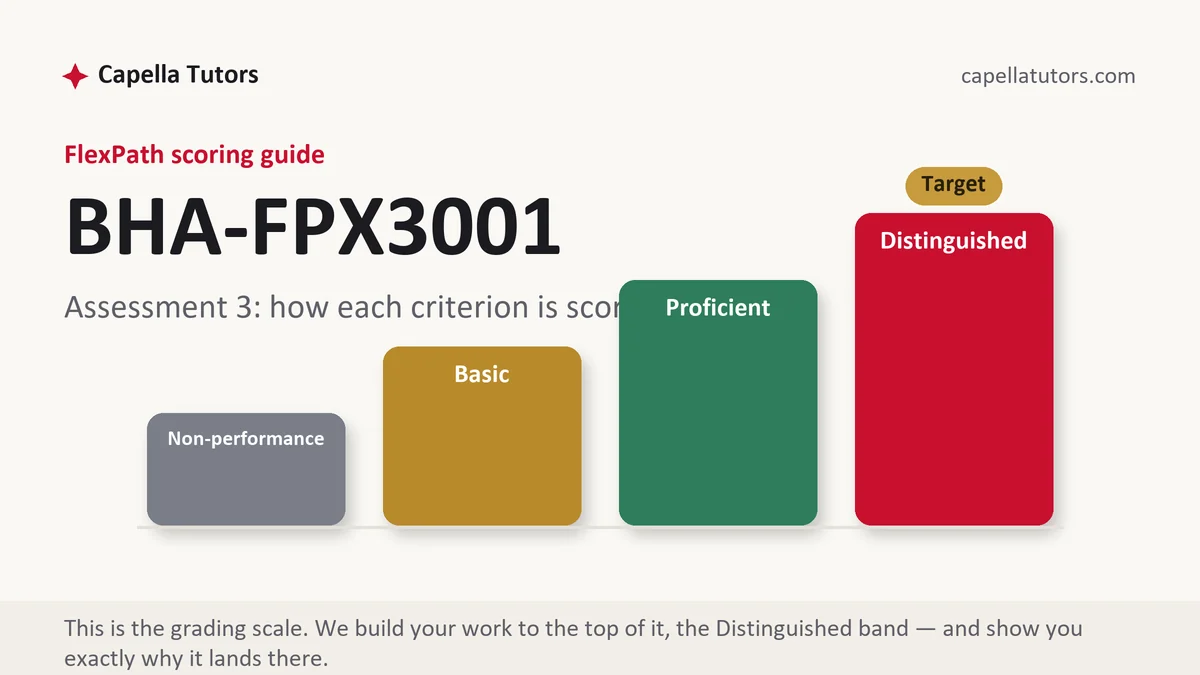
How BHA FPX 3001 Assessment 3 is scored
Each criterion is placed at one of four levels on its own merits, and the difference between the top two is usually a connection rather than more content:
| Level | What it means on a public health analysis |
|---|---|
| Distinguished | The population work is connected to the delivery system through a specific mechanism, the funding path is traced, the measure is named with its denominator, and the paper says what the arrangement cannot reach. |
| Proficient | An accurate account of the prevention work and its measures, described alongside the delivery system rather than joined to it. |
| Basic | A correct summary of what public health agencies do, with funding described as government money and no measure attached. |
| Non-performance | The funding path or the connection to the delivery system is absent, or no population measure is offered. |
Governance is the quiet fact that makes this deliverable different. A health department reports to a board or a county authority, competes for appropriations against roads and schools, and often depends on categorical grants that can only be spent on the purpose they were awarded for. That constraint explains more program design than any clinical consideration, and saying so is analysis.
The BHA FPX 3001 Assessment 3 method, step by step
-
Choose a program with a countable outcome
Screening, immunization, communicable disease follow-up, and environmental inspection all produce numbers. Pick one, because a paper about prevention in general has no measure and therefore no criterion it can satisfy fully.
-
Trace the money to its source and its condition
Follow the funding backwards: a federal categorical grant, a state appropriation, a local levy, a fee, or a claim submitted to a payer for a billable service. Then say what the money may and may not be spent on, since that condition shapes the program more than any preference does.
-
Find the point where it touches the delivery system
Population work reaches patients through clinical settings: a result that has to be reported, a test a practice performs, a referral the department makes, a registry both consult. Name the point of contact and what crosses it, because that is the connection the criterion wants.
-
State the measure with its denominator
A count of tests performed is an activity. A share of an eligible population tested inside a defined window is a measure, and the criteria in an upper-division course expect the second one, with the year and the source attached.
-
Name who the program does not reach
Every population program has a group outside it: children not enrolled in the program that requires the test, families who move between counties, households without a phone the department can call back. Naming that group is the equity half of the analysis and it is frequently a criterion of its own.
-
Check governance and vintage, then self-score
Confirm who the agency answers to and that every figure carries its year and population. Then grade the draft against each criterion and rewrite anything below the top level before you submit.
A structure that maps to the criteria
These are our planning targets for an analysis at this level. The scoring guide attached to your assessment decides the sections and the length.
| Section | What it must do | Guide |
|---|---|---|
| The population problem | The condition, who it affects locally, and the figures that establish its size. | ~225 words |
| The program and its authority | What the agency does, who it reports to, and the legal basis for the activity. | ~250 words |
| The funding path | Where the money comes from, what conditions attach to it, and what happens when a grant cycle ends. | ~275 words |
| The link to delivery | The point where the program touches clinical settings, and what crosses it in both directions. | ~275 words |
| Measures and gaps | The population measure with its denominator, and the group the program does not reach. | ~225 words |
| References | Federal and state program sources, peer-reviewed public health research, current APA. | as needed |
Annotated sample excerpt
A model excerpt from our team showing a funding path traced and a connection named. Study the components, then rebuild it around your own program.
The county's childhood blood lead program exists because two different obligations meet in it: the federal low-income program requires a blood lead test for enrolled children at twelve and twenty-four months, and the state's own reporting rule requires every elevated result to reach the health department, which is what turns a laboratory value into a home inspection.1 The money arrives on three separate tracks and they do not substitute for each other: the tests themselves are billed to the child's coverage as a clinical service, the case management and the environmental visit run on a categorical federal grant that may be spent on lead and on nothing else, and the two sanitarians who perform the inspections sit in a county budget line that competes each year with every other county service.2 The measure that matters is not tests performed but the share of enrolled children with a documented test by twenty-seven months, and the gap the program cannot close from its own side is the practice that orders the test and never receives the result back, since a value that returns to a laboratory portal nobody in a two-physician office opens is a test that produced no action.3
- 1Two obligations from two levels of government are named together, which explains why the program exists at all rather than asserting that prevention is worthwhile.
- 2The funding path is traced on three tracks with the categorical restriction stated. This is the paragraph that separates an upper-division answer from a summary of what health departments do.
- 3The measure carries a denominator and a window, and the gap is a specific breakdown at the point where the program meets a clinical setting. Naming what the arrangement cannot reach is the last mark in this criterion.
The full premium sample for your exact assessment, written fresh to your scoring guide and issue, is free to request. Study it, revise it into your own voice, and submit work you understand.
The five mistakes that cost Distinguished
- Public health described in parallel. The criterion asks for the connection to the delivery system, not a second section running alongside it.
- Funding called government money. Grants, appropriations, levies, and billable services behave differently, and the differences explain the program.
- Activity reported as a measure. Tests performed is a count. A share of an eligible population inside a window is a measure.
- No group named as unreached. Every population program has an edge, and the equity criterion is looking for who sits outside it.
- Governance left out. Who the agency answers to explains program design more reliably than clinical reasoning does.
Pre-submission checklist
- The population problem carries local figures with years attached
- The agency's authority and reporting line are stated
- The funding path is traced to its sources with their conditions
- A specific point of contact with clinical settings is named
- The measure has a denominator and a window, and the unreached group is named
- Program sources cited directly, references reconciled in both directions
Population health deliverable due?
Send the prompt, the criteria, and the county or program your assessment names. The sample comes back inside 24 to 48 hours with the funding path traced, the link to clinical settings named, and every measure carrying its denominator and its year.