This manual is for BHA FPX 3001 Assessment 1, start to submission. Assessment 1 of BHA FPX 3001, Essentials of the Healthcare System, is where four questions start running underneath everything: who pays, who delivers the care, who is covered, and who is left out. The assessment usually asks you to describe part of that arrangement and explain how it works, and the criteria separate a student who memorized a diagram from one who can follow money and a patient through it. Reciting that there are public and private payers is the Basic answer. What follows is the method our tutors use for this deliverable, a structure built from the criteria, and an annotated sample excerpt. Want the draft handled for you? A premium original sample comes back in 24 to 48 hours, reworked free until it meets the guide. Capella's catalog lists the course as BHA-FPX3001, and some courserooms print BHA3001; both point to this same Assessment 1.
One honesty note before the manual: Capella revises courses and scoring guides over time, so always write to the exact scoring guide attached to your assessment in the courseroom. The course identity above is verified on capella.edu; the method and structure below are our tutors' approach to it, not Capella's official rubric text.
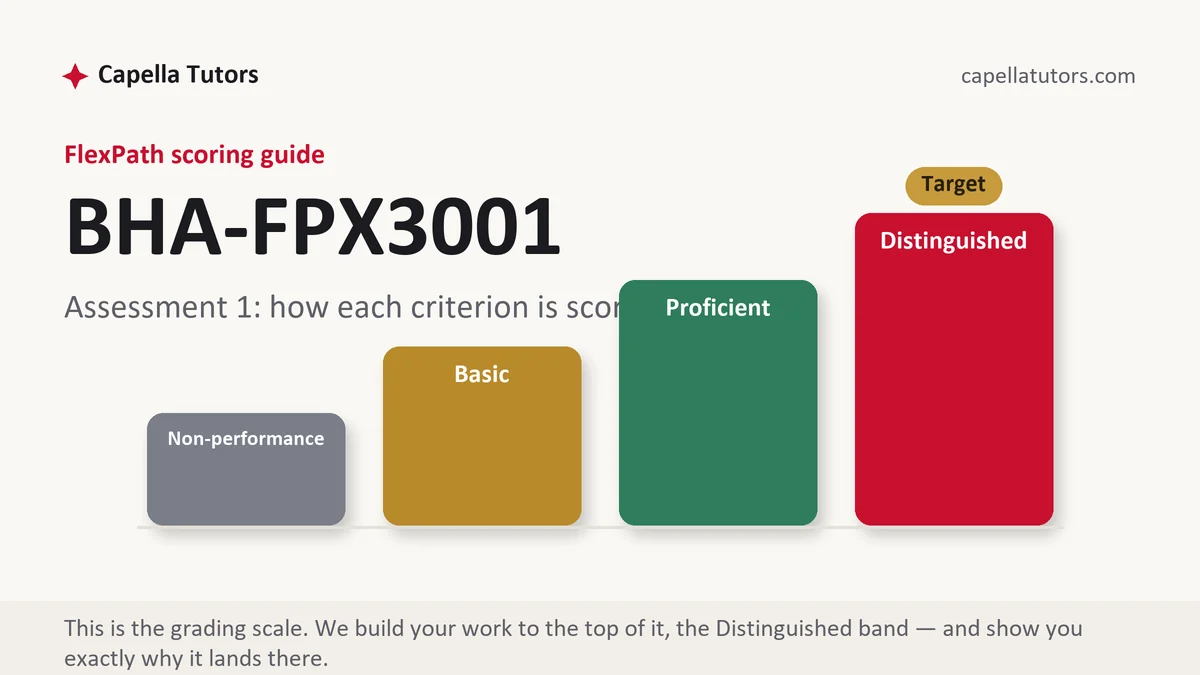
How BHA FPX 3001 Assessment 1 is scored
FlexPath scores each criterion on its own against four written levels, and the top level in this course usually asks for movement rather than more categories:
| Level | What it means on a coverage and access analysis |
|---|---|
| Distinguished | Coverage, access, and utilization are held apart, at least one barrier is traced to a measurable consequence, state variation is acknowledged, and people without coverage are given a size and a composition. |
| Proficient | An accurate account of the payers and the settings, with access described as a general problem rather than a traced one. |
| Basic | A complete inventory of insurance types and facility types, correct and static, with nothing moving through it. |
| Non-performance | A required part of the arrangement is missing, most often the uninsured, or no analysis of access is attempted. |
Three words do most of the work in this course, and keeping them apart is worth more than another paragraph of detail. Coverage means somebody holds a plan. Access means care is obtainable in practice, which depends on cost sharing, network, appointment supply, distance, hours, and language. Utilization is the care that was actually used. A population can be thoroughly covered and poorly served, and the sentence saying so is often the sentence that earns the criterion.
The BHA FPX 3001 Assessment 1 method, step by step
-
Follow one person instead of listing components
Choose an individual with a condition, a payer status, and an address, then move them through a year. Every abstract point in the course becomes visible in that story, and the paper stops being an inventory the moment somebody is walking through it.
-
Draw the money in the other direction
For each stop in that year, say who paid, how the payment was calculated, and what the person owed. A fixed amount per admission, a negotiated fee, a capitated payment, and a sliding-scale charge produce four different incentives, and the criteria are watching for whether you noticed.
-
Turn the guide into headings and refuse the list
Give each criterion its own section. Then check every paragraph for the list reflex: if a section reads as items separated by commas, rewrite it as a sequence with somebody in it, because a criterion asking you to analyze access will not accept an inventory of plan types however complete it is.
-
Name the barrier and then measure it
A barrier is only analysis when it has a consequence attached. Eleven weeks to a specialist appointment, a deductible that resets in January, a clinic reachable only by a bus that stops running at six: each of those produces a countable outcome, and naming the outcome is what lifts the criterion.
-
Say what varies by state
The joint federal and state program is not one national benefit, and eligibility and covered services are state decisions. A sentence describing it as uniform is inaccurate, and the criteria in this course are written by people who know that.
-
Check every figure's vintage, then self-score
Read the sample description before the headline number, since a rate covering adults under 65 and one covering the whole population are different facts wearing the same percentage sign. Then grade yourself criterion by criterion and rewrite whatever sits below the top level.
A structure that maps to the criteria
The lengths below are our tutors' planning targets for an analysis of this size, not Capella requirements. Your scoring guide decides the sections and the length.
| Section | What it must do | Guide |
|---|---|---|
| Introduction | The part of the arrangement you are analyzing and the claim you are making about it. | ~150 words |
| Who pays | The public programs, commercial coverage, the separate federal systems, and the people with none. | ~275 words |
| Who delivers | The settings involved, what each is designed to handle, and the payment that sustains it. | ~250 words |
| Coverage against access | The barriers in this case, each one carried through to a countable consequence. | ~300 words |
| Where it leaves people | Who is served well, who is not, and the state decisions that change the answer. | ~225 words |
| References | Federal statistical and program sources, peer-reviewed health services research, current APA. | as needed |
Annotated sample excerpt
A model excerpt from our team, written to show coverage and access coming apart on the page. Read it for the sequence, then build your own from your own case.
The patient is 58, self-employed as a floor installer in a state that did not expand its low-income program, earning about 9,000 dollars in a slow year, which places him below the threshold where marketplace subsidies begin and above nothing that would qualify him for the state program as an adult without dependent children.1 He therefore holds no coverage, and the distinction the criteria care about appears immediately: care is not unavailable to him, since the hospital's sliding-scale policy would discount his inguinal hernia repair to something between 900 and 1,400 dollars, but the surgeon's office requires the estimated patient portion in advance and he cannot produce it in one payment, so the repair does not happen.2 What happens instead is countable: two emergency department visits for pain in eleven months, one of them ending in an overnight observation stay billed at several times the cost of the elective repair, absorbed by the hospital as uncompensated care and by the patient as three weeks of lost work.3
- 1Eligibility is explained through one person's earnings and state, which is far more precise than a paragraph about the coverage gap and shows the state decision doing the work.
- 2The sentence separates availability, affordability, and the practical rule that decides the outcome. Access failing while a discount policy exists is exactly the distinction the criterion is testing.
- 3The consequence is counted in visits, dollars, and lost weeks. A barrier traced to a measurable outcome is what moves this criterion to the top level.
The full premium sample for your exact assessment, written fresh to your scoring guide and issue, is free to request. Study it, revise it into your own voice, and submit work you understand.
The five mistakes that cost Distinguished
- Coverage and access used as synonyms. They come apart constantly in practice, and this criterion is usually written to see whether you know it.
- The low-income program described as uniform. Eligibility and benefits are state decisions, and a single national description of them is wrong.
- The uninsured left out. A system description that stops at insured populations has omitted the group the analysis criterion cares about most.
- Statistics with no year. A rate detached from its release cannot be checked, and an evaluator will treat it as unsupported.
- An inventory instead of an analysis. Lists of payer types and facility types are the Basic answer no matter how complete they are.
Pre-submission checklist
- One person carries the analysis from symptom to setting
- Every payment is described by how it is calculated, not just by who pays it
- Coverage, access, and utilization are used as three different words
- At least one barrier is traced to a countable consequence
- State variation is stated where it changes the answer
- Every figure carries its year and its population, APA reconciled both ways
System analysis due this week?
Tell us which part of the arrangement your assessment targets and whether your instructor wants a national view or a state one. The sample comes back inside 24 to 48 hours built around movement rather than categories, with every rate carrying its year and the population in its denominator.