This manual is for BHA FPX 2106 Assessment 2, start to submission. Assessment 2 of BHA FPX 2106, Health Information Management in Healthcare Organizations, moves from the rule to the record itself. The assessment usually asks you to examine a data quality problem and propose a control, and the criteria will not accept an adjective where a rate belongs. Poor documentation is an opinion until it carries a numerator, a denominator, and a period; once it does, the same sentence becomes a management argument with a cost attached. What comes next is the method our tutors use here, a structure keyed to each criterion, and an annotated sample excerpt. Want a worked model to start from? A premium original sample lands inside 24 to 48 hours, revised free until every criterion is satisfied. Capella's catalog lists the course as BHA-FPX2106, and some courserooms print BHA2106; both point to this same Assessment 2.
One honesty note before the manual: Capella revises courses and scoring guides over time, so always write to the exact scoring guide attached to your assessment in the courseroom. The course identity above is verified on capella.edu; the method and structure below are our tutors' approach to it, not Capella's official rubric text.
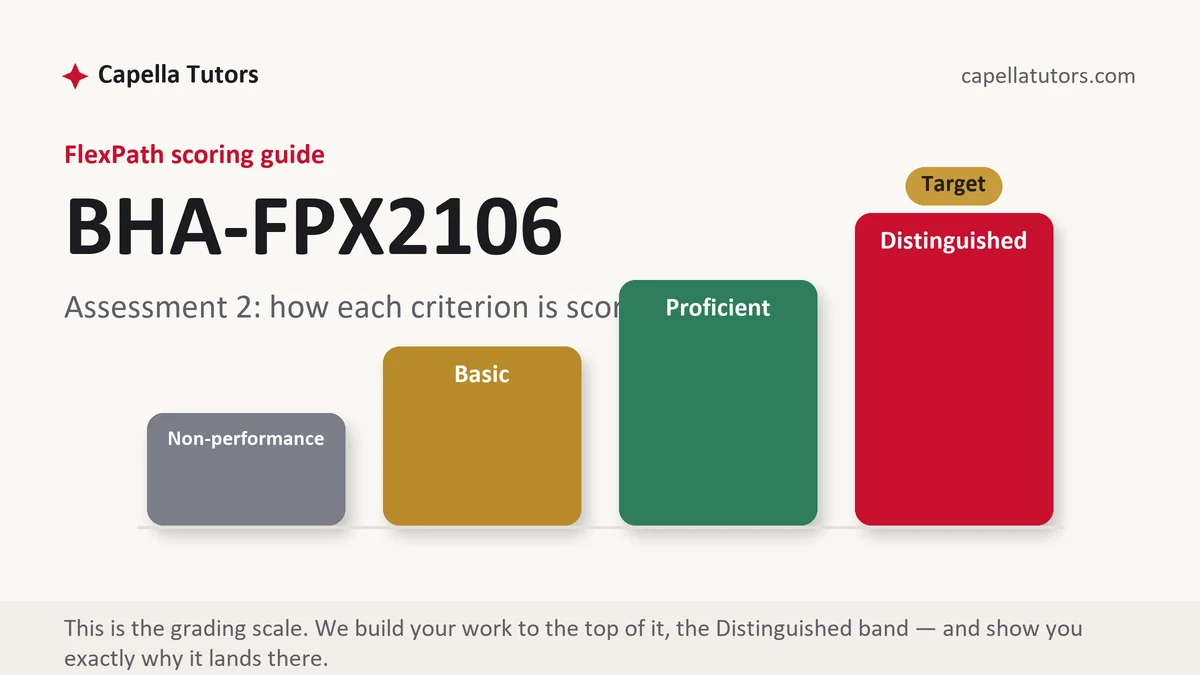
How BHA FPX 2106 Assessment 2 is scored
Criteria are scored individually at one of four levels, and the top level in a data quality deliverable is unusually concrete about what it wants to see:
| Level | What it means on a data quality analysis |
|---|---|
| Distinguished | The dimension at issue is named and measured, the rate carries its denominator and window, the cost is calculated from the rate, and the control sits at the point where the error is created rather than where it is found. |
| Proficient | A real problem, correctly measured, answered with a control placed somewhere sensible in the workflow. |
| Basic | An accurate description of a documentation problem with no rate behind it and a recommendation to improve training. |
| Non-performance | No measurement is offered, or the recommendation is a software purchase with no operational change attached to it. |
Health information problems are cheap to describe and expensive to fix, which is why the criteria keep asking for arithmetic. A rate turns a complaint into a case, a cost turns a case into a proposal, and a control with an owner turns a proposal into something a committee can approve.
The BHA FPX 2106 Assessment 2 method, step by step
-
Name the dimension and the failure mode
Completeness, accuracy, timeliness, consistency, and clarity fail in different ways and cost different amounts. Say which one you are addressing and what it looks like when it breaks, because a paper about data quality in general has no measure available to it.
-
Build the rate before the narrative
Numerator, denominator, and window, in that order. Registrations in a quarter, records affected, hours of rework per record: three numbers produce an argument that a reader can recalculate, and recalculating is exactly what a careful evaluator does.
-
Trace the error to the step that created it
Most record defects are created at registration and discovered days later by somebody else. Walk the workflow backwards from the discovery to the keystroke, and name the step, the role, and the condition that made the error easy.
-
Put the control where the error is made
A required second identifier, a minimum search protocol, a hard stop on a partial match, a field that will not accept a blank. Controls at the point of creation prevent; controls at the point of discovery only clean up, and the criteria can tell the difference.
-
Attach an owner, a report, and a cadence
Say who runs the new step, what report shows whether it is working, how often somebody looks at it, and what happens when the rate drifts back. A control with nobody watching it decays inside a quarter.
-
Price the exposure, then self-score
Rework hours, claim denials, and the cost of a records request handled badly are all quantifiable in rough terms, and a number in the exposure paragraph is worth a page of concern. Then grade the draft against each criterion and revise anything below the top level.
A structure that maps to the criteria
The targets below are our planning figures for an analysis of this scope. Your scoring guide is what governs the sections, their order, and the length.
| Section | What it must do | Guide |
|---|---|---|
| The setting and the workflow | The facility, the department, and the process as it currently runs, step by step with its handoffs. | ~225 words |
| The problem, measured | The dimension, the rate with its denominator and window, and how the figure was produced. | ~275 words |
| Where the error is created | The step, the role, and the conditions that make the error likely, traced backwards from discovery. | ~250 words |
| Consequences | Patient safety, rework, billing, and reporting effects, each tied to the rate rather than asserted. | ~250 words |
| The control | The change, its position in the workflow, its owner, the report behind it, and the review cadence. | ~250 words |
| References | Professional practice briefs, regulatory sources where relevant, and peer-reviewed informatics work, current APA. | as needed |
Annotated sample excerpt
An original model excerpt from our team, showing arithmetic doing the arguing. Take the structure and rebuild it around the numbers your own scenario supplies.
The defect here is not a duplicate record but an overlay, which is the more expensive failure: a walk-in registration on 14 February matched an arriving patient to an existing record belonging to a different person with the same surname and a date of birth transposed by two digits, so one chart now contains two people's information.1 In this constructed but representative quarter the walk-in desk completed 9,400 registrations and the health information department identified 11 overlays, a rate of 1.2 per 1,000, against 380 straightforward duplicates in the same period, and while the duplicates take about 22 minutes each to reconcile, an overlay takes a technician and a clinician between four and six hours because every entry has to be attributed before it can be moved.2 The control therefore belongs at the search step and not in the correction queue: a minimum two-field search, a required third identifier before any match is accepted, and a hard stop that prevents a partial match from being confirmed by a clerk working alone at the walk-in desk.3
- 1The paragraph opens by distinguishing two failure modes that students routinely merge, and it defines the one it is analyzing by what actually happened rather than by a textbook line.
- 2The arithmetic is complete and labeled: numerator, denominator, window, and a rework cost per event, with the two failure types priced separately so the argument for prioritizing one is visible.
- 3The control lands at the keystroke that created the error and is described as three specific mechanisms rather than as better verification, which is what the top level means by a control.
The full premium sample for your exact assessment, written fresh to your scoring guide and issue, is free to request. Study it, revise it into your own voice, and submit work you understand.
The five mistakes that cost Distinguished
- Data quality asserted with no rate. Errors are frequent is unscorable. A numerator, a denominator, and a window make it an argument.
- A control at the discovery point. Catching defects downstream is cleanup. The criterion rewards prevention at the step that creates them.
- A system purchase offered as the fix. Software with nobody assigned to run the new step reproduces the old error faster.
- Duplicates and overlays treated as the same problem. They have different causes, different costs, and different corrections.
- No owner and no report. A control nobody watches has a short life, and the sustainability criterion is written to catch it.
Pre-submission checklist
- The data quality dimension is named and its failure mode described
- A rate appears with numerator, denominator, and time window
- Constructed figures are labeled as constructed
- The error is traced back to the step and role that created it
- The control sits at the point of creation and names an owner, a report, and a cadence
- Consequences are tied to the rate, APA reconciled in both directions
Data quality assessment due?
Send the workflow, the criteria, and any figures your course provided. The sample returns inside 24 to 48 hours with the rate calculated in the open, the cost tied to it, and a control placed at the step where the error is actually made. Revision stays free until the criteria are satisfied.