This manual is for BHA FPX 2106 Assessment 1, start to submission. Assessment 1 of BHA FPX 2106, Health Information Management in Healthcare Organizations, is usually the privacy deliverable, and it is the one where half-answers are most common. The assessment typically hands you a request for information and asks whether the organization may release it, which is four questions rather than one: who is asking and in what capacity, whether the purpose falls inside treatment, payment, or operations, what the minimum necessary amount would be, and what the disclosure itself has to document. Answer them in that order and the criteria have nowhere to go. The manual below gives the method, a structure drawn from the criteria, and an annotated sample excerpt. Out of hours this week? A premium original sample returns in 24 to 48 hours, revised at no charge until the guide is met. Capella's catalog lists the course as BHA-FPX2106, and some courserooms print BHA2106; both point to this same Assessment 1.
One honesty note before the manual: Capella revises courses and scoring guides over time, so always write to the exact scoring guide attached to your assessment in the courseroom. The course identity above is verified on capella.edu; the method and structure below are our tutors' approach to it, not Capella's official rubric text.
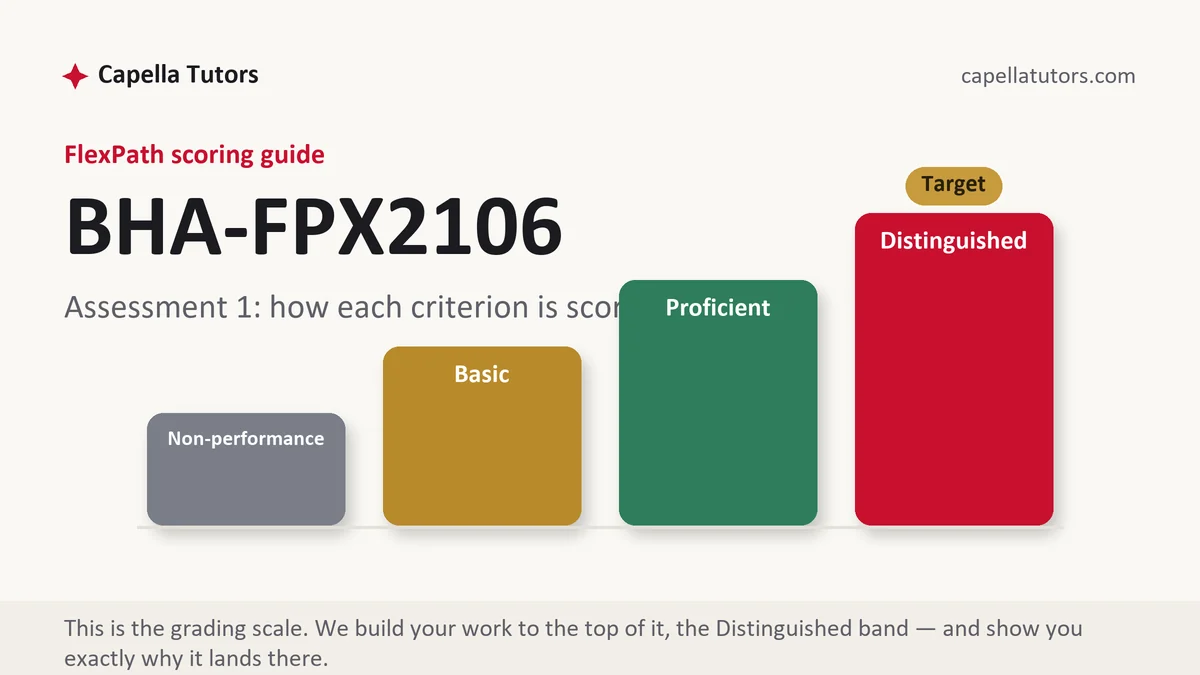
How BHA FPX 2106 Assessment 1 is scored
FlexPath places each criterion at one of four levels, judged on its own, and in a privacy deliverable the levels reward precision rather than caution:
| Level | What it means on a privacy and disclosure analysis |
|---|---|
| Distinguished | The correct rule and the correct part are named, the four-step reasoning is visible in order, the documentation the disclosure requires is listed, and the paper says where state law could change the answer. |
| Proficient | The right conclusion with the right rule behind it, reasoned in general terms rather than element by element. |
| Basic | A correct instinct about privacy supported by a summary of what the rules broadly require. |
| Non-performance | No rule is identified, or consent and authorization are used interchangeably in the analysis that decides the answer. |
One distinction carries more marks in this course than any other: what the law requires against what the organization has chosen to do. Refusing to fax a result, holding a note back from a portal, demanding a written request for every release, these may be defensible institutional decisions and none of them is the federal rule. When you assert an obligation, name its source; when you describe a practice, say whose practice it is.
The BHA FPX 2106 Assessment 1 method, step by step
-
Identify the requester and the capacity
A person, an employer, an attorney, another provider, a plan, and a public health authority are six different requesters with six different answers, and the same individual can occupy two of those roles in a week. Write the capacity down before anything else, because it decides the rest of the analysis.
-
Test the purpose against treatment, payment, and operations
Those three purposes are permitted without authorization; almost everything outside them is not. Say which one applies, or say plainly that none does, and resist the temptation to stretch operations into a general category for anything the organization finds convenient.
-
Apply the minimum necessary standard, and name its exception
Even a permitted disclosure is limited to what the purpose requires, with a specific exception for disclosures for treatment. State the amount you would release and the reason it stops there, because a criterion asking about minimum necessary is asking for a boundary, not a definition.
-
List the elements the authorization must contain
An authorization is a document with required contents: what is being disclosed, who discloses it, who receives it, the purpose, an expiration date or event, the individual's signature and date, and the statement of the right to revoke. Consent is a different instrument, and using the two words as synonyms tells the evaluator you read a summary.
-
Say what the state layer could change
Where a state law is more protective of the individual than the federal floor, the state law governs, and categories such as behavioral health and communicable disease results are the usual places it appears. Name the check even when you cannot perform it.
-
Cite the rule itself, then self-score
Quote from the regulation rather than from an explainer, cite it in the form APA prescribes for regulatory material, and confirm the reference list matches the text both ways. Then grade yourself criterion by criterion and rewrite anything below the top level.
A structure that maps to the criteria
Lengths below are our tutors' planning targets for a privacy analysis of this size, not Capella requirements. Your scoring guide decides the sections and the format.
| Section | What it must do | Guide |
|---|---|---|
| The request | Who is asking, in what capacity, for what information, and on what date, stated neutrally. | ~150 words |
| The rule that applies | The regulation and the part governing this disclosure, cited to the rule text. | ~250 words |
| The four-step analysis | Requester, purpose, minimum necessary, documentation, worked in that order. | ~325 words |
| What the organization does | The decision, the release itself or the refusal, and exactly what leaves the building. | ~250 words |
| Limits and the state check | Where state law could change the answer, and what the analysis does not resolve. | ~200 words |
| References | Regulations cited as regulations, federal guidance and practice briefs behind them, current APA. | as needed |
Annotated sample excerpt
A model excerpt from our team, written to show the four-step reasoning arriving in order. Study the sequence, then run your own request through it.
The request comes from an insurance underwriter evaluating a life policy application, accompanied by a form the applicant signed at the agent's office, and the first question is not whether the signature is genuine but what capacity the requester holds, which here is a third party with no treatment, payment, or health care operations relationship to this practice.1 Because the purpose sits outside those three categories, a valid authorization is required, and the form supplied fails on two of the required elements: it names no expiration date or event, and it describes the information to be disclosed as any and all medical records, which is not the specific description the rule contemplates.2 The practice's answer is therefore a hold rather than a refusal, with a written response to the underwriter identifying the two defects, a copy to the applicant, and no records leaving the building until a corrected authorization arrives, at which point the release is limited to what that authorization actually names rather than to the whole chart.3
- 1Starts with capacity rather than with the signature, which is the reasoning order the criterion is looking for. The permitted purposes are ruled out explicitly instead of by implication.
- 2The authorization is tested element by element and the two defects are named. An evaluator scoring application finds the specific failures rather than a general judgment about validity.
- 3The action is a hold with a written response and a copy to the individual, and the last clause holds the release to the authorization's own scope. Precision at the end is where this criterion is won.
The full premium sample for your exact assessment, written fresh to your scoring guide and issue, is free to request. Study it, revise it into your own voice, and submit work you understand.
The five mistakes that cost Distinguished
- HIPAA as one undivided rule. Name the rule and the part. The criterion is written to see whether you know they are different instruments.
- Consent and authorization treated as one instrument. Different triggers, different required elements, and the difference is directly scorable.
- Operations stretched to cover everything. If the purpose does not fit, say it does not fit. Forcing the category is worse than the honest answer.
- An explainer page cited where the regulation belongs. The rule is free to read, and evaluators in this course check whether you did.
- The state layer never mentioned. A federal-only answer to a privacy question is a partial answer, and saying so costs nothing.
Pre-submission checklist
- The requester's capacity is identified before anything else
- The purpose is tested against treatment, payment, and operations explicitly
- The minimum necessary boundary is stated as an amount, with its exception noted
- Authorization elements are listed and the document is tested against them
- The state law check appears in the text
- Regulations cited to the rule in current APA, references reconciled both ways
Privacy deliverable due?
Send the scenario, the criteria, and your facility type. The sample comes back inside 24 to 48 hours with the rule cited to its part, the four-step analysis in order, and one review pass spent only on confirming that each regulatory statement matches its source.