This manual is for BHA FPX 2106 Assessment 3, start to submission. Assessment 3 of BHA FPX 2106, Health Information Management in Healthcare Organizations, is the stage where a rule and a workflow have to be explained to someone who does not work in health information. The assessment usually asks you to take a records process, judge it against what the regulation requires, and recommend a workflow the department could actually run, written for the person who has to approve it. Two criteria carry the weight: whether you know what the individual is entitled to, and whether your recommendation survives contact with a busy department. Below is the method, a section plan mapped onto the guide, and an annotated sample excerpt. Rather not start from nothing? A premium original sample arrives inside 24 to 48 hours, revised free until the guide is met. Capella's catalog lists the course as BHA-FPX2106, and some courserooms print BHA2106; both point to this same Assessment 3.
One honesty note before the manual: Capella revises courses and scoring guides over time, so always write to the exact scoring guide attached to your assessment in the courseroom. The course identity above is verified on capella.edu; the method and structure below are our tutors' approach to it, not Capella's official rubric text.
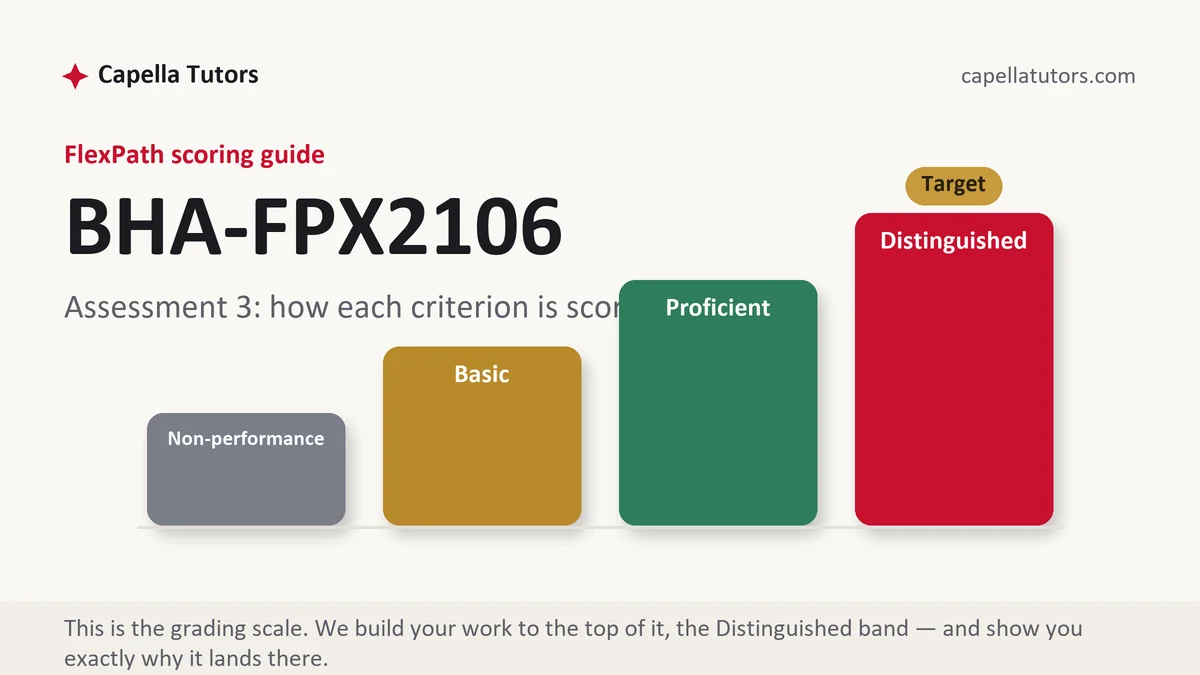
How BHA FPX 2106 Assessment 3 is scored
Four levels per criterion, scored independently, with the top level naming the additional move rather than praising the work below it:
| Level | What it means on a records access recommendation |
|---|---|
| Distinguished | The entitlement is stated accurately with its timeline and its limits, the current workflow is described step by step, and the recommendation names the owner, the added handling time, and the audit that shows it working. |
| Proficient | A correct account of the right and a sensible workflow change, with the operational cost left unstated. |
| Basic | A general description of how records requests are handled, with a recommendation to streamline the process. |
| Non-performance | The individual's entitlement is described incorrectly, or no workflow recommendation is made. |
Write this one for the person who signs off on it. A committee needs to know who runs the new step, how much time it adds to a transaction, what training it takes, what the audit trail will show, and what the organization is exposed to if nothing changes. Name a number wherever a number exists and say plainly where one does not.
The BHA FPX 2106 Assessment 3 method, step by step
-
Separate the record sets before you write anything
The designated record set and the legal health record are not the same collection, and the request in front of you attaches to one of them. Say which, and say what sits inside it in this organization, because the boundary decides what the individual receives.
-
State the entitlement with its clock
The right of access carries a timeline, a limited extension available with written notice, a rule about the form and format the individual asks for, and limits on what may be charged. Get these right in plain sentences, since an audience of non-specialists is exactly who this deliverable is written for.
-
Map the current process as it actually runs
Every step, every handoff, every queue, including the parts nobody documents: who opens the mail, who verifies identity, who pulls imaging from a separate system, who checks the fee, who mails it. The gaps become visible only at this grain.
-
Find the step that decides the turnaround
One handoff usually governs the whole timeline, and it is rarely the copying. It is a signature, a verification call, or a second system that only one person can retrieve from. Name it, and aim the recommendation there rather than at the visible part.
-
Cost the recommendation in minutes and roles
Say how long the new step adds per request, who performs it, and what training or access it requires. A proposal that names a technology and stops is the standard failure mode in health information writing, and the criteria have learned to look for the operational half.
-
Name the exposure, then self-score
Late responses, incorrect fees, and refusals that were not the organization's to make all carry consequences, and stating them in one honest paragraph is what turns a workflow memo into a case. Then grade the draft criterion by criterion and rewrite anything below the top level.
A structure that maps to the criteria
Planning targets our tutors use for a deliverable of this size. The scoring guide attached to your assessment sets the sections and the audience.
| Section | What it must do | Guide |
|---|---|---|
| The situation | The request, the setting, and what the department currently does with it. | ~175 words |
| What the individual is entitled to | The right, its timeline, the extension, the format rules, and the limits on fees, in plain language. | ~275 words |
| The current workflow | Every step and handoff, with the queue times where they exist and the systems involved named. | ~275 words |
| The step that governs turnaround | The handoff that decides the timeline, with the evidence that it is the governing one. | ~225 words |
| The recommendation | The change, the owner, the minutes it adds, the training, and the audit that verifies it. | ~275 words |
| References | The regulation cited to its part, federal guidance and practice briefs alongside it, current APA. | as needed |
Annotated sample excerpt
A model excerpt from our team showing a recommendation written for the person who has to approve it. Study the components, then build the version your own workflow needs.
The practice answers records requests in a median of 26 days, comfortably inside the timeline on paper, and the distribution is the problem: requests that include imaging run at 34 days because the compact discs are burned by the single radiologic technologist who also covers the afternoon schedule, and eight of last quarter's ninety-one requests crossed the deadline entirely.1 The governing step is that retrieval, not the copying everyone assumes, so the recommendation moves image export to two named front-desk staff with read-and-export access, a change that adds roughly nine minutes per affected request to a desk with capacity at midday and removes a dependency on one person's clinical schedule.2 Verification uses the request log the department already keeps, with the health information supervisor reviewing days-to-completion by request type monthly, and the fee schedule reviewed at the same time, since the cost-based limit on what may be charged is the second place this practice has exposure and neither the log nor the fee sheet has been examined in two years.3
- 1The median is reported and then immediately distrusted, because the tail is where the compliance risk sits. Naming the subgroup that fails is more useful than reporting the average that passes.
- 2The recommendation moves a task to people with available capacity, prices it in minutes, and explains what dependency it removes. That is the operational half most health information proposals leave out.
- 3The audit runs on an existing log with a named owner and cadence, and the paragraph raises a second exposure the reader had not asked about, which is the kind of judgment the top level describes.
The full premium sample for your exact assessment, written fresh to your scoring guide and issue, is free to request. Study it, revise it into your own voice, and submit work you understand.
The five mistakes that cost Distinguished
- The entitlement described from memory. Timelines, extensions, and fee limits are specific, and a criterion asking about the right will check them.
- A workflow described at the wrong grain. Records are copied and sent is not a workflow. Handoffs and queues are where the turnaround is decided.
- Averages hiding the failures. A median inside the deadline can conceal a subgroup missing it every time. Report the shape, not just the center.
- A recommendation with no operational cost. Minutes, roles, and training are what a committee needs before it can approve anything.
- Institutional practice presented as law. If the organization chose it, say the organization chose it, and keep the rule separate.
Pre-submission checklist
- The designated record set and the legal health record are distinguished
- The entitlement is stated with its timeline, extension, format, and fee limits
- The current workflow appears step by step with its handoffs
- The step governing turnaround is named, with evidence
- The recommendation carries an owner, added minutes, training, and an audit
- The regulation is cited to its part, references reconciled in both directions
Records workflow deliverable due?
Send the prompt, the criteria, and the process your assessment describes. The sample comes back inside 24 to 48 hours with the entitlement stated accurately, the workflow mapped at the grain that shows the handoffs, and a recommendation priced in minutes and roles.