This manual is for BHA FPX 2102 Assessment 2, start to submission. Assessment 2 of BHA FPX 2102, Leadership and Communication in Healthcare Management, is graded harder than the leadership work because it is easier to check. The assessment usually asks you to plan the communication around a change, and every element of that plan is verifiable: whether the night shift was included, whether the people who take the phone calls heard before the patients did, whether anyone can answer back. A plan of intentions scores Basic. A plan of decisions, with audiences, channels, senders, and dates, scores where you want to be. What follows is the method, a section plan tied to the criteria, and an annotated sample excerpt. Prefer that we built the message plan with you? A premium original sample returns inside 24 to 48 hours, reworked free until the guide is met. Capella's catalog lists the course as BHA-FPX2102, and some courserooms print BHA2102; both point to this same Assessment 2.
One honesty note before the manual: Capella revises courses and scoring guides over time, so always write to the exact scoring guide attached to your assessment in the courseroom. The course identity above is verified on capella.edu; the method and structure below are our tutors' approach to it, not Capella's official rubric text.
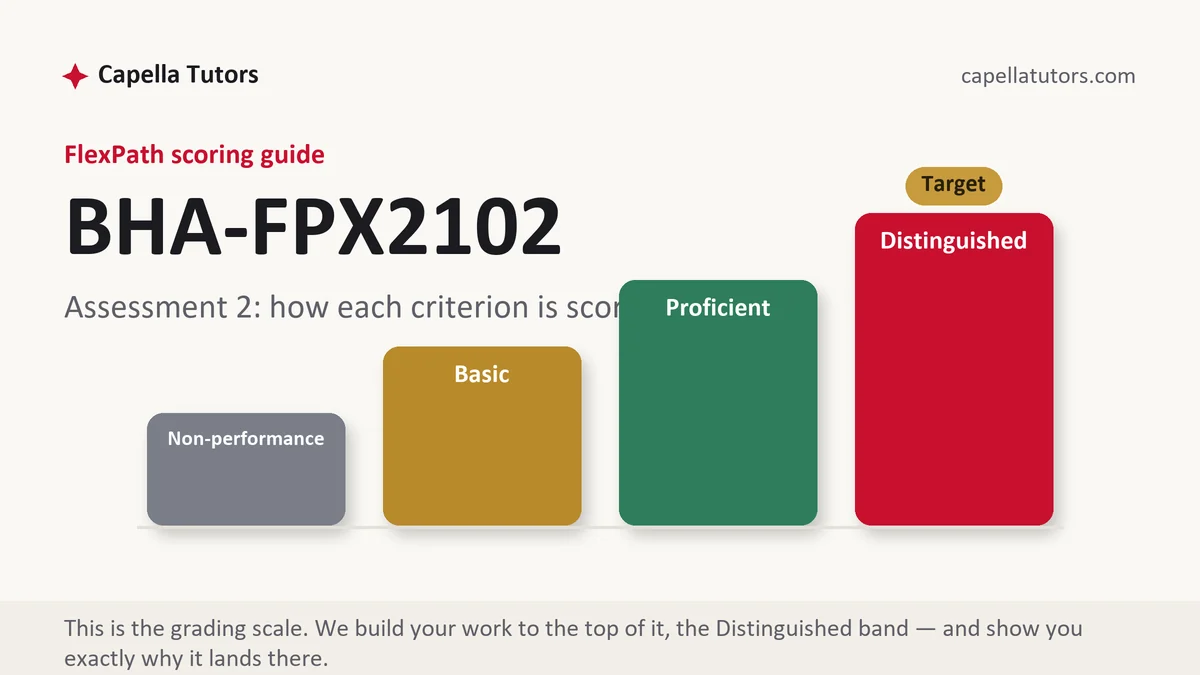
How BHA FPX 2102 Assessment 2 is scored
No letter grades, no partial credit across criteria. Each row of the guide sits at one of four levels, and the top row is a specification:
| Level | What it means on a communication plan |
|---|---|
| Distinguished | Every affected group is reached, each message has an audience, a channel, a sender, a date, and one requested action, and the plan includes a route for people to answer back plus a check that the message landed. |
| Proficient | A complete plan covering the main audiences, with timing and channels, and no feedback route. |
| Basic | A paragraph of intentions about keeping everyone informed, with staff treated as one undifferentiated group. |
| Non-performance | An audience the change directly affects is absent from the plan, or no plan is provided at all. |
Register is scored quietly throughout. A note to an executive leads with the ask and puts the reasoning underneath; a briefing for front-desk staff names the change, the start date, and the person to ask, and stops. Writing that borrows its tone from a motivational poster reads as junior however clean the grammar is.
The BHA FPX 2102 Assessment 2 method, step by step
-
List every group the change touches, then add the one you forgot
Staff on each shift, the clinicians, the people who answer the phone, the patients already booked, the referring practices, and whoever maintains the website and the recorded message. The forgotten group is usually the one that finds out from a patient.
-
Give every message five attributes
Audience, channel, sender, date, and the single action the reader is meant to take. A message with no requested action is an announcement, which is fine, but say so, since a plan made entirely of announcements has no way to fail visibly and no way to succeed either.
-
Match the sender to the hierarchy
A message travelling up a clinical hierarchy carries different weight from one travelling across it. Physicians usually hear a change best from a clinical peer, front-desk staff from their own supervisor, and patients from whoever they already talk to. Say who sends each one and why.
-
Sequence it so nobody learns from a patient
Order the messages by date and check the sequence backwards: could anyone in a later row be asked about this by someone in an earlier row? Internal before external, phone staff before the website, booked patients before the recorded message changes.
-
Build the route back and the landing check
Name where questions go and who answers them, then name what you will look at in three or four weeks to know the message worked: call volume about the change, the share of arrivals who knew before they came, the number of exceptions granted at the desk.
-
Write in the required form, then self-score
If the guide asks for a memo, write a memo with a subject line and a first-sentence ask, not an essay wearing a header. Then grade yourself against each criterion and rewrite anything short of the top level before submitting.
A structure that maps to the criteria
Planning targets our tutors use for a communication plan of this size. The scoring guide attached to your assessment decides the format and the sections.
| Section | What it must do | Guide |
|---|---|---|
| The change and its rationale | What is changing, when it starts, and the one-sentence reason a reader will accept. | ~175 words |
| Audiences | Every group affected, with what each one needs to know and what each one is being asked to do. | ~275 words |
| Message plan | Audience, channel, sender, date, and requested action, laid out in a form somebody could execute. | ~300 words |
| Sequence and risks | The order, the reason for it, and the objection each group is most likely to raise. | ~250 words |
| Feedback and follow-up | Where questions go, who answers, and the indicator that shows the message landed. | ~200 words |
| References | Communication and change sources cited to the original work, professional standards alongside, current APA. | as needed |
Annotated sample excerpt
A model excerpt from our team showing a message plan written as decisions. Study the specificity, then rebuild it for the change your own prompt describes.
Walk-in immunization at both clinic sites becomes appointment-based on the first of October, and the first message goes out nine days ahead of that, from the site manager to the eleven front-desk and scheduling staff across both locations, in person at the Tuesday huddle rather than by email, asking each of them to practice the two-sentence explanation and the same-week booking offer before they use it on a patient.1 The second message reaches the two hundred and forty patients with standing seasonal appointments through the automated reminder that already runs, signed by the medical director, seven days ahead, asking them only to keep the time they already hold, and it is written at the reading level the practice uses for its discharge material rather than in the language of the operational memo it came from.2 Questions route to the site manager and to a single voicemail box checked twice a day, and the plan's landing check is the count of walk-in arrivals turned into same-week bookings in the first fortnight, reviewed at the existing operations meeting on the fifteenth.3
- 1Every attribute is present in one row: audience, sender, channel, date, and the specific action requested. Choosing the huddle over email is itself a decision an evaluator can score.
- 2The patient message is a different register, a different sender, and a different ask, which is what audience awareness looks like on the page rather than as a claim about it.
- 3A route back and a landing check, both attached to things that already happen. A plan that only pushes information outward is half a plan and the criterion tends to say so.
The full premium sample for your exact assessment, written fresh to your scoring guide and issue, is free to request. Study it, revise it into your own voice, and submit work you understand.
The five mistakes that cost Distinguished
- Staff as one audience. Night shift, phone staff, and clinicians need different messages from different senders, and the criterion is watching for the split.
- No requested action. A message that asks for nothing cannot be checked, and a plan of such messages cannot be scored as a plan.
- Communication only outward. Name where questions go and who answers them, or the feedback criterion has nothing in it.
- An essay with a memo header. Format compliance is its own criterion here more often than students notice.
- Cheerleading register. Exciting new process reads as junior. Name the change, the date, and the person to ask.
Pre-submission checklist
- Every affected group appears, including the shift and the role easily forgotten
- Each message carries audience, channel, sender, date, and one requested action
- Internal audiences are reached before external ones, and the sequence is justified
- A named route exists for questions, with somebody answering them
- A landing check is named, with a review date that already exists
- The deliverable is in the form the guide asked for, APA reconciled both ways
Communication deliverable due?
Send the change, the criteria, and the setting it lands in. The sample comes back inside 24 to 48 hours as a plan somebody could execute, with every message carrying a sender and a date, and it arrives in the format your scoring guide names.