This manual is for BHA FPX 2102 Assessment 3, start to submission. Assessment 3 of BHA FPX 2102, Leadership and Communication in Healthcare Management, puts a disagreement in front of you and asks you to manage it. The assessment usually gives you two parties with legitimate competing priorities and one resource between them, which means the criteria are reading for the interest behind each position, the route the disagreement escalates along, and the person who decides when agreement never arrives. Resolving it with a promise of open communication is the most common way to lose that criterion. Below you will find the method our tutors use, a structure that follows the guide's own order, and an annotated sample excerpt. Would you rather we built the draft? A premium original sample lands inside 24 to 48 hours, revised free until the criteria are met. Capella's catalog lists the course as BHA-FPX2102, and some courserooms print BHA2102; both point to this same Assessment 3.
One honesty note before the manual: Capella revises courses and scoring guides over time, so always write to the exact scoring guide attached to your assessment in the courseroom. The course identity above is verified on capella.edu; the method and structure below are our tutors' approach to it, not Capella's official rubric text.
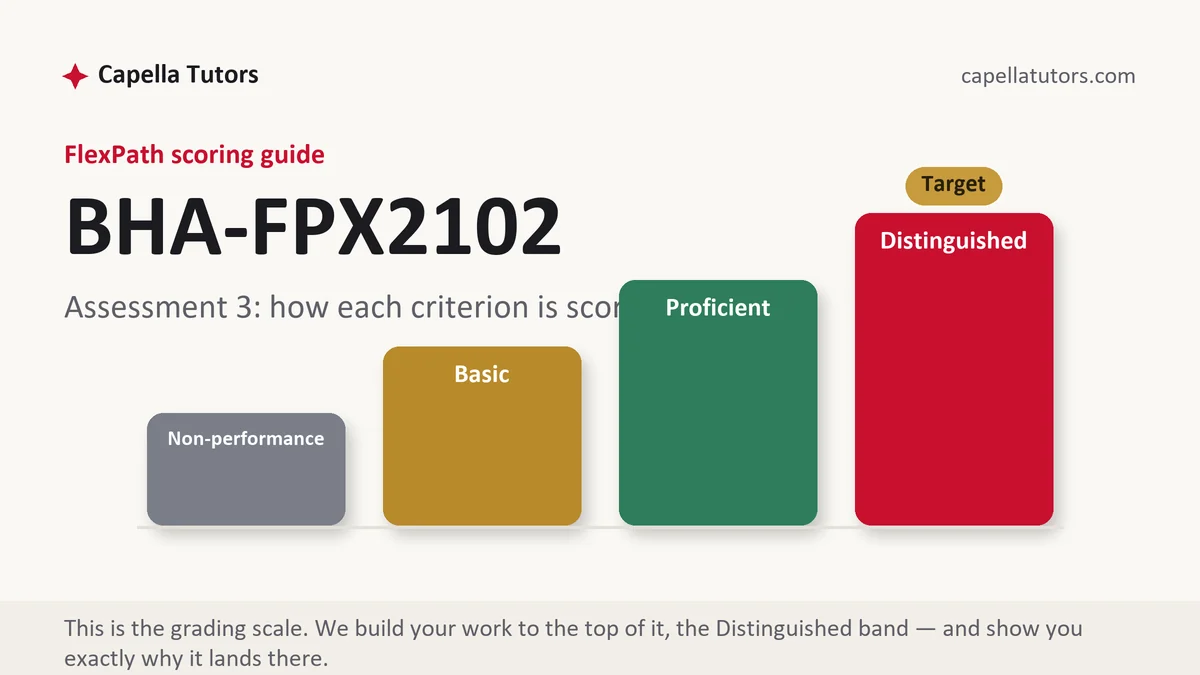
How BHA FPX 2102 Assessment 3 is scored
Each criterion is graded against four descriptions on its own terms, and the highest description is the only one written as instructions:
| Level | What it means on a conflict resolution deliverable |
|---|---|
| Distinguished | Each position is stated fairly, the interest underneath it is named, the resolution is a decision with a decider and a date, and the paper says what happens if the parties never agree. |
| Proficient | Both sides are represented accurately and a workable resolution is proposed, with the escalation path implied rather than named. |
| Basic | A summary of the disagreement followed by a recommendation that everyone communicate better and respect each other's roles. |
| Non-performance | One party's position is missing or misrepresented, or no resolution is offered. |
Reflection criteria show up in this deliverable more than anywhere else in the course, and they are not asking for modesty. Name a behavior of your own, say what it costs, and describe its replacement in specific terms. Anything softer than that scores as a sentiment.
The BHA FPX 2102 Assessment 3 method, step by step
-
Write both positions as a reasonable person would state them
If one side comes out looking foolish, you have not understood it yet. Draft each position in the words its holder would use, then check that a reader could not tell which one you favor from those two paragraphs alone.
-
Separate the position from the interest
A position is what someone demands; an interest is what they need. Two evaluation slots and a protected lunch hour are positions. Predictable therapist utilization and a defensible way to answer the phone at eleven in the morning are interests, and interests are what resolutions get built from.
-
Name the resource actually in dispute
Nearly every conflict scenario in this course has one scarce thing at its center: a room, an hour, a person, a piece of equipment. Say what it is and how much of it exists, because a disagreement stops being personal the moment the constraint is on paper.
-
Choose a mode and say why
Collaboration is the default answer and it is not always the right one. Where the resource is genuinely fixed and the clock is running, a decision imposed with the reason explained does less damage than three more meetings. Credit the framework you are using and defend the mode you picked.
-
Name the decider, the date, and the fallback
The criterion that separates the top two levels is usually this one. Who decides if the parties cannot agree, by when, and what happens in the meantime. Write those three items as a sentence, not as an implication.
-
Write the reflection concretely, then self-score
Say what you did in the last comparable situation, what it cost, and what you will do next time, with the specificity of a calendar entry. Then grade the draft against each criterion and rewrite whatever is not yet at the top level before you submit.
A structure that maps to the criteria
Our tutors' planning targets for a deliverable of this size. Your scoring guide decides the format, the sections, and the length it expects.
| Section | What it must do | Guide |
|---|---|---|
| The situation | The department, the scarce resource, and how the disagreement surfaced, with dates and roles. | ~200 words |
| Position one | The first party's account, stated as they would state it, with the interest underneath it named. | ~225 words |
| Position two | The second party's account, given the same weight and the same treatment. | ~225 words |
| The resolution | The approach chosen and why, what each side gets, and the decider, the date, and the fallback. | ~300 words |
| Reflection and follow-up | Your own behavior named and replaced, plus the check that tells you the resolution held. | ~200 words |
| References | Conflict and negotiation sources credited to their original authors, current APA. | as needed |
Annotated sample excerpt
An original model excerpt from our team, showing interests separated from positions and a decision that survives disagreement. Take the structure into your own scenario.
The rehabilitation manager wants the two daily evaluation slots protected for new referrals and the front-desk team wants permission to fill them when a same-day cancellation leaves a therapist idle, and stated that way the disagreement looks like a preference on both sides.1 The interests underneath are compatible: the manager needs referral wait time held under two weeks because the referring orthopedic group watches it, and the scheduling team needs a defensible answer for the patient standing at the desk at ten in the morning, which is a different problem that a protected slot does not solve.2 The resolution keeps both evaluation slots protected until nine each morning, releases them to the desk after that with a same-week rebooking obligation attached, and gives the clinic director the decision if referral wait time crosses fourteen days in any two consecutive weeks, reviewed at the existing monthly meeting rather than whenever the argument next flares up.3
- 1Both positions are given in one sentence with equal weight, and the paragraph refuses to make either party the problem, which is what a fair statement of the dispute looks like.
- 2The interests are named and turn out to be different problems rather than opposite ones. This is the paragraph that makes a resolution possible instead of a compromise that satisfies nobody.
- 3The resolution carries a rule, a trigger, a decider, and an existing review date. Naming who decides when agreement fails is usually the difference between the top two levels.
The full premium sample for your exact assessment, written fresh to your scoring guide and issue, is free to request. Study it, revise it into your own voice, and submit work you understand.
The five mistakes that cost Distinguished
- Resolution by goodwill. Encouraging open communication is a wish. The criterion asked for interests, a decider, and a date.
- A villain. If one party is written as unreasonable, the fairness criterion is already lost and the resolution has nowhere to go.
- Positions restated as interests. They wanted the slots is a position. Why they wanted them is the interest, and only one of those builds a solution.
- No escalation path. Every scenario needs an answer to what happens if the parties never agree, in writing.
- Reflection as modesty. I could improve my communication is not a behavior. Name the thing you did and what replaces it.
Pre-submission checklist
- Both positions are stated as their holders would state them
- The interest under each position is named and they are distinguished from each other
- The scarce resource is identified with its actual size
- The chosen approach is credited and defended against the alternative
- A decider, a trigger, and a date appear in the resolution
- The reflection names a specific behavior and its replacement, APA reconciled both ways
Conflict scenario to answer?
Send the scenario, the criteria, and anything you know about the department it sits in. The sample returns inside 24 to 48 hours with both positions stated fairly, the interests separated, and a resolution that names who decides when agreement does not arrive.