This manual is for BHA FPX 2102 Assessment 1, start to submission. Assessment 1 of BHA FPX 2102, Leadership and Communication in Healthcare Management, is where you stop reading about managers and start writing as one. The assessment usually asks you to take a department with a real problem and apply one named leadership approach to it, which is a narrower job than it sounds: the criteria do not reward how many models you can summarize, they reward whether the model you chose changes a decision somebody has to make. Below is the method our tutors use on departments like this one, a criterion-mapped structure, and an annotated sample excerpt. Prefer backup on it? A premium original sample comes back in 24 to 48 hours, with revision free until the guide is met. Capella's catalog lists the course as BHA-FPX2102, and some courserooms print BHA2102; both point to this same Assessment 1.
One honesty note before the manual: Capella revises courses and scoring guides over time, so always write to the exact scoring guide attached to your assessment in the courseroom. The course identity above is verified on capella.edu; the method and structure below are our tutors' approach to it, not Capella's official rubric text.
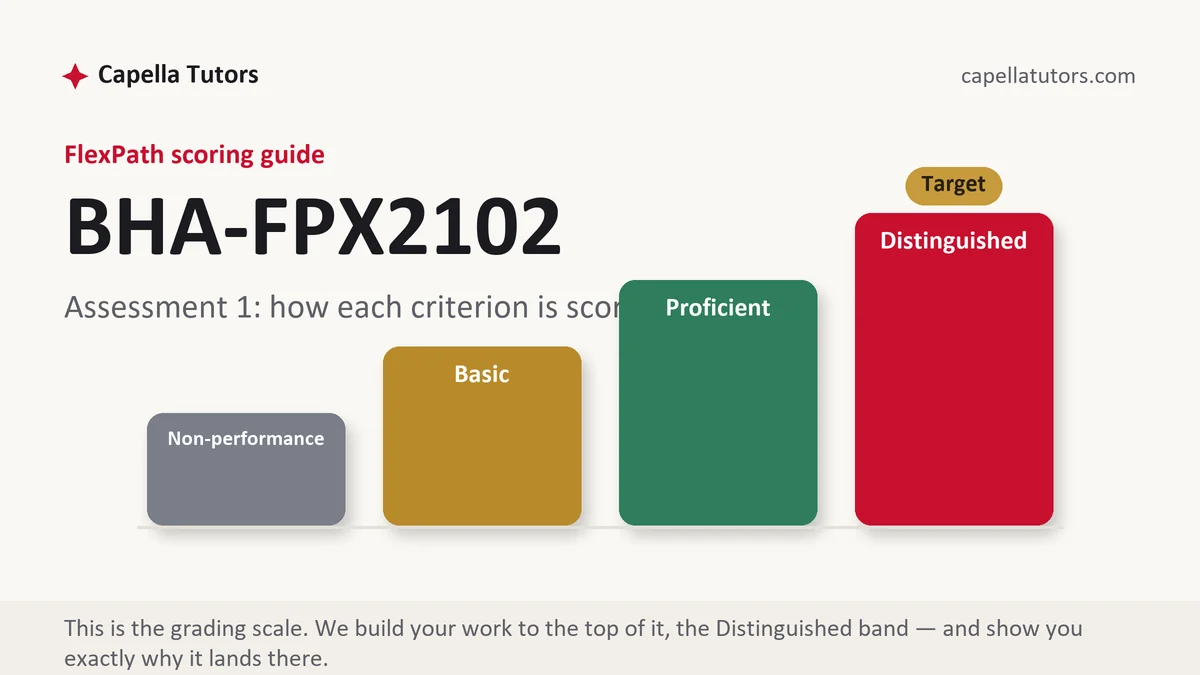
How BHA FPX 2102 Assessment 1 is scored
FlexPath grades each criterion on its own against four written levels, and the level you are aiming at is describing a specific move rather than a general standard:
| Level | What it means on an applied leadership analysis |
|---|---|
| Distinguished | One model, credited to the person who developed it, is applied to particular decisions in a department described with numbers, and the paper says what the leader stops doing as well as what the leader starts. |
| Proficient | The model is accurate, correctly credited, and connected to the situation in general terms. |
| Basic | Three or four approaches summarized and a preference announced, with the department untouched by any of them. |
| Non-performance | No model is applied, or the situation is described with no detail a leadership choice could respond to. |
The fastest way to move a criterion in this course is to add facts to the department. Size, hours, staffing mix, tenure, and volume are what turn a leadership preference into a defensible choice, and a scenario with numbers in it makes every later section easier to write.
The BHA FPX 2102 Assessment 1 method, step by step
-
Describe the department until it constrains the answer
Weak drafts say morale is low. A usable description reads like this: a community hospital patient access department, 23 registrars across three shifts, seven of them hired since March, covering an emergency desk that never closes and two outpatient desks that open at six. Every later claim now has somewhere to land.
-
Pick one model and credit it properly
Choose the approach that suits the problem, not the one you like. Transformational leadership traces to Burns in 1978 and to Bass afterward, servant leadership to Greenleaf's 1977 essay, and the situational approach associated with Hersey and Blanchard argues that the readiness of the person in front of you selects the style. Cite the origin rather than the textbook chapter that condensed it.
-
Diagnose people or system before you prescribe
A department missing its accuracy target because two registrars are careless needs one answer. The same department missing it because a new hire covers the busiest hour alone needs another, and coaching will not repair the second. The criteria reward the writer who names which one this is.
-
Make the model do something visible
Application means a changed decision: which meeting happens, who is paired with whom, what the manager stops approving personally, what gets checked at seven in the morning instead of at the end of the week. Two of those beat a page of theory.
-
Attach a measure the department already produces
Registration accuracy, insurance verification rework, time to complete an arrival, and turnover at ninety days are figures a patient access department already reports. Name the one you will watch, the review date, and who looks at it.
-
Check format compliance, then self-score
Your scoring guide decides whether this is an essay, a memo, or a briefing, and format is scored in this course more often than students expect. Match the form, then grade the draft criterion by criterion and rewrite anything below the top level.
A structure that maps to the criteria
These lengths are our tutors' planning targets, not Capella rules. Your scoring guide decides the format, the sections, and the length it wants.
| Section | What it must do | Guide |
|---|---|---|
| The department | Size, shifts, staffing mix, tenure, and the problem as it presents, with constructed figures labeled. | ~250 words |
| The problem, diagnosed | Whether the cause sits with people or with the system, argued from the detail above. | ~250 words |
| The leadership approach | The named model, credited to its originator, and why this situation suits it. | ~250 words |
| The approach applied | Specific decisions that change, including what the leader stops doing personally. | ~300 words |
| Measures and review | The existing indicator, the review date, and the role that owns the check. | ~200 words |
| References | Leadership theory cited to the original work, professional competencies alongside it, current APA. | as needed |
Annotated sample excerpt
An original model excerpt from our team, showing a model applied rather than described. Read it for the moves and then write your own department.
With seven of twenty-three registrars inside their first six months and a department that verifies coverage for an emergency desk running around the clock, an appeal to shared purpose has nothing yet to stand on, so the approach here begins transactional and becomes something else later.1 Concretely, the supervisor sets three explicit standards for the arrival transaction, checks a sample of ten registrations against them every morning at seven, and gives each new registrar the result the same day rather than at a monthly meeting, which is what Hersey and Blanchard's argument about readiness looks like when the readiness in question is four months of experience.2 What the supervisor stops doing matters as much: she stops personally correcting the errors she finds, because every correction she makes herself is a piece of learning the new registrar does not get, and the department's ninety-day turnover is the number that will tell her within a quarter whether the trade was worth it.3
- 1The staffing facts do the arguing. Seven new hires out of twenty-three is the reason a transactional floor comes first, and the sentence says so instead of asserting a preference.
- 2Application arrives as a routine with a time on it, and the theory is credited inside the same sentence rather than in a separate paragraph of definitions.
- 3Naming what the leader stops doing is the move most undergraduate papers skip, and it is usually written into the top level of the criterion in one form or another.
The full premium sample for your exact assessment, written fresh to your scoring guide and issue, is free to request. Study it, revise it into your own voice, and submit work you understand.
The five mistakes that cost Distinguished
- Four theories compared, none used. A comparison table is not an application, and the criterion uses the word apply for a reason.
- A department with no numbers. Staffing, hours, and volume are what make a leadership choice defensible instead of decorative.
- Models credited to the survey text. An evaluator who teaches this material can tell whether you went to the source.
- Only additions, no subtractions. A plan where the manager does everything she did before plus six new things is not a plan.
- A measure invented for the paper. Choose something the department already reports, or the follow-up section reads as fiction.
Pre-submission checklist
- The department is described with size, shifts, tenure, and volume
- Constructed figures are labeled as constructed
- One model is named and credited to its originator
- Application appears as specific decisions, including something the leader stops doing
- The measure already exists and has an owner and a review date
- Format matches what the scoring guide asked for, APA reconciled both ways
Leadership analysis due this week?
Tell us the department: how many staff, which shifts, who reports to whom, and the friction you actually see. The sample comes back inside 24 to 48 hours with the theory fastened to those details, written in the format your guide asks for rather than as an essay with a header on it.