This manual is for BHA FPX 2003 Assessment 1, start to submission. Assessment 1 of BHA FPX 2003, Current Trends and Future Directions in Healthcare Management, is the measurement stage of the course. The assessment usually asks you to identify a development affecting health care organizations and describe it with evidence rather than with impressions, which means a number, a year, a publisher, and the population the number describes. Enthusiasm about a topic scores nothing here; a quantity a reader can check scores every time. What comes next is the method our tutors apply here, a criterion-by-criterion structure, and an annotated sample excerpt. Would you rather we took it? A premium original sample for this exact assessment comes back in 24 to 48 hours, revised free until it satisfies the guide. Capella's catalog lists the course as BHA-FPX2003, and some courserooms print BHA2003; both point to this same Assessment 1.
One honesty note before the manual: Capella revises courses and scoring guides over time, so always write to the exact scoring guide attached to your assessment in the courseroom. The course identity above is verified on capella.edu; the method and structure below are our tutors' approach to it, not Capella's official rubric text.
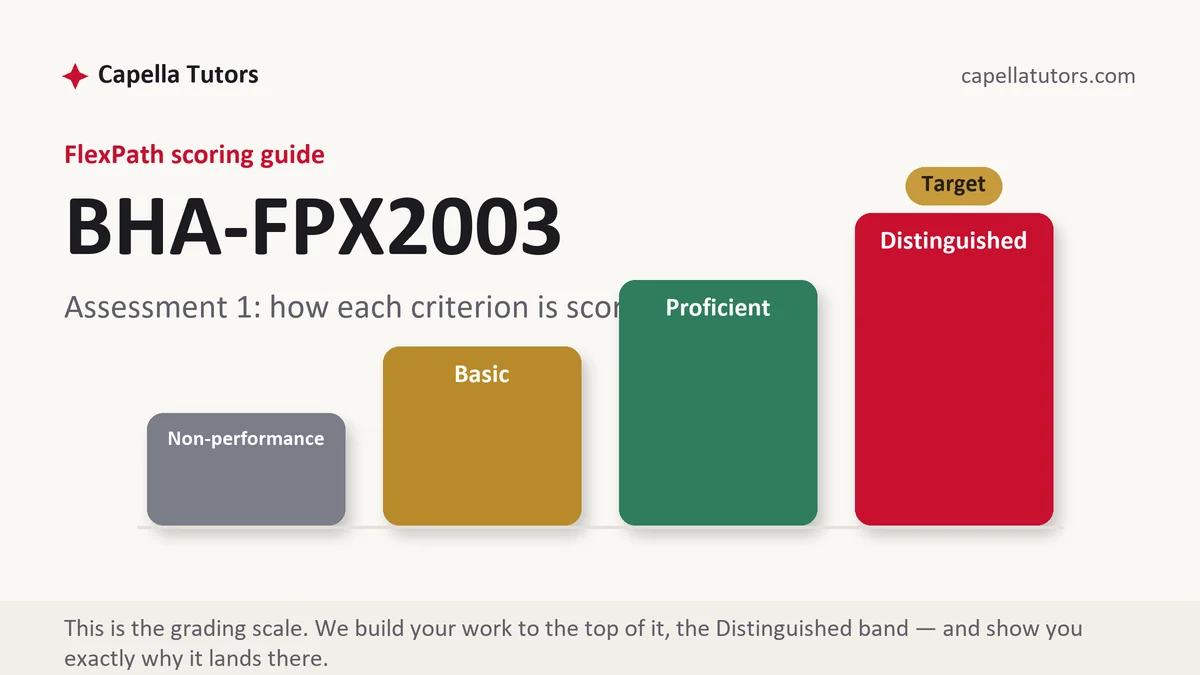
How BHA FPX 2003 Assessment 1 is scored
FlexPath grades criteria, not papers. Each row of your scoring guide is placed at one of four levels, and the top row tells you the sentence you are missing:
| Level | What it means on a quantified trend analysis |
|---|---|
| Distinguished | The trend is stated narrowly enough to be wrong, carried by figures with years and denominators, and separated from the symptoms it produces. The paper also names the driver it thinks dominates and what would change its mind. |
| Proficient | The trend is accurate, current, and supported. Everything checks out, and the driver analysis stops at a list. |
| Basic | A report of what is already widely known, correct and unquantified, with the trend described as a topic rather than a claim. |
| Non-performance | A required element is absent, most often the evidence itself, where the paper asserts growth with no figure behind it. |
The habit worth building on this first deliverable is conversion. Every complaint in health care management has a measured form: pressure becomes a vacancy rate, demand becomes visits per thousand, cost becomes a rate per unit of service. Convert before you write, and the criteria stop feeling subjective.
The BHA FPX 2003 Assessment 1 method, step by step
-
Quantify before you characterize
Find the numbers first, then decide what you think. If you cannot locate two figures with years attached, the trend you have chosen is not one you can defend at this level, and it is cheaper to discover that now than in the fourth paragraph.
-
Cut the trend down to a claim
Price transparency is a topic. A claim sounds like this: since the federal price transparency requirement took effect in 2021, published charge files have become common while consumer use of them has stayed low, and the gap has real consequences for a small hospital's revenue office. Narrow enough to be wrong is the test.
-
Turn each criterion into a heading
Number the criteria, give each one a section, and hold the guide's own wording beneath the heading while you draft. Trends writing wanders because there is always another development worth mentioning, and the heading structure is what stops a second example from eating the analysis.
-
Separate the driver from the symptom
A symptom is what people complain about; a driver is what produces it. Long phone hold times in a billing office are a symptom, and the drivers underneath might be a new estimate request volume, a staffing gap on the afternoon shift, or a payer portal that stopped returning benefit detail. Say which one dominates and give your reason.
-
Compare like with like
A figure from an unusual period describes that period only. When you set two years beside each other, check that the population, the definition, and the collection method match, and say so in the sentence. Where they do not match, name the mismatch instead of quietly averaging it away.
-
Self-score, then submit with the clock in mind
Read the draft against each criterion and mark it Distinguished, Proficient, Basic, or Non-performance yourself. Rewrite anything short of the top level. Submit early in the week, since an evaluator has up to two business days and the weekend does not count.
A structure that maps to the criteria
The word targets below are our tutors' planning figures for a trend analysis of this size, not Capella requirements. Your scoring guide sets the sections and the length.
| Section | What it must do | Guide |
|---|---|---|
| Introduction | The trend as one narrow claim, the setting it affects, and the period it covers. | ~125 words |
| The evidence | Two or three quantities with years, publishers, and the population each one counts. | ~300 words |
| Drivers behind it | The forces producing the trend, kept apart from its effects, with the dominant one argued. | ~300 words |
| Who it reaches | Consequences for patients, staff, the finance office, and the board, kept distinct from each other. | ~250 words |
| What it means for management | The decision the trend forces, and the indicator that would show whether the response is working. | ~200 words |
| References | Federal data, peer-reviewed health services research, and named survey organizations, current APA. | as needed |
Annotated sample excerpt
An original model paragraph from our team, written to show what evidence looks like when it is carrying an argument instead of decorating one. Copy the moves, not the numbers.
The federal requirement that hospitals publish a machine-readable charge file and a list of shoppable services took effect in 2021, and compliance reviews since then have consistently found published files that are complete in form and difficult to use in practice.1 Inside one 90-bed community hospital the operational effect shows up in a place the rule never mentions: in a constructed but representative quarter, the business office logged 610 telephone price estimate requests against 4,180 outpatient registrations, and 41 percent of those calls arrived after the patient had already been scheduled.2 The trend, then, is not that prices became public. It is that the obligation to explain a price moved from a published file to a two-person business office that was never staffed for it.3
- 1The rule is dated and its effect is characterized cautiously, with the source of the characterization implied rather than overstated. No adjective is doing work a citation should be doing.
- 2The local figures arrive with their denominator and their window, and the sentence labels them as constructed. A rate a reader can recalculate is what the evidence criterion is looking for.
- 3The closing sentence converts the trend from a headline into a management problem with a location and a staffing implication. That conversion is the difference between Proficient and the level above it.
The full premium sample for your exact assessment, written fresh to your scoring guide and issue, is free to request. Study it, revise it into your own voice, and submit work you understand.
The five mistakes that cost Distinguished
- Growth with no denominator. Up forty percent means nothing until the reader knows forty percent of what, over which months.
- A topic where a claim belongs. Telehealth is a subject heading. A sentence that could be shown to be false is a trend statement.
- Vendor material used as proof. A supplier's own white paper is marketing with citations, and using it as evidence loses the criterion outright.
- An unusual year treated as the new baseline. A spike produced by a temporary waiver is a spike until the rule that created it becomes permanent.
- Drivers listed instead of ranked. Five causes given equal weight is a description. Naming the one that dominates is the analysis.
Pre-submission checklist
- The trend is stated as one claim narrow enough to be wrong
- At least two figures carry a year, a publisher, and a denominator
- Constructed or internal numbers are labeled as what they are
- Drivers are separated from symptoms and one is argued as dominant
- Consequences are written separately for each group affected
- Every citation appears in the reference list and every reference in the text
Trend analysis due this week?
Send the prompt, the criteria, and the setting you are writing about, whether that is a hospital, a clinic group, a long-term care provider, or a payer. The sample comes back inside 24 to 48 hours with every figure dated and sourced, and revision stays free until the guide is met.