This manual is for BHA FPX 2003 Assessment 3, start to submission. Assessment 3 of BHA FPX 2003, Current Trends and Future Directions in Healthcare Management, is the forecasting stage. The assessment usually asks you to project where a development is going and to say what an organization should be doing now because of it, and the criteria are built to catch the two ways that goes wrong: a prediction with no horizon, and a certainty the evidence cannot support. A forecast that names its timeframe, states the assumption it rests on, and identifies the signal that would falsify it scores; an adverb does not. Below is our tutors' method for it, a section plan built off the guide, and an annotated sample excerpt. Need it handled? A premium original sample lands inside 24 to 48 hours, revised at no charge until the guide is satisfied. Capella's catalog lists the course as BHA-FPX2003, and some courserooms print BHA2003; both point to this same Assessment 3.
One honesty note before the manual: Capella revises courses and scoring guides over time, so always write to the exact scoring guide attached to your assessment in the courseroom. The course identity above is verified on capella.edu; the method and structure below are our tutors' approach to it, not Capella's official rubric text.
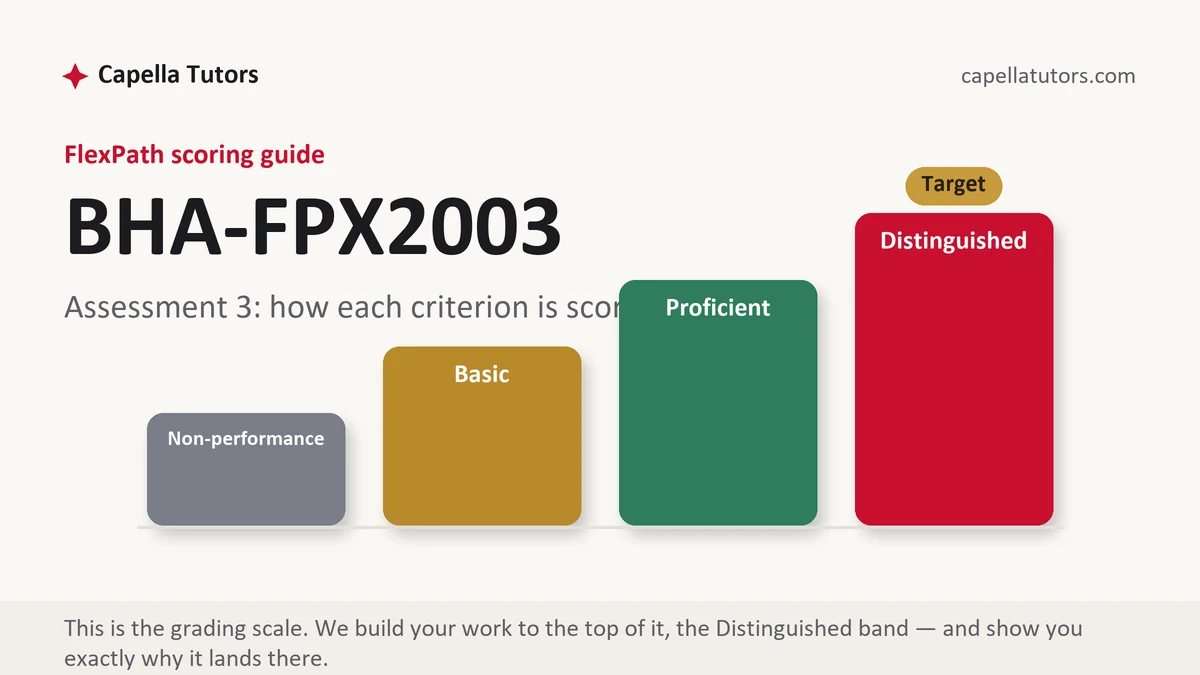
How BHA FPX 2003 Assessment 3 is scored
Criteria in FlexPath are scored one at a time against four descriptions, and the description at the top is a checklist disguised as a paragraph:
| Level | What it means on a future-direction analysis |
|---|---|
| Distinguished | The projection carries a horizon, a stated assumption, and a named signal that would show the assumption failing, and the paper says what the organization does in the meantime. Uncertainty is quantified rather than apologized for. |
| Proficient | A reasonable projection with support and a timeframe, missing the signal that would tell anyone whether it is holding. |
| Basic | A confident statement about the future with no date and no condition attached, defended by the sources that agree with it. |
| Non-performance | No projection is made, or the assessment's forward-looking element is answered with a summary of the present. |
Forecasting at undergraduate level is not fortune telling and the criteria do not ask for it. What is being graded is whether you can hold a claim and its uncertainty in the same paragraph, which is a management skill long before it is a writing one.
The BHA FPX 2003 Assessment 3 method, step by step
-
Set the horizon before you write the claim
Decide whether you are projecting eighteen months, three years, or five, and say so in the first sentence. A horizon changes the evidence you need and the confidence you are allowed, and a projection without one cannot be judged by anybody, including you.
-
Write the assumption as a separate sentence
Every forecast rests on something staying true: a payment rule, a labor market, a supply chain, a regulatory posture. Put that condition in its own sentence so a reader can accept the forecast and reject the assumption, or the reverse.
-
Name the signal you would watch
A falsifiable forecast identifies the observable event that would tell you it is wrong: a rule that lapses, a payer that stops covering something, a hiring pattern that reverses. This is the sentence undergraduate papers almost never include and the one that most reliably lifts a criterion.
-
Build the guide into headings and keep the present short
Give each criterion its own section. Then hold the description of the current situation to the minimum the projection needs, because a forward-looking criterion answered with three pages of background is answered with two paragraphs of forecast.
-
Say what the organization does before the future arrives
The useful version of a forecast is an action that makes sense either way: a pilot with a small budget, a contract with a shorter term, a job description written to be revised. Name one, with a role attached.
-
Read for hedging, then self-score
Delete every could potentially and may possibly, and replace each with either a probability you are willing to defend or a stated unknown. Then mark yourself against each criterion and rewrite whatever sits below the top level before you submit.
A structure that maps to the criteria
Planning targets from our tutors for a forward-looking analysis of this size. The scoring guide attached to your assessment governs the sections and the word count.
| Section | What it must do | Guide |
|---|---|---|
| Introduction | The development, the horizon you are projecting over, and the claim in one sentence. | ~125 words |
| Where it stands now | The current position with evidence, kept tight because it is the platform and not the paper. | ~200 words |
| The projection | What you expect to change, by when, with the reasoning that supports the direction and the pace. | ~300 words |
| Assumption and signal | The condition the forecast depends on, and the observable event that would show it failing. | ~250 words |
| What to do now | The action that makes sense under either outcome, with a role, a scale, and a review date. | ~250 words |
| References | Peer-reviewed research, federal projections, and named industry surveys, current APA. | as needed |
Annotated sample excerpt
An original model excerpt from our team, showing a projection that states its own conditions. Learn the structure and rebuild it with your own development and setting.
Within three years, ambient documentation tools that draft a clinical note from the recorded visit will be standard equipment in this five-site urgent care group rather than a pilot, on the assumption that the current pattern holds in which payers reimburse the visit and not the documentation method, leaving the savings entirely internal to the practice.1 The pace depends on one measurable quantity the group can watch in its own data: clinician time spent in the record after the last patient leaves, running at a constructed 47 minutes a day per clinician today, since a tool that returns half of that pays for itself against locum coverage and a tool that returns eight minutes does not.2 The signal that would break the forecast is not technical. It is a documentation or attestation requirement that makes an automatically drafted note more expensive to defend than to write, and if that appears the group should expect adoption to stall regardless of how well the tool performs.3
- 1The horizon sits in the first three words and the assumption is written into the same sentence as a condition rather than buried as a caveat at the end of the section.
- 2The pace of adoption is tied to a quantity the organization can actually observe, with the constructed figure labeled, so the forecast has an internal test instead of an external hope.
- 3The falsifying signal is named and it is a policy event rather than a technology failure. Identifying the right kind of signal is what separates a forecast from an expectation.
The full premium sample for your exact assessment, written fresh to your scoring guide and issue, is free to request. Study it, revise it into your own voice, and submit work you understand.
The five mistakes that cost Distinguished
- Eventually. An adverb is not a horizon, and a criterion asking for future direction cannot be satisfied by one.
- No stated assumption. A forecast with no condition attached cannot be argued with, which means it cannot be scored as reasoning either.
- Only the sources that agree. Two analysts who disagree, named and weighed, is stronger evidence than four who concur.
- A projection with nothing to do about it. The criterion wants an action that makes sense before the outcome is known, not after.
- Hedging as a substitute for judgment. May potentially eventually reads as a writer avoiding a claim, and evaluators mark it as an unmet criterion.
Pre-submission checklist
- The horizon appears in the first sentence of the projection
- The assumption behind the forecast is written as its own sentence
- A named, observable signal would show the assumption failing
- At least one source that disagrees is stated fairly and answered
- One action is recommended that makes sense either way, with a role attached
- Reference list and citations reconcile, every figure carrying its year
Forward-looking analysis due?
Send the prompt, the criteria, and the development you are projecting. The sample returns inside 24 to 48 hours with a horizon, a stated assumption, a falsifying signal, and an action a named role can start now. Free revision until the guide is met.