This manual is for BHA FPX 2003 Assessment 2, start to submission. Assessment 2 of BHA FPX 2003, Current Trends and Future Directions in Healthcare Management, is where a trend has to turn into a decision. The assessment usually asks you to take a development affecting a specific organization and recommend what its management should do, which means an action, an owner, a first step, a rough cost, and a way of knowing in six months whether it worked. This is the deliverable where papers with excellent research still lose criteria, because a recommendation nobody owns is not a recommendation. The rest of this page is the method, a structure that answers the criteria in order, and an annotated sample excerpt. Prefer backup? A premium original sample reaches you inside 24 to 48 hours, revised at no cost until the criteria are met. Capella's catalog lists the course as BHA-FPX2003, and some courserooms print BHA2003; both point to this same Assessment 2.
One honesty note before the manual: Capella revises courses and scoring guides over time, so always write to the exact scoring guide attached to your assessment in the courseroom. The course identity above is verified on capella.edu; the method and structure below are our tutors' approach to it, not Capella's official rubric text.
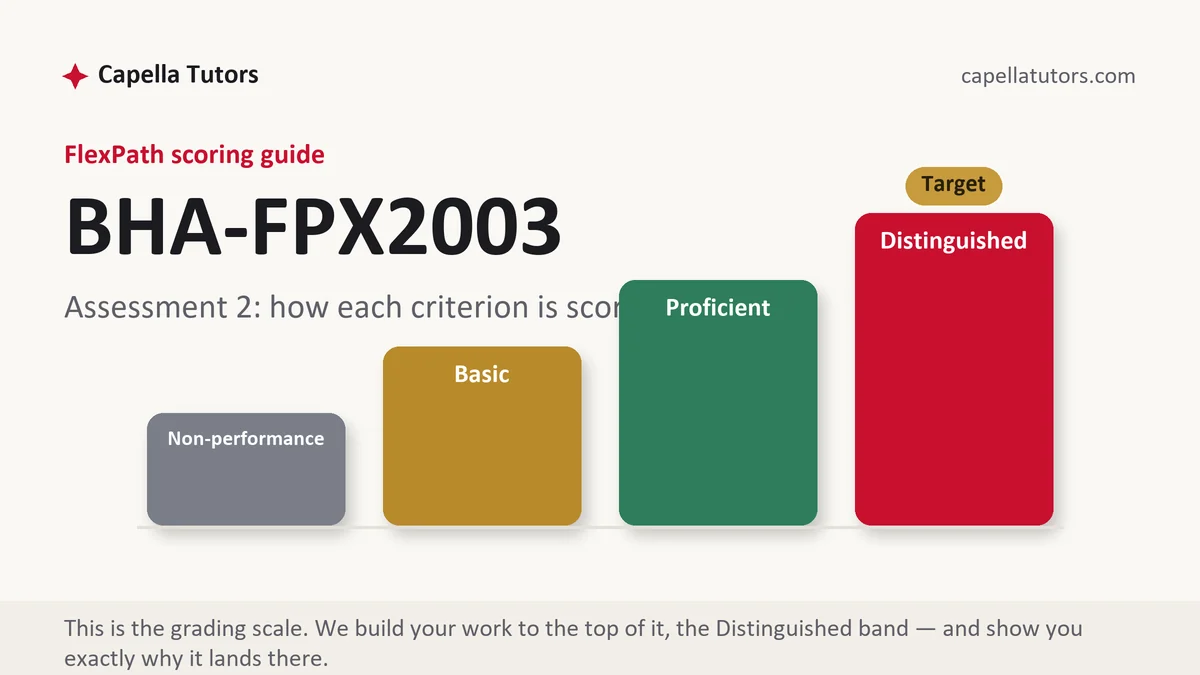
How BHA FPX 2003 Assessment 2 is scored
Every criterion in FlexPath is scored on its own, at one of four levels, and the wording of each level is the most useful writing instruction you will get all term:
| Level | What it means on a management recommendation |
|---|---|
| Distinguished | The recommendation names a role, a first step, a cost order of magnitude, and a measure, and it states what the organization risks by doing nothing. The alternative that was rejected is named, with the reason. |
| Proficient | A sound recommendation with support behind it, owned by the organization in general rather than by a role in particular. |
| Basic | A sensible course of action described in the passive voice, with nobody assigned and nothing measured. |
| Non-performance | The recommendation is missing, or it restates the trend as though describing a problem were the same as answering it. |
One test settles most drafts in this course. Read your recommendation and ask whether a department head could walk out of the room and start on it. If the answer needs a translation step, the criterion has not been met yet, however good the analysis above it is.
The BHA FPX 2003 Assessment 2 method, step by step
-
Choose the organization before you choose the trend
Recommendations only get specific when the setting is fixed. Decide the size, the ownership, the payer mix, and the market position first, three sentences will do, and then pick the development that actually presses on an organization shaped like that.
-
Frame the decision as a choice between named options
A recommendation with no alternative reads as a preference. Lay out two or three real options, including the option of doing nothing, and price each one roughly. The criterion asking for justification is asking you to say why the others lost.
-
Build the outline from the guide, and put the decision early
Give every criterion a heading, then place the recommendation near the front rather than saving it for a conclusion. Management readers, and evaluators reading like them, want the answer first and the reasoning underneath it.
-
Attach an owner, a step, a cost, and a date
Four items turn a wish into a plan: the role responsible, the first thing that happens, the order of magnitude it costs, and the date the first check occurs. Write them in the sentence rather than in a table nobody reads.
-
Pick a measure the organization already collects
A new data collection is a project of its own and it will not survive contact with a busy department. Choose an indicator that already exists in a report somebody already runs, and name the report and the cadence.
-
Stress-test it, then self-score
Ask what happens if your dominant driver is the wrong one, and write the answer into the paper as a sentence about the cost of being wrong. Then grade yourself against each criterion and revise anything below the top level before submitting.
A structure that maps to the criteria
These are our tutors' planning targets for a recommendation of this scope. Your scoring guide decides the deliverable, its sections, and its length.
| Section | What it must do | Guide |
|---|---|---|
| The organization | Size, ownership, payer mix, market position, and the pressure the trend puts on it. | ~150 words |
| The development | The trend in one claim with its evidence, kept short because the decision is the subject here. | ~200 words |
| Options considered | Two or three courses of action, including doing nothing, each with a rough cost. | ~250 words |
| The recommendation | The chosen action with its owner, first step, cost order, and the reason the alternatives lost. | ~300 words |
| Measurement and risk | The existing indicator that will show progress, its review cadence, and the cost of being wrong. | ~200 words |
| References | Peer-reviewed research, federal sources, and named survey organizations in current APA. | as needed |
Annotated sample excerpt
A model excerpt written by our team to show a recommendation carrying its own machinery. Take the shape, not the content, and rebuild it around your own organization.
Recommendation: the three-site group should sign a clinical affiliation with the regional system for referral access and shared call coverage, and should decline the asset purchase, with the practice administrator owning the negotiation and the first term sheet reviewed at the February partners meeting.1 The purchase option loses on a specific ground rather than a philosophical one: the group's leverage rests on being the only independent primary care panel in the county, and once ownership transfers, the negotiated rates that follow are the system's rates, which in this market are set for a system that does not need the panel.2 Progress is read from two numbers the group already produces monthly, the share of specialist referrals that secure an appointment within fourteen days and the after-hours call volume handled without a hospital transfer, reviewed at the same partners meeting rather than in a new report.3
- 1Opens with the decision, the owner, and the first date. An evaluator scanning for the recommendation criterion finds it in the first clause instead of the last paragraph.
- 2Says why the rejected option was rejected, using the organization's own leverage rather than a general argument about consolidation. Specific reasons are what the justification criterion pays for.
- 3The measures already exist and the review already happens. Choosing indicators the group produces anyway is what makes the plan survivable, and the criterion notices.
The full premium sample for your exact assessment, written fresh to your scoring guide and issue, is free to request. Study it, revise it into your own voice, and submit work you understand.
The five mistakes that cost Distinguished
- The organization should. A sentence with no subject is a recommendation with no owner, and the criterion is written to catch it.
- No option rejected. A single course of action offered without alternatives leaves the justification criterion with nothing to score.
- A brand-new measure. An indicator that requires a new collection process will not be collected, and an evaluator with operations experience knows it.
- Cost left out entirely. An order of magnitude, even a rough one, is what separates a proposal from a preference.
- A scanning grid with no decision attached. Twelve items in four boxes earn nothing unless something is chosen at the end of them.
Pre-submission checklist
- The organization is described in enough detail to constrain the answer
- Two or three options appear, including doing nothing
- The recommendation names a role, a first step, a cost order, and a date
- The rejected options are refused for stated reasons
- The measure is one the organization already collects, on an existing cadence
- APA checked in both directions, every figure carrying its year
Recommendation deliverable due?
Tell us the organization type and the development your prompt names, and the sample comes back inside 24 to 48 hours with a recommendation that carries an owner, a first step, a cost order, and a measure. Eight people handle it, one of them reading the draft against the guide criterion by criterion.