This manual is for BHA FPX 2002 Assessment 3, start to submission. Assessment 3 of BHA FPX 2002, Evolution of Healthcare Delivery in the United States, is the synthesis stage of the course. The assessment usually asks you to connect a past policy or development to an arrangement that exists in health care today, and to say what somebody managing inside that arrangement should take from the history. Two criteria carry most of the weight at this point: whether the connection is traceable rather than asserted, and whether the lesson you draw is specific enough to act on. Below you get the method our tutors follow, a structure assembled from the criteria, and an annotated sample excerpt. Short on time? A premium original sample for this exact deliverable arrives inside 24 to 48 hours, with free revision until it meets the guide. Capella's catalog lists the course as BHA-FPX2002, and some courserooms print BHA2002; both point to this same Assessment 3.
One honesty note before the manual: Capella revises courses and scoring guides over time, so always write to the exact scoring guide attached to your assessment in the courseroom. The course identity above is verified on capella.edu; the method and structure below are our tutors' approach to it, not Capella's official rubric text.
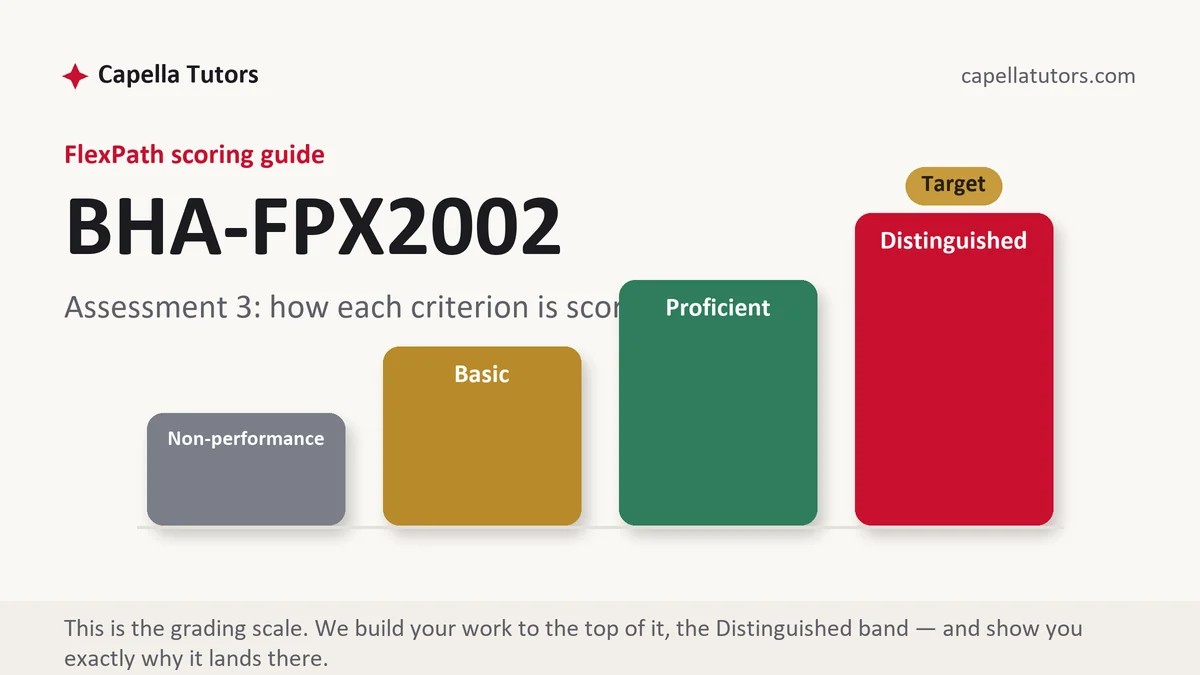
How BHA FPX 2002 Assessment 3 is scored
Nothing in FlexPath is averaged. Each criterion is placed at one of four levels on its own merits, and the top description tells you what to add rather than what to avoid:
| Level | What it means on a history-to-present synthesis |
|---|---|
| Distinguished | The line from the past decision to the present arrangement is traced through a named carrier, a rule or an institution that still operates, and the lesson names a decision a manager could actually make. The paper also concedes what the history does not predict. |
| Proficient | The connection is correct and the lesson is sensible. Accurate work that stops at the point where the reader wanted the carrier named. |
| Basic | History in the first half, present day in the second half, and a closing paragraph asserting that the past still matters without showing how. |
| Non-performance | The present-day half is missing, or the lesson is a generality that would fit any policy in the course. Interchangeable content reads as absent. |
This is the deliverable where the course stops testing recall and starts testing use. The material is the same material; what changes is that the reader now wants a consequence for somebody currently employed. Keep the writing at undergraduate register, keep the claims inside what your sources support, and let the specificity do the arguing.
The BHA FPX 2002 Assessment 3 method, step by step
-
Choose a present-day arrangement first, then work backwards
Most weak syntheses start in the past and hope to arrive somewhere. Start at the thing that exists now, a payment category, an eligibility line, a facility type, a licensing boundary, and then find the decision that created it. Working backwards guarantees a connection rather than hoping for one.
-
Identify the carrier that moved the effect forward
A policy from 1963 does not touch 2026 by memory. Something carried it: a funding stream that still flows on the same formula, an exclusion still written into a program's rules, an agency still running the same review. Name that carrier and the connection stops being a claim.
-
Convert the guide into headings and keep the halves apart
Give each criterion its own section. Keep the historical account and the present-day analysis in separate labeled sections even when the prompt describes them in one sentence, because a merged section is how a strong historical passage ends up with an unwritten present-day criterion attached to its final paragraph.
-
Write the lesson as a decision, not as a value
Learning from history is not a finding. A finding sounds like this: any expansion of a benefit should be read together with the exclusions written into it, because the exclusions are what determine where the population actually ends up. That sentence tells a manager where to look, which is what the criterion means by application.
-
Say what the history cannot tell you
One honest limitation is worth more than another paragraph of detail. Conditions differ, the actors had information you do not, and a single case cannot establish a rule. Name the limit and the criterion asking for evaluation is answered in the same breath.
-
Audit the sources, then self-score
Check that the statute or the program document is cited rather than a summary of it, that each figure carries its year, and that every reference is used in the text. Then grade yourself criterion by criterion and rewrite anything below the top level before you submit.
A structure that maps to the criteria
The lengths below are our planning targets for a synthesis of this scope, not requirements. Follow the sections your scoring guide names, in the order it names them.
| Section | What it must do | Guide |
|---|---|---|
| Introduction | The present-day arrangement, the past decision behind it, and the claim connecting them. | ~150 words |
| The historical account | What was decided, when, by whom, and what it required, kept to the material the connection needs. | ~250 words |
| The carrier | The rule, funding formula, or institution that transmitted the effect forward, named and dated. | ~250 words |
| The arrangement today | What the present situation looks like operationally, described so a reader could recognize it. | ~250 words |
| The lesson, as a decision | What somebody managing inside that arrangement should do differently, plus what the history cannot settle. | ~200 words |
| References | Statutes and program documents first, historical and peer-reviewed scholarship behind them, current APA. | as needed |
Annotated sample excerpt
An original model excerpt from our team showing a carrier being named rather than implied. Read it for structure, then write the version that belongs to your own case.
Between the mid 1950s and the late 1970s the resident population of American state psychiatric hospitals fell by roughly three quarters, and the community mental health centers legislated in 1963 were funded to build capacity that in most states never reached the scale the closures assumed.1 The carrier that moved this into the present is a financing rule rather than a clinical one: the federal program for low-income coverage enacted in 1965 declined to match state spending on care delivered in large mental institutions while matching it in nursing facilities, so a state could shift a resident and a cost at the same time.2 The arrangement a county administrator manages today, in which the jail and the emergency department absorb the demand a closed institution used to hold, descends from that asymmetry, and any proposal to expand community capacity has to name the payer that will carry the operating cost rather than the grant that will build the building.3
- 1The historical account is compressed to the two facts the argument needs, with the direction of change quantified loosely and honestly rather than precisely and unsupportably.
- 2The carrier is a specific financing asymmetry, dated and explained in one clause. This is the sentence that separates a traced connection from an asserted one.
- 3The lesson is a decision rule a working administrator could apply on Monday, and it grows out of the mechanism rather than out of the writer's opinion about deinstitutionalization.
The full premium sample for your exact assessment, written fresh to your scoring guide and issue, is free to request. Study it, revise it into your own voice, and submit work you understand.
The five mistakes that cost Distinguished
- The relevance paragraph. A closing claim that history informs current practice is the most common way to lose the application criterion in this course.
- A connection with no carrier. If nothing named transmitted the effect, the reader is being asked to take the link on faith.
- A lesson that fits any policy. If your recommendation would survive swapping the historical case for a different one, it is not specific enough to score.
- Judging the past by what is known now. Say what the actors knew and what constrained them, then evaluate. The order matters to the criterion.
- Summaries standing in for the source. A paper about a statute that never touches the statute reads as assembled from descriptions of descriptions.
Pre-submission checklist
- The present-day arrangement is named in the introduction, not just in the conclusion
- A specific carrier links past to present, with its date
- Historical account and present-day analysis sit in separate labeled sections
- The lesson is written as a decision somebody could act on
- One honest limitation of the historical evidence appears in the text
- Statutes and program documents cited directly, current APA both ways
Synthesis deliverable due?
Send the prompt, the criteria, and the policy or period you have been assigned. We return a premium original sample inside 24 to 48 hours with the carrier named, the present-day arrangement described operationally, and the lesson written as a decision. Revision is free until the guide is satisfied.