This manual is for BHA FPX 2002 Assessment 2, start to submission. Assessment 2 of BHA FPX 2002, Evolution of Healthcare Delivery in the United States, moves from describing one change to explaining movement between two fixed points. The assessment usually asks you to compare the system at two dates, or to trace a trend across a stated period, and to say what pushed it from one position to the other. That shift is what makes the second deliverable harder than the first: the reader is no longer buying a description, the reader is buying a cause. The manual below sets out the method, a section plan drawn from the criteria, and an annotated sample excerpt. Want it handled? A premium original sample written to your scoring guide comes back inside 24 to 48 hours, revised free until every criterion is satisfied. Capella's catalog lists the course as BHA-FPX2002, and some courserooms print BHA2002; both point to this same Assessment 2.
One honesty note before the manual: Capella revises courses and scoring guides over time, so always write to the exact scoring guide attached to your assessment in the courseroom. The course identity above is verified on capella.edu; the method and structure below are our tutors' approach to it, not Capella's official rubric text.
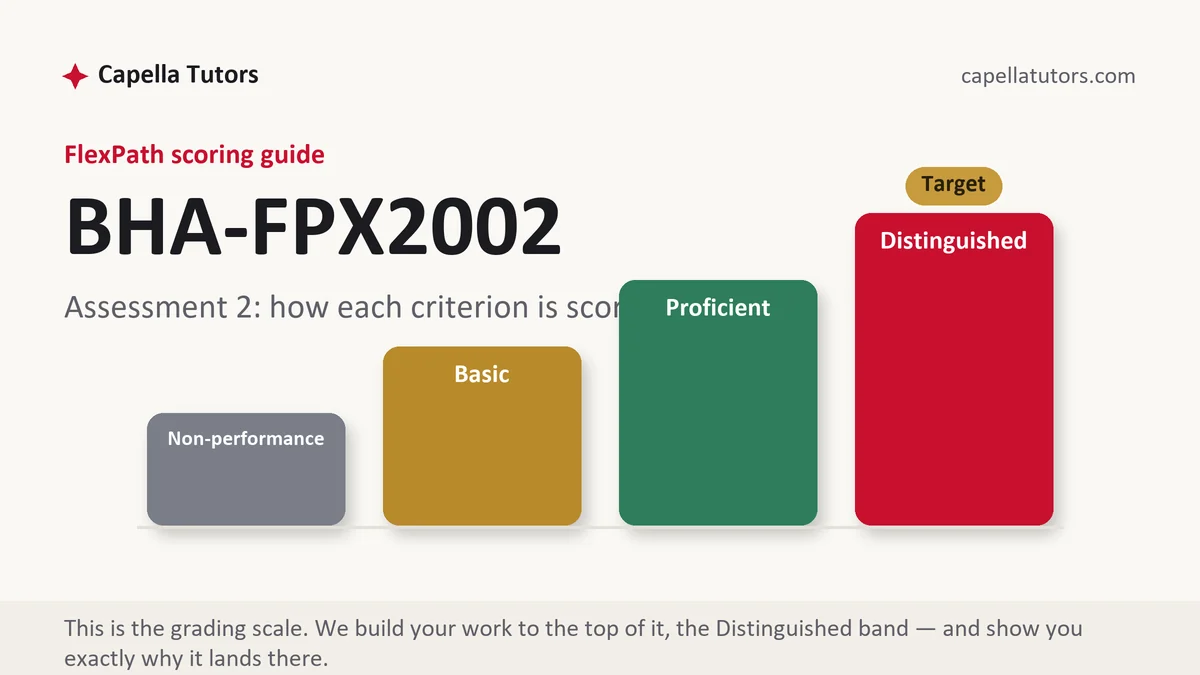
How BHA FPX 2002 Assessment 2 is scored
There is no curve and no letter grade in FlexPath. A criterion sits at one of four levels, and the level descriptions are the instructions most students never read closely enough:
| Level | What it means on a comparison across two periods |
|---|---|
| Distinguished | Both dates are described in the same terms, the movement between them is explained by a mechanism rather than by time passing, and the paper says which part of the shift the evidence does not settle. Find the extra clause in the criterion and answer it. |
| Proficient | Both periods are accurate and the contrast is clear. Correct throughout, and short of the causal step the top level asks for. |
| Basic | Two descriptions sitting next to each other. Everything in them is true and nothing connects them, which is the standard landing place for a comparison paper. |
| Non-performance | One side of the comparison is missing, or the second period is described in categories the first was not. An unmatched comparison reads as absent rather than weak. |
Comparison work rewards symmetry above almost everything else. If the earlier date is described by who paid, where care happened, and who was left out, the later date has to answer those same three questions in that same order, or the reader has nothing to hold the two against each other with.
The BHA FPX 2002 Assessment 2 method, step by step
-
Pick two dates you can defend
Choose points where something identifiable had already happened, not round numbers. A comparison of 1970 with 1980 is arbitrary; a comparison of the year before a federal benefit took effect with the year five years after it did has a reason built into the choice, and stating that reason is often worth a sentence in the introduction.
-
Set the same categories on both sides
Decide on three or four categories before you write either half: financing, setting, workforce, who went without. Then answer each one at both dates. Asymmetry is the single most common defect in submitted comparison papers, and it is invisible to the writer and obvious to the evaluator.
-
Turn the guide into your section list
Number the criteria and give each one a heading. Where a criterion covers both periods, write it as one section with two halves rather than splitting it across the paper, because a criterion answered in two distant places tends to be scored on whichever half the reader found first.
-
Explain the movement with a rule, a price, or a technology
Systems do not drift. Something changed what was paid for, what was legal, or what was possible. Name that thing, date it, and show it operating: a benefit extended to a new population, a payment method that reversed an incentive, a device that made a treatment portable.
-
Give the numbers their year and their denominator
Every quantity in a comparison needs the year it describes and the population it counts. Never carry a percentage from one decade into a sentence about another, and never place a dollar figure from one era beside one from another without noting that they are not comparable dollars.
-
Read it once for symmetry, once for cause, then submit
Two passes with two different questions. First pass: does the later period answer every category the earlier one raised? Second pass: is there a mechanism sentence between the two halves, or just a paragraph break? Fix both, self-score against the guide, and submit early enough that a two business day evaluation still lands inside your week.
A structure that maps to the criteria
The targets below are our tutors' planning numbers for a comparison of this size. Your scoring guide governs the sections, the order, and the length.
| Section | What it must do | Guide |
|---|---|---|
| Introduction | The two dates, why those two, and the one sentence saying what moved between them. | ~150 words |
| The earlier position | Financing, setting, workforce, and exclusion at the first date, in that order, with sources. | ~250 words |
| The later position | The same four categories at the second date, answered in the same order, so the contrast is readable. | ~250 words |
| The mechanism between | The rule, price, or technology that produced the movement, dated and shown operating. | ~250 words |
| What it cost and what it settled | Who gained, who lost, and the part of the shift the record cannot resolve. | ~200 words |
| References | Program documents, statute text where relevant, and peer-reviewed history in current APA. | as needed |
Annotated sample excerpt
A model paragraph written by our team to show what a mechanism sentence looks like when it is actually doing work. Study the shape, then build your own from your own two dates.
In 1971 a patient in this rural county whose kidneys had failed either moved to a city with a hospital-based program or did not receive dialysis at all, and the county's own service consisted of a referral list.1 The 1972 amendments to the Social Security Act extended federal coverage to end-stage renal disease, which converted an unaffordable treatment into a reimbursable one and made a freestanding unit a viable business in a town of eleven thousand.2 By the end of the decade the county had a six-station unit run by a private operator, three days a week, and the constraint on care had moved from whether a patient could pay to whether a patient could reach the building on a winter morning.3
- 1The earlier date is described by what a patient could actually get, not by a national statistic. Local and concrete is what lets the second half of the comparison have something to answer.
- 2One sentence carries the mechanism: a coverage decision changed the economics, and the economics changed where the service could exist. The date sits inside the sentence rather than in a footnote.
- 3The later date answers the same question the first one raised and then names the barrier that replaced the old one. Saying that a constraint moved rather than disappeared is the judgment the top column describes.
The full premium sample for your exact assessment, written fresh to your scoring guide and issue, is free to request. Study it, revise it into your own voice, and submit work you understand.
The five mistakes that cost Distinguished
- Two descriptions with no bridge. A paragraph break is not a cause. Between the halves belongs a sentence naming what moved the system.
- Unmatched categories. If financing appears at the first date and not the second, the comparison criterion has nothing to score.
- Time as the explanation. Over the years is a filler phrase standing where the mechanism should be, and evaluators read it as an admission.
- Percentages travelling between decades. A share detached from its year cannot be checked and will be treated as unsupported.
- A conclusion that only says things changed. Name who gained, who lost, and what the record leaves open, or the closing criterion scores on nothing.
Pre-submission checklist
- Both dates are named in the introduction with a reason for choosing them
- The same categories are answered at both dates, in the same order
- A mechanism sentence sits between the two halves, with its date inside it
- Every figure carries its year and the population it counts
- Gains and losses are both named in the closing section
- Reference list and in-text citations reconcile in both directions
Comparison paper on the clock?
Send the prompt, the criteria, and the two dates you were given or chose. The sample comes back inside 24 to 48 hours with matched categories on both sides, a dated mechanism between them, and every figure carrying its year. Eight people handle it, one of them grading the draft criterion by criterion.