This manual is for BHA FPX 2002 Assessment 1, start to submission. Assessment 1 of BHA FPX 2002, Evolution of Healthcare Delivery in the United States, sets the habit the course will grade for the rest of the term. The assessment usually asks you to take one development in American health care and account for what it changed: the arrangement that existed before it, the change itself in operational terms, and a consequence somebody could have observed afterward. Undergraduate criteria here read for dates, named actors, and mechanisms rather than for enthusiasm. What follows is the method our tutors use on it, a structure keyed to the criteria, and an annotated sample excerpt. Want it off your desk? A premium original sample for this exact assessment returns in 24 to 48 hours, rewritten free until the guide is met. Capella's catalog lists the course as BHA-FPX2002, and some courserooms print BHA2002; both point to this same Assessment 1.
One honesty note before the manual: Capella revises courses and scoring guides over time, so always write to the exact scoring guide attached to your assessment in the courseroom. The course identity above is verified on capella.edu; the method and structure below are our tutors' approach to it, not Capella's official rubric text.
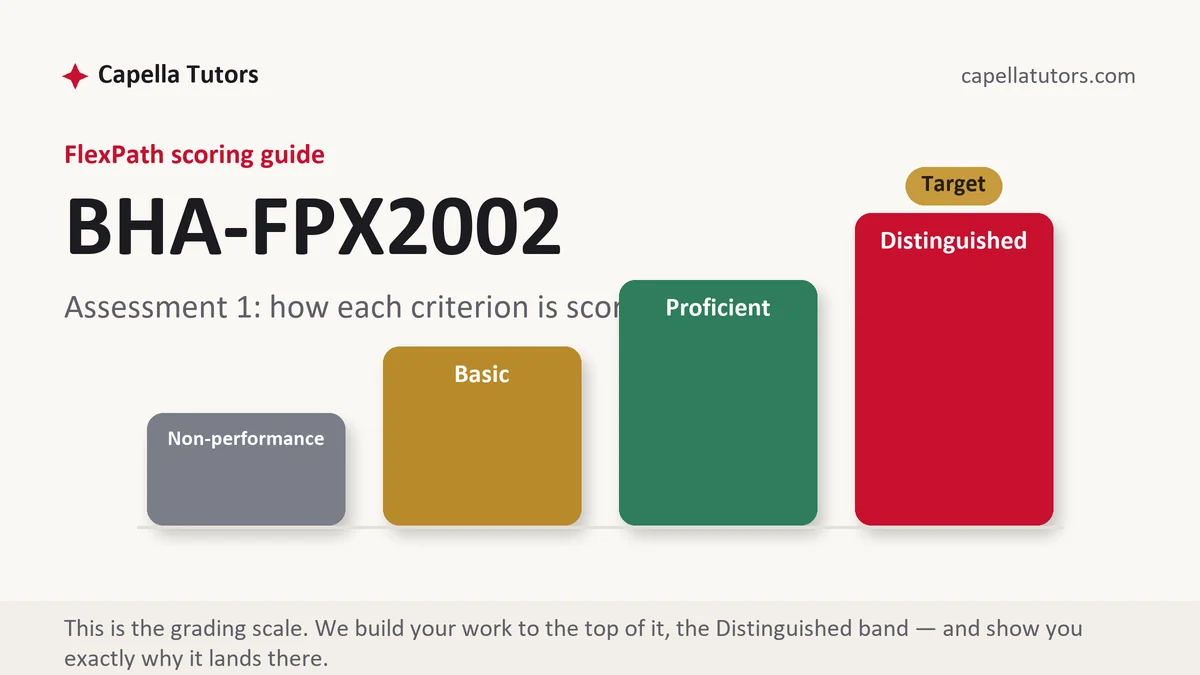
How BHA FPX 2002 Assessment 1 is scored
FlexPath awards no letter grades. Each criterion on your scoring guide lands on one of four levels, and the wording of the level you are aiming at is the brief you write to:
| Level | What it means on a historical analysis |
|---|---|
| Distinguished | The change is dated, the actors are named, and the mechanism is traced from the decision to the behavior it produced. The paper also says which part of the record is thin, which is usually the extra move the criterion pays for. |
| Proficient | The change is described accurately and the effects are correct. Complete, well sourced, one causal step short of the top of the guide. |
| Basic | A correct account in the correct order, events reported and nothing explained. Where most first submissions in a history course sit. |
| Non-performance | A required element is missing, most often the before-and-after comparison the criterion asks for. An absent element scores lower than a weak one. |
Because this is early work in a lower-division course, the criteria are literal on purpose. They tell you what to produce and in what order, and an evaluator looks for each element where the guide implies it belongs. Write to that literalness rather than around it, and the discipline carries into the upper-division requirements later in the degree.
The BHA FPX 2002 Assessment 1 method, step by step
-
Narrow the subject until it has years and a place
A criterion cannot be satisfied by a century. Cut the subject down until it carries a start year, an end year, and a setting: not the growth of outpatient care, but the movement of cataract and hernia repair out of inpatient wards between 1980 and 2000 in one metropolitan market. A subject that narrow leaves room for evidence, and evidence is what the guide rewards.
-
Build the document out of the criteria
Open an empty file and make every criterion a heading, with the top-level wording underneath it in brackets while you draft and stripped out before you submit. Then keep every paragraph underneath one of them. History invites storytelling, and storytelling is what buries the analysis an evaluator is hunting for.
-
Describe the baseline as something a person recorded
The change means nothing until the reader can see what it replaced. Write the earlier arrangement with details that make it measurable: who paid, where the patient slept, how long the stay ran, how many beds the service held. Where a figure comes from a constructed example rather than a published table, say so in the sentence that uses it.
-
Name the mechanism, then rank the drivers
Two or three forces usually arrive together, and a paper that lists them equally has made no judgment. Say which one did the most work and why. Technology gets over-credited here, because a new technique explains what became possible and a payment rule explains what actually happened.
-
Carry one consequence down to a person
General improvement is unscorable. Follow the change until it reaches somebody: a patient who now travels farther for the same operation, a nurse whose unit closed, a county left with one facility instead of two. One consequence traced that far outscores four asserted in a list.
-
Self-score against the guide, then submit early in the week
Read the draft one criterion at a time and mark yourself Distinguished, Proficient, Basic, or Non-performance without generosity. Anything under the top level gets another pass. Then submit on a Monday or a Tuesday, because an evaluator has up to two business days and a Thursday attempt can sit over a weekend.
A structure that maps to the criteria
Word counts below are planning targets our tutors use for an analysis of this kind, not Capella rules. Your scoring guide decides the sections and the length it wants.
| Section | What it must do | Guide |
|---|---|---|
| Introduction | Name the development, the years it covers, and the setting, then state in one sentence what the paper argues that it changed. | ~150 words |
| The arrangement before | How care was organized, financed, and delivered ahead of the change, written with numbers rather than adjectives. | ~250 words |
| The change itself | What was invented, enacted, or paid for, dated, with the operative detail restated in your own words. | ~250 words |
| Drivers, ranked | The clinical, financial, and political pressures behind it, with the dominant one named and defended. | ~250 words |
| Consequence and the line to now | One effect followed to a person or a place, plus the present-day arrangement that descends from it. | ~250 words |
| References | Government documents, historical scholarship, and peer-reviewed work in current APA, checked in both directions. | as needed |
Annotated sample excerpt
An original model paragraph from our team, written to show the register that scores at the top of a historical criterion. Treat it as study material: lift the moves, then draft your own version.
In 1979 the eye service at a 210-bed community hospital admitted patients the night before a cataract extraction, kept them lying still for two days afterward, and reported an average stay of 3.4 days on a 22-bed ward, figures constructed here to stand in for the case records this analysis would normally cite.1 Three changes arrived inside a decade and none of them was a matter of taste: lens fragmentation and implantation removed the surgical reason for immobility, a local anesthetic block let a patient leave on the same afternoon, and the federal payment rules of the early 1980s stopped rewarding the extra night.2 By 1994 the ward was shut and the operation was being done in a freestanding center three miles away, which is the sequence this paper explains rather than the progress it is usually mistaken for.3
- 1Opens on the arrangement that existed before, with a stay length and a bed count that make the later change measurable, and labels the constructed figures as constructed instead of dressing them up as published data.
- 2Separates the technique from the payment rule and puts them in sequence. An evaluator reading for causal reasoning finds it here, in one sentence, rather than having to assemble it from three paragraphs.
- 3Ends on the closure and refuses the word improvement. Naming what the sequence was, rather than judging it, is the move that keeps a history criterion out of the Basic column.
The full premium sample for your exact assessment, written fresh to your scoring guide and issue, is free to request. Study it, revise it into your own voice, and submit work you understand.
The five mistakes that cost Distinguished
- The century in a page. A paper that opens with the almshouse and reaches the present in its last paragraph has covered everything and analyzed nothing.
- Technology credited with the whole change. A new technique makes something possible; a payment rule usually decides whether it happens. Say which one you are arguing.
- A consequence nobody observed. Access improved is a claim with no owner. Name who saw the difference, and where.
- Adjectives standing in for the record. Widespread, rapid, and significant are all replaceable with a number and a year, and the criteria pay for the replacement.
- Improvement offered as the conclusion. The strongest ending in this course names what the change also cost, because the guide rewards the writer who noticed both.
Pre-submission checklist
- Every criterion on the guide has its own labeled section
- The subject carries a start year, an end year, and a setting
- The arrangement before the change is described with figures, constructed ones labeled
- One driver is named as dominant, with the reason stated
- At least one consequence is followed to a specific person or place
- Citations and reference list agree in both directions, current APA
Historical analysis due this week?
Send the prompt, the criteria, and the development you were assigned. A team of eight returns a premium original sample written to the top column in 24 to 48 hours, with every date and mechanism attached to something a reader can look up. Revisions carry no charge until the guide is met.