Send the prompt, the scoring guide and the setting you want written about, and a premium original sample arrives inside 24 to 48 hours, built against the Distinguished descriptors with every claim tied to a dataset or a study rather than to a view. On the transcript this is SOC FPX 1150, How Society Works: Human Differences, Collaboration, and Problem Solving, worth 3 points, one of the Social Science options on Capella's FlexPath general education menu, which asks for 22.5 points at minimum and at least 2 points from each of its four categories. Students from every bachelor's program on campus sit in it, so no prior sociology is assumed and none is needed. In Capella's catalog the course code is written SOC-FPX1150.
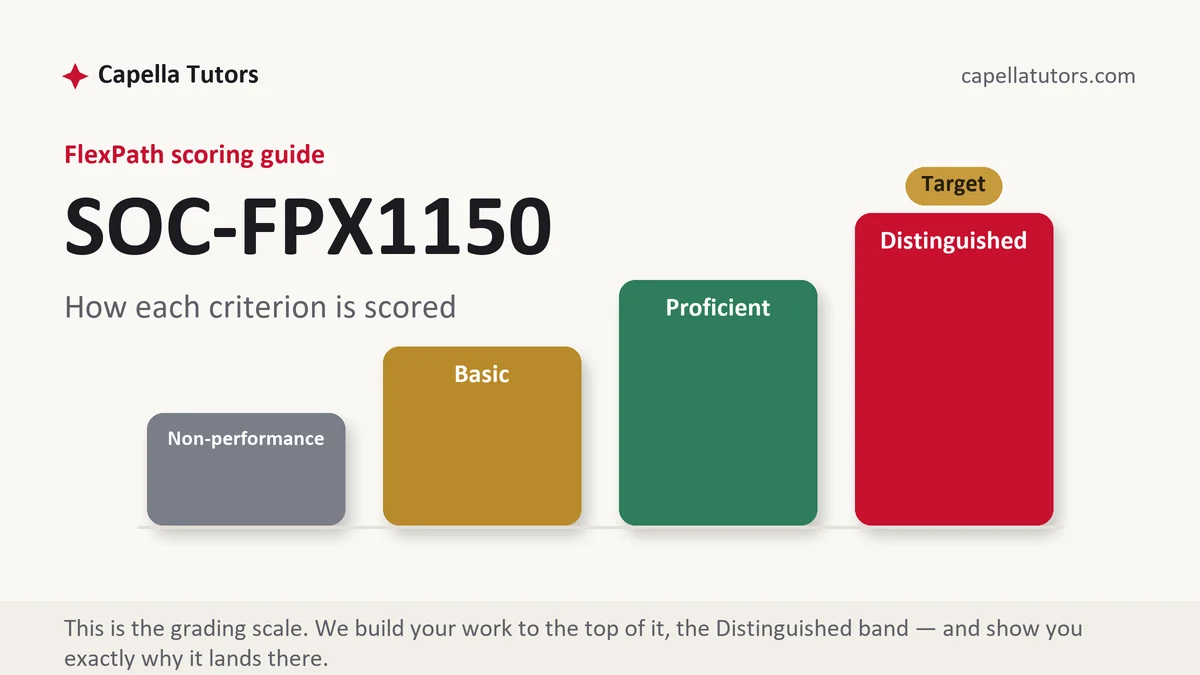
What SOC FPX 1150 actually grades
The skill under examination is a change of altitude. You take something you have watched happen to one person and show that it is patterned, then come back down and explain what the pattern does to that person. C. Wright Mills gave the move its name in 1959 when he distinguished a personal trouble, which belongs to a biography, from a public issue, which belongs to a structure. One man out of work in a town of a thousand is a trouble. Four hundred out of work in the same town is an issue, and no account built out of individual character will explain it. Assessments here usually hand you a familiar situation and grade whether you can make that shift without losing either end of it.
The perspectives are the tools for doing that, and the criteria want one used rather than three listed. The functionalist frame asks what an arrangement does for the whole, and it gets sharper with Robert Merton's distinction between the consequences an institution intends and the ones it produces without announcing them. The conflict frame asks who sets the terms, who benefits, and who absorbs the cost, and it does not require you to agree with Marx to use it. Symbolic interactionism works at eye level, where meaning is produced in the exchange itself, and it explains things the other two frames step over. Each answers a different question about the same case, which is why the choice has to be defended in a sentence.
Human differences enter this course structurally rather than psychologically. The graded question is not how people feel about a group but how the arrangements around them distribute schooling, housing, credit, transport and time, and how that distribution reproduces itself across a generation. That is why the evidence expected here is demographic and institutional. Life chances is the term the discipline uses for the summary of those odds, and the way to write about it is with a number, a place and a year attached rather than an adjective.
Collaboration is the last strand and the one students underestimate, because it looks like the easy part of the title. Groups behave differently by size, a pair holds together only while both members stay, and adding a third creates the possibility of a majority and of a mediator. Shared goods attract free riding whenever the benefit reaches everyone and the effort does not, which Mancur Olson set out in 1965, and it is why a volunteer rota collapses in month three while everybody still supports the cause. A problem-solving section that ignores that logic proposes goodwill and gets marked accordingly.
How we help in this course
Work on 1150 begins with the data rather than the prose. Tell us the setting, the perspective your courseroom is using, and the population you want described, and the sample comes back with figures pulled from named public datasets, each carrying its geography, its year and the population it covers, so the reader can go and check. Concepts are attributed to the sociologists who introduced them, since a first course is where that habit either forms or does not, and the upper-division courses in your program will assume it did.
The rest of the arrangement matches every other course we support. A premium original sample inside 24 to 48 hours, aimed at the Distinguished column of your own guide, then reviewed criterion by criterion and again for citation, language and originality. Revisions are free until the criteria clear, and returned faculty comments go back through the same cycle without a new charge. FlexPath lets you carry two courses inside a billing session, and a 3-point general education course is usually the second one, so we schedule around whichever course is carrying your degree.
The assessments, one by one
Assessment 1
An opening assessment in a sociology course usually asks for a change of altitude: something you have watched happen to one person, shown to be patterned, then brought back down to what the pattern does to that person. Read the full Assessment 1 manual.
Assessment 2
A middle assessment in this course usually turns to collaboration, which students underestimate because it looks like the easy part of the title. Read the full Assessment 2 manual.
Assessment 3
A closing assessment in this course usually asks you to apply a sociological perspective and defend the choice. Read the full Assessment 3 manual.
How to actually write SOC FPX 1150: where to begin
Open the scoring guide, turn each criterion into a heading, and narrow the subject until one paper can answer it. Inequality is not a question and neither is community. A place, a population and an outcome make one: whether the closure of a single bus route changed who could reach the county hospital on a weekday. Then define the concept you are using in your own words and say how you would recognize it if you saw it, which is what operationalizing means and is the step that separates a sociology paper from an essay about how things feel.
Build each analytical section as a ladder with four rungs. Start with the observation, in specifics. Climb to the concept that names it. Attach the evidence, meaning a dataset, a study or a documented case, with its year and its population. Then come back down to the setting and say what the concept predicts should also be true there, which is the rung most drafts skip and the one that demonstrates understanding rather than recall.
Here is the contrast, using a case small enough to check. A ninety-unit apartment building has a shared laundry room that is persistently left filthy. The Basic paragraph says residents are inconsiderate and cites a source about civility. The paragraph that scores describes the room as a shared resource with a diffuse cost, notes that nobody owns the outcome and that anonymity in a building that size makes informal sanction nearly impossible, and connects it to the logic of collective action rather than to character. It then predicts what should follow if the account is right, that the problem is worst on floors where turnover is highest, and proposes a change to the incentive rather than the attitude: a named weekly responsibility posted on the door, a visible log, and the room split into two serving forty-five units each. Same facts, and only the second paragraph has done any sociology.
| Section | What goes in it | What Distinguished looks like |
|---|---|---|
| The question | A place, a population, an outcome, and the period the paper covers. | A question narrow enough that evidence could contradict it. |
| Concept and perspective | The sociological concept defined and recognizable, with the frame you chose and why. | A frame chosen for the question rather than listed, with what it leaves out admitted. |
| Evidence | Public data or published research, with source, year, geography and population stated. | Numbers reported with their denominator, and a second source that agrees or does not. |
| Level of analysis | Whether the explanation runs at the level of interaction, organization or institution. | The level named and held, with any move between levels made deliberately. |
| Collaboration and response | The proposal, who does what, and the incentive or norm it changes. | The free-rider problem addressed rather than assumed away, with a named owner. |
| References | Current APA throughout, primary attribution for concepts, release years for data. | Data cited to the agency that produced it, not to the news article that mentioned it. |
Developing the synthesis
Synthesis here means putting a number and a story into the same argument and saying what each one is for. Survey data tells you how widespread something is and lets you compare groups and years, and it cannot tell you what the arrangement means to the people inside it. Interview and observational work tells you the mechanism and the meaning, from a small purposive sample that was never designed to estimate a prevalence. Neither is the superior kind of evidence, and treating them as rivals is a mistake this course watches for. The sentence that earns the criterion says which question each source answers, then uses one to test the other: if the interviews suggest that people avoid the clinic because the hours conflict with shift work, the survey should show the effect concentrated among hourly employees, and if it does not, your mechanism needs revising rather than repeating.
Citations that survive faculty review
Four kinds of source carry a sociology paper and they are not interchangeable. Peer-reviewed journals reached through the Capella library, the American Sociological Review and its neighbors among them, support any claim about how a social pattern behaves. Federal statistical products supply the facts about populations, with the American Community Survey as the everyday workhorse, and they are cited to the agency and the release year rather than to the newspaper that reported them. Survey programs with public documentation, principally the General Social Survey, let you quote an attitude alongside the exact question that produced it, which matters because a small change in wording moves a result more than students expect. Theory gets attributed to the person who built it, so the sociological imagination is Mills, latent functions are Merton, and the term symbolic interactionism is Herbert Blumer's. Then check the reference list against the citations in both directions, and confirm every figure in the prose still matches the table it came from.
The mistakes that land Basic instead of Distinguished
- An opinion with a citation stapled to it. The source has to support the specific claim, not merely share its subject.
- Character used to explain a pattern. If the same behavior appears across thousands of people, personal failing is the one explanation the evidence rules out.
- A group statistic read onto an individual. A rate describes a population, and inferring the person from the aggregate is the error this course exists to prevent.
- A perspective named in the introduction and never seen again. The frame has to produce the analysis, otherwise it is a label.
- Society treated as a person. Society did not decide anything, and naming the actual institution, agency or employer is always the stronger sentence.
SOC FPX 1150 questions students actually ask
Can I use my own neighborhood, family or job as the case?
Yes, and a case you can see in detail usually beats one you read about, as long as you keep it in its proper role. Your observation supplies the pattern worth explaining. It does not supply the proof that the pattern is general, which has to come from data or from published research on comparable settings. Write the case with enough specifics that a reader can picture it, change identifying details, then attach the evidence and say plainly what one setting can and cannot establish. The failure to avoid is the paper where an anecdote and a citation sit side by side and the citation is decoration, because an evaluator can tell within two sentences which one the argument is resting on.
Where do I find sociological data I am allowed to cite?
Three free sources cover most undergraduate assessments. The American Community Survey, published every year by the Census Bureau, gives you income, housing, education, commuting and household composition down to small geographies, which is what you want when the paper is about a place. The General Social Survey, run by NORC at the University of Chicago since 1972, gives you attitudes and reported behavior with the exact question wording available, which matters because the wording is often the finding. Pew Research Center reports sit between the two and publish their methods and sample sizes openly. Cite the year of the release rather than the year you read it, and give the geography and the population the estimate covers.
The prompt says apply a sociological perspective. Which one, and may I use two?
Choose by the question you asked, not by which theory you liked most in the reading. If your question is about what an arrangement does for the people who benefit from it, the functionalist frame gives you manifest and latent consequences. If it is about who gets to set the rules and who absorbs the cost, the conflict frame is the right instrument. If it is about how meaning gets made in interaction, symbolic interactionism is the one that pays. Two perspectives are fine when the assessment invites comparison, on one condition: apply each to the same case and say what each one reveals that the other misses. Naming three and applying none is the most common way this criterion gets lost.
Sociology assessment due?
Send the criteria and the setting you want analyzed. The draft comes back with the perspective applied and every figure sourced to a public dataset. First premium sample free.